
The Architecture of Regret: Addiction, Accountability, and the Difference Between Reflection and Self-Punishment
Author: Adam Fistler, Behavioral Systems Analyst ( adam@adamfistler.com )
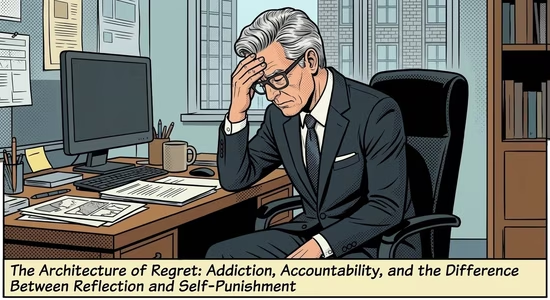
A person leaves active addiction and eventually becomes able to look backward.
The scene is not abstract. There are unpaid bills, damaged trust, missed calls, broken promises, frightened family members, friends who stopped answering, and years that cannot be returned. The person remembers what they did while using alcohol or drugs, gambling, lying, disappearing, borrowing, stealing, or arranging life around the next relief.
Then the mind begins its accounting.
"I was focused on myself. I wanted what I wanted. I did not care about anyone else."
That conclusion may feel like honesty. It may even resemble accountability. But it can become another form of distortion if it turns specific behavior into a permanent identity and treats self-punishment as payment.
There is a difference between looking directly at harm and building a private courtroom in which the sentence never ends.
This article examines that difference through psychology, neuroscience, and biology. It does not excuse addiction or erase responsibility. It explains how compulsive behavior narrows attention, changes reward learning, weakens future-oriented decision-making, and filters perception through old belief systems. It also examines why regret can signal restored empathy, why accountability can be hijacked into self-attack, and why refusing to move beyond shame can continue harming the people a person wants to repair things with.
What a Belief System Is

A belief system is the set of internal assumptions through which a person interprets events, themselves, and other people.
For someone unfamiliar with the term, it can be understood as a hidden operating system. It does not determine every thought, but it influences what the mind notices, what it ignores, what it expects, and which actions appear available under pressure.
A child does not build these assumptions from detached analysis. The brain learns from repetition.
If the environment is chaotic, the child may learn:
- people cannot be relied upon;
- danger arrives without warning;
- asking for help is unsafe;
- emotions must be suppressed;
- personal needs will not be met;
- being alone is unbearable;
- or worth must be earned through performance.
These conclusions are not necessarily accurate descriptions of reality. They are adaptations to the environment available at the time.
The brain is predictive. It uses prior experience to interpret new information. If a person expects rejection, they may notice one distracted expression while overlooking many signs of warmth. If they expect humiliation, a neutral question may be interpreted as criticism. If they believe distress is intolerable, an ordinary period of anxiety may be processed as an emergency.
Beliefs operate as filters. They influence attention, memory, interpretation, and behavior.
When substance use becomes part of the person’s history, the belief system may include assumptions such as:
- pain must be stopped immediately;
- ordinary life cannot provide relief;
- asking for help will expose weakness;
- consequences can be dealt with later;
- one more use will restore control;
- or the substance is the only reliable way to become calm, confident, social, numb, energized, or detached.
The behavior is destructive. The belief system explains why it becomes available so quickly under pressure.
The Compulsive Imperative
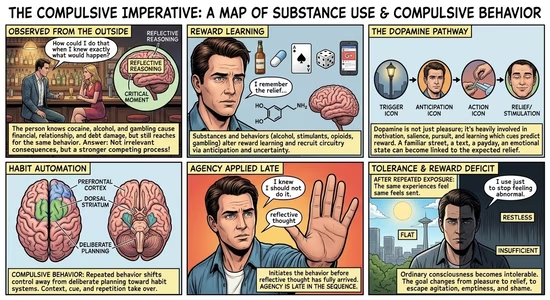
From the outside, substance use can look like a series of obvious decisions. A person knows cocaine has caused financial damage, knows alcohol has damaged relationships, knows gambling has produced debt, and still reaches for the same behavior.
The person may later ask:
"How could I do that when I knew exactly what would happen?"
The answer is not that consequences became irrelevant in every part of the mind. The answer is that, during the critical moment, the systems required to weigh those consequences were competing against a much stronger immediate process.
Reward learning
Alcohol, stimulants, opioids, and other substances alter reward learning. Gambling and other compulsive behaviors can also recruit reward circuitry through anticipation, uncertainty, and intermittent reinforcement.
Dopamine is often described as a pleasure chemical, but that is incomplete. It is heavily involved in motivation, salience, pursuit, and learning which cues predict reward. A substance, betting opportunity, familiar street, text message, payday, argument, or emotional state can become linked to the expected relief.
The pathway becomes increasingly efficient:
trigger → anticipation → action → relief or stimulation
Repeated activation strengthens the association between the trigger and the behavior. The person does not need to consciously debate the entire history each time. The cue begins to call up the response.
Habit automation
Repeated behavior shifts control away from deliberate planning and toward habit systems involving structures such as the dorsal striatum. The behavior becomes less dependent on a fully reasoned decision and more dependent on context, cue, and repetition.
This does not mean the person has no agency. It means agency is being applied late in the sequence, after the system has already gathered momentum.
A person may honestly say, “I knew I should not do it,” while also having a brain that has learned to initiate the behavior before reflective thought has fully arrived.
Tolerance and reward deficit
With repeated exposure, the brain adapts to excessive stimulation. Reward responses can become less sensitive, while ordinary experiences feel flat, restless, or insufficient. The person may use not to feel extraordinary but to stop feeling abnormal.
The goal changes from pleasure to relief.
That distinction matters. A person may not be chasing happiness. They may be trying to escape agitation, emptiness, shame, withdrawal, loneliness, or the sense that ordinary consciousness is intolerable.
Why the Consequences Disappear in the Moment
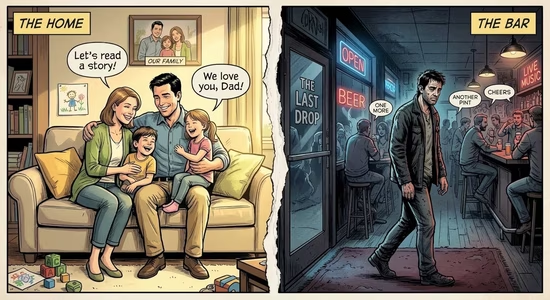
The person may know intellectually that use will hurt them and others. But knowledge is not a single function. It has to be available, emotionally active, and connected to decision-making at the exact time of the urge.
Prefrontal strain
The prefrontal cortex supports planning, inhibition, working memory, consequence evaluation, and the capacity to hold several time horizons at once.
Acute intoxication, withdrawal, severe stress, sleep deprivation, craving, and emotional arousal can all impair these functions. The person’s ability to simulate the future becomes weaker. The immediate reward becomes vivid; the later cost becomes abstract.
This is sometimes described as reduced executive control or hypofrontality. It does not mean the prefrontal cortex simply shuts off like a light. It means its regulatory influence can be reduced relative to reward, stress, and habit systems.
Timeline collapse
Under intense craving, the mind’s time horizon contracts.
Yesterday’s consequences feel distant. Tomorrow’s consequences feel unreal. The present urge becomes the most concrete fact in the environment.
The calculation changes from:
What will this do to my family, health, finances, and future?
to:
How do I stop this feeling in the next ten minutes?
That is a biological and psychological narrowing of attention.
Stress physiology
Threat and distress activate the sympathetic nervous system and the hypothalamic-pituitary-adrenal axis. Adrenaline and cortisol prepare the body for urgent action. Under chronic stress, the person may remain in a state of agitation, exhaustion, or emotional volatility.
When the nervous system treats distress as an emergency, immediate relief becomes overvalued. The behavior that reliably changes the internal state is granted priority.
The system is not asking whether the action is wise. It is asking whether the action has previously ended the alarm.
Why the Brain Says, “Just This Once”

Before a destructive behavior occurs, the mind often generates a series of permissions:
- “It will not be that bad.”
- “I can handle it.”
- “Nobody will know.”
- “I have been good for long enough.”
- “This is the last time.”
- “I will fix everything afterward.”
These statements are not always deliberate lies. They are often the result of several processes operating at once.
Cognitive dissonance
A person may hold two conflicting beliefs:
- “I want to be reliable and present.”
- “I want to use right now.”
The conflict produces psychological discomfort. One way to reduce that discomfort is to minimize the consequences. If the harm is mentally reduced, the action becomes easier to permit.
The mind is not required to prove that the choice is good. It only needs to make the choice feel survivable.
Temporal discounting
The brain tends to value immediate rewards more heavily than delayed outcomes. This is called temporal discounting.
A guaranteed change in feeling now can outweigh a possible problem later, especially when the future is emotionally distant and the current distress is physically present.
The statement “I can deal with it later” is often the output of a system that is discounting future costs while overvaluing immediate relief.
Attentional narrowing
Craving concentrates attention on reward-related information. The person remembers how the substance or behavior changed their state before. They may temporarily lose access to the full emotional force of previous consequences.
The consequences are not necessarily erased from memory. They are pushed outside the active field of attention.
Belief-filtered interpretation
If a person believes that pain is unmanageable, healthy support is unavailable, or they are already damaged beyond repair, the destructive behavior can appear to be the only practical option.
The action is then filtered through a belief such as:
"Nothing else will work."
That belief may be false, but it is experienced as a fact while the system is under pressure.
The Role of Need Fulfillment

Compulsive behavior often attempts to meet a real need through an unreliable method.
The need may be:
- relief from emotional pain;
- a sense of safety;
- connection;
- confidence;
- energy;
- escape from shame;
- control;
- stimulation;
- rest;
- or freedom from internal noise.
The substance or behavior may temporarily provide one of these states. Alcohol may reduce social fear. Stimulants may produce energy or confidence. Opioids may reduce emotional and physical pain. Gambling may create anticipation and the possibility of sudden rescue.
The method is destructive, but the underlying need is not imaginary.
This distinction prevents two errors. The first is moralizing the need. The second is confusing the effectiveness of the short-term method with its long-term usefulness.
A behavior can work immediately and still destroy the system that depends on it.
Looking Back: Why Reflection Begins After Stability

During active addiction, attention is organized around immediate relief and the management of the next problem. The person may not have the capacity to model the full emotional reality of others.
This does not mean empathy is absent forever. It means empathy competes with survival, intoxication, withdrawal, craving, secrecy, and shame.
When substance use decreases or stops, attention becomes available for material that had previously been pushed aside. The person may begin to recognize how others experienced them.
That recognition can feel brutal.
But the capacity to ask, “What did this do to them?” is itself evidence of expanded perspective. Psychology describes this in terms of perspective-taking and theory of mind: the capacity to model another person’s internal experience rather than remaining confined to one’s own immediate state.
Neural systems involved in social understanding include distributed networks involving the medial prefrontal cortex, temporoparietal junction, anterior insula, anterior cingulate, and other regions. No single brain area produces empathy by itself. Empathy is a coordinated process involving attention, interpretation, emotional resonance, and regulation.
The important point is simple:
A person who is beginning to understand the effects of past behavior is not necessarily becoming more selfish by thinking about it. They may be moving beyond the narrow self-focus required by active survival behavior.
Accountability Versus Self-Punishment
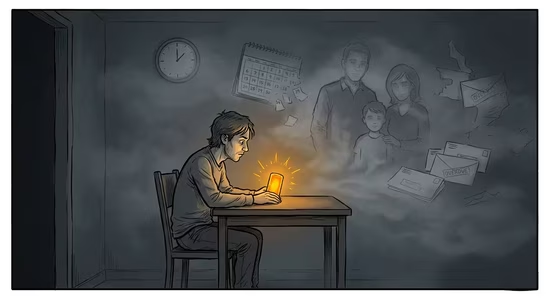
Accountability means identifying what happened, what one did, what the impact was, and what must change.
Self-punishment adds a different process:
- repeating the worst version of the story;
- turning behavior into identity;
- treating pain as payment;
- refusing to allow evidence of change to count;
- and assuming that continued suffering proves moral seriousness.
These are not the same.
A person can say:
"I lied, disappeared, used money irresponsibly, and damaged trust. Those actions harmed people. I am responsible for repairing what can be repaired and changing how I live."
That is accountability.
A person can also say:
"I am selfish, broken, dangerous, and permanently unworthy. Nothing I do now can alter what I was."
That is not a more honest version of the first statement. It is a totalizing identity verdict.
The first identifies variables. The second turns the entire system into a defect.
When “Finding My Part” Becomes Distorted

Taking responsibility for one’s own part can be useful. It prevents blame-shifting and restores agency.
But the concept can be expanded beyond its proper limits.
A person may begin to claim responsibility for:
- every feeling another person had;
- every consequence of a complex situation;
- other people’s choices;
- conditions they could not control;
- or an imagined intention that was never present.
Specific responsibility becomes total responsibility.
The person may also erase the difference between:
- acting from compulsive need;
- acting carelessly;
- acting selfishly;
- acting avoidantly;
- and acting with deliberate intent to harm.
These behaviors can all cause serious damage, but they are not psychologically identical.
It is possible to say:
"I was focused on my own needs and pleasures, and I failed to account for other people."
That may be an accurate description of impact and attention.
It is different from saying:
"I consciously wanted to destroy everyone around me."
The first identifies egocentric attention and impaired judgment. The second invents a level of malice that may not belong to the facts.
Radical moral neutrality does not mean emotional indifference. It means refusing to add fictional motives to real harm.
The Weaponization of Harm

A person can use the suffering they caused as evidence against themselves indefinitely.
The internal argument sounds like this:
"If I stop feeling terrible, I will stop caring. If I forgive myself, I will become dangerous again. If I suffer enough, I will prove that I understand what I did."
This makes self-condemnation appear protective.
But self-condemnation can remain self-centered. The person is still focused on the self—now as villain rather than victim. The attention remains trapped in personal identity, personal shame, personal punishment, and personal unworthiness.
The people who were harmed do not necessarily benefit from this.
They are more likely to benefit from:
- reliable contact;
- honest communication;
- financial and practical responsibility;
- emotional steadiness;
- respect for their boundaries;
- no demand that they comfort the person who hurt them;
- and observable change over time.
A collapsed person may feel deeply guilty and still be unreliable. A regulated person may feel less dramatic guilt and become more dependable.
The measure is not how intensely a person suffers. It is what their current behavior produces.
How Unresolved Shame Can Continue the Damage
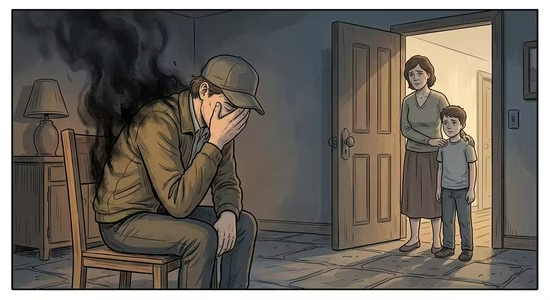
Refusing to move beyond shame does not keep the past contained. It affects present behavior.
Irritability and reactivity
Chronic guilt and self-attack maintain stress activation. A person who is continually internally threatened may become short-tempered, defensive, or difficult to approach.
Family members may then experience the person as unpredictable again—not because the original behavior has returned, but because the same physiological instability is being expressed through a different channel.
Withdrawal
Shame often produces avoidance. The person may stop answering messages, avoid eye contact, refuse meaningful conversations, or leave situations where the past might be mentioned.
The intention may be to prevent further harm. The effect can be emotional absence.
People who were already deprived of stability may experience the withdrawal as another abandonment.
Reassurance demands
A person who believes they are permanently bad may repeatedly seek evidence that others still accept them.
The roles reverse. The people who were harmed become responsible for managing the guilty person’s emotional state:
- “Do you still love me?”
- “Do you think I am a terrible person?”
- “Can you tell me I am forgiven?”
- “Are you still angry?”
This can force the injured person to comfort the person who caused the injury. The original harm is then followed by an emotional labor demand.
Resentment
If shame is maintained without action, it can eventually produce resentment toward the people who remind the person of it. The person may not consciously blame them, but their presence activates the internal trial.
They may become distant, passive-aggressive, or emotionally punitive. The mind begins treating loved ones as witnesses rather than people.
Overcompensation
A person may attempt to buy back worth through grand gestures, excessive promises, money, gifts, or constant availability. When these efforts fail to erase the past, frustration follows.
Repair is not the same as performance. It requires durable behavior, not dramatic proof.
Self-Forgiveness Is Not Exoneration

Self-forgiveness does not mean:
- the harm was acceptable;
- no one should remain angry;
- trust must be restored;
- consequences should disappear;
- the past should be forgotten;
- or the person is entitled to reconciliation.
Self-forgiveness means ending the belief that continued self-destruction is required in order to prove responsibility.
It means holding two facts at the same time:
- The behavior caused real harm.
- The person is capable of becoming more than the behavior.
This is not a contradiction. It is the basis of change.
From a psychological perspective, self-forgiveness can reduce shame while preserving guilt in its useful form. Guilt can identify a behavior that violated values. Shame converts the behavior into a verdict about the entire self.
A workable guilt signal says:
"I did something harmful. I need to respond differently."
A destructive shame signal says:
"I am harmful by nature. There is no meaningful response available."
The first supports repair. The second supports paralysis, avoidance, relapse, and emotional withdrawal.
The Biology of Moving Forward

The nervous system does not change through argument alone. It changes through repeated experience.
A person who stops using substances but continues living in constant self-threat may remain physiologically activated. Sleep, concentration, appetite, emotional regulation, and impulse control can all be affected by chronic stress.
A calmer internal state does not guarantee recovery, but it gives the prefrontal systems more opportunity to operate. Planning becomes easier. Delayed consequences become more visible. Emotional reactions become less automatic. The person can notice an urge without immediately converting it into action.
Neuroplasticity is not magic. It is the brain’s capacity to change through repeated patterns of attention, behavior, learning, and environment.
Every reliable action is data:
- answering when you said you would;
- telling the truth before being confronted;
- attending treatment;
- refusing money or situations that trigger old behavior;
- accepting another person’s boundaries;
- repairing a financial obligation;
- tolerating discomfort without escaping into substances;
- and remaining present when shame appears.
These actions build a different prediction system.
The brain begins to learn that distress can rise and fall without requiring the old behavior. Other people begin to learn that promises may be supported by conduct.
What Repair Actually Looks Like

Repair is not an emotional performance. It is a sequence.
It includes naming the harm without forcing the injured person to comfort you. It includes hearing their account without interrupting to explain your intentions. It includes accepting that they may not trust you, forgive you, or want continued contact.
It includes changing the conditions that supported the old behavior:
- access to substances;
- financial instability;
- secrecy;
- isolation;
- untreated mental health symptoms;
- high-risk relationships;
- sleep deprivation;
- avoidance of emotional support;
- and the belief that discomfort must be removed immediately.
Repair also requires respecting the autonomy of the people affected. They are allowed to make decisions that do not provide the recovering person with relief.
Their forgiveness is not a treatment plan.
Their continued relationship is not proof of recovery.
Their anger is not evidence that change has failed.
The Difference Between a Sentence and a Specification

Self-punishment asks:
"How much suffering do I need to endure before I am allowed to stop being the person I was?"
Accountability asks:
"What specific behavior must change, and what evidence will show that it has changed?"
The first question has no measurable endpoint. It creates permanent debt.
The second produces specifications:
- no hidden drug use;
- no lies about money;
- no disappearing during conflict;
- no manipulation of family members;
- no demand for immediate forgiveness;
- consistent treatment attendance;
- direct repair where appropriate;
- and stable conduct over time.
A computer does not improve because someone insults it for producing an error. The error has to be located, understood, and corrected. The metaphor is limited—human beings are not machines—but the principle is useful. Repeated self-attack is not the same as error correction.
Conclusion: Stop Using the Whip as Evidence
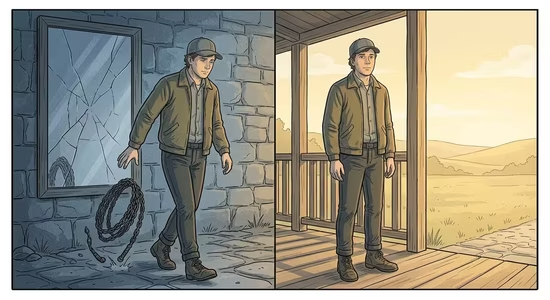
The harm caused during active addiction was real. Other people may remain hurt, angry, cautious, or unwilling to participate in repair. Those reactions belong to them.
The person in recovery is responsible for acknowledging the damage without altering the facts, inventing malice, demanding absolution, or turning remorse into another method of avoiding present action.
The mind that once narrowed around immediate relief may now be capable of seeing the wider field. That wider vision hurts because it includes the people affected.
But pain is not the same as punishment.
Reflection says:
"I can see what happened, what I did, what it cost, and what must change."
Self-punishment says:
"I must keep destroying myself to prove that I understand destruction."
Only the first creates room for repair.
The people harmed do not need a permanent internal execution. They need the person who exists now to become accurate, stable, honest, and present.
The past cannot be made harmless by suffering over it. It can only be answered by what happens next.
Moving From Mapping the System to Rewiring It
Insight into shame loops and compulsion does not automatically rewrite the nervous system or subconscious prediction loops that drive self-attack and immediate relief-seeking. My work combines systems analysis, hypnosis, and behavioral conditioning to interrupt these automated loops and restore emotional regulation and personal agency.
If you recognize these patterns and are ready to do the structural work to change them, reach out to schedule a consultation.

About The Author
Adam Fistler is a Behavioral Systems Analyst, Board Certified Hypnotist, Certified 5-PATH® Hypnotist, and former owner of the Baltimore Hypnosis Center. A member of the International 5-PATH® Hypnosis Association and certified by the National Guild of Hypnotists, Adam has studied hypnosis, behavior change, and the relationship between thoughts, beliefs, emotions, and behavior for more than two decades.
His perspective is shaped by more than professional training. Adam has also lived through addiction and recovery firsthand across South Jersey and the Philadelphia region, including surviving on the streets of Camden. This gives him a deeply personal understanding of the struggle from both sides: as a practitioner who has helped others create change and as someone who has had to confront his own deeply ingrained patterns and beliefs.
During his own recovery, Adam returned to the principles of hypnosis, mindfulness, self-talk, and behavioral change that he had studied throughout his career. He discovered that recovery could be about more than simply managing cravings or avoiding relapse—it could also be an opportunity to understand the beliefs, emotional patterns, and experiences that had shaped his behavior.
Today, Adam combines his professional experience with the lessons of his own journey to serve clients throughout Greater Baltimore Maryland Region, and beyond, helping others explore the possibility of meaningful, lasting change. His approach is grounded in empathy, curiosity, practical tools, and the belief that people are more than the behaviors they are trying to overcome.
Explore my Addiction & Recovery Resources
Contact Adam Fistler, BCH - Behavioral System Analyst
Examine an Overview of Addiction, Substance Abuse & Recovery
The Slow Descent: How Addiction Hijacks the Mind, Body, and Survival System
Learn more about my Addiction, Substance Abuse & Recovery Services
Discover how Hypnosis aids with Addiction & Recovery
Rethinking Recovery: The Science, Stigma, and Advocacy of The Sinclair Method
Addiction Is Not a Moral Failure: Celebrities and Their Struggles with Addiction
Explore my Addiction & Recovery Articles
Review a List of All My Addiction & Recovery Articles
Neurotransmitters and Neurochemistry in Addiction
Endorphins, Pain, Mood, and Addiction: Understanding the Endogenous Opioid System
Your Addiction Isn't Broken Code - It's Legacy Code
Societal Lockout: When Rebuilding a Life Becomes One Roadblock After Another
The Mechanics of Infidelity: A Neurochemical, Psychological, and Biological Map
Chasing the Spark: Mistaking a Nervous-System Alarm for Attraction