Recovery Was Not a Straight Line: From Repeated Rehab to Rebuilding My Life
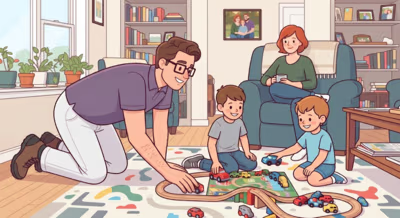
My first experience with rehab came in July 2014, during one of the most painful weekends of my life. My wife, Michele, discovered my addiction at the same time my mother was dying. In the space of a few days, the secret I had worked so hard to hide was exposed, my family was facing the loss of my mother, and I was forced to confront a life I no longer recognized.
I had grown up seeing addiction as a moral failing. I believed people used drugs because they wanted to have fun, avoid responsibility, or ignore the consequences of their choices. I thought they were lazy, dishonest, and unwilling to stop.
Those beliefs were based on incomplete information. I had absorbed the same stigma that society places on people with addiction: that they are thieves, liars, con artists, and no-good people. So when addiction became part of my own life, I did not see myself as someone who needed help. I saw myself as the kind of person I had been taught to despise.
That shame was one of the reasons I hid my addiction for so long.
My First Experience With Treatment
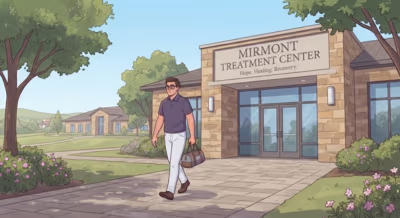
My first inpatient treatment experience was at Mirmont Treatment Center in Media, Pennsylvania. The message I received was that addiction was a disease of the mind and that recovery required attending twelve-step meetings for life. After inpatient treatment, I spent several months in intensive outpatient treatment at Kennedy Behavioral Health, now part of Jefferson Health, in Turnersville, New Jersey.
The treatment was largely focused on management and coping. I was taught to manage cravings, distract myself, wait for urges to pass, and develop strategies that would help me avoid using. In twelve-step settings, I was encouraged to pray for the cravings and character defects to be removed.
Those tools may help some people, and I do not deny that many people find value in twelve-step recovery. But for me, something was missing. I had already spent years studying hypnosis, the subconscious mind, emotions, and personal change. My understanding was that many destructive patterns have emotional roots. Traditional addiction treatment seemed primarily focused on managing those patterns, while my experience with hypnosis had taught me to look for ways to heal them.
I was told, in effect, that the purpose of rehab was not to heal the causes of addiction. It was to help me manage the condition and maintain abstinence.
That distinction became increasingly important to me.
Trying to Manage What I Did Not Yet Understand
Much of traditional rehab asks a person to use conscious strategies to manage unconscious or deeply ingrained patterns. That can be useful, but it also has limits. Anyone who has tried to change an irrational fear, an unwanted habit, or overwhelming anxiety knows the difference between what they understand rationally and what they feel emotionally.
A person may know that a thought is irrational and still feel it as completely real. They may understand that a behavior is destructive and still experience a powerful urge to repeat it.
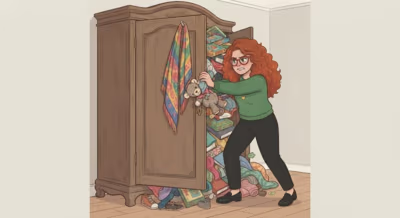
The twelve-step model approached this through surrender, prayer, character defects, and moral inventory. The fourth step, for example, involves making a searching inventory of resentments and personal conduct. Such work can be meaningful when approached carefully and with trauma-informed guidance. Without that care, however, it can become harmful.
There is no universal quality control for sponsorship. Sponsors are not necessarily trained therapists, and some have responded to trauma in ways that reinforce blame. A trauma survivor needs support that recognizes the difference between responsibility and culpability. Telling someone that they caused their own assault because of where they were or how they dressed is not recovery; it is harm.
I also became concerned with the way twelve-step communities often measure success primarily through time abstinent. Clean time matters, but it is not the same thing as emotional growth, healthy relationships, sound judgment, or an improved quality of life. A person can accumulate sober time while remaining angry, frightened, isolated, or trapped in destructive patterns.
The Cycle Begins

My first experience with rehab resulted in about two months of sobriety. By December 2014, I was back in inpatient treatment.
Once again, I encountered much of the same education: addiction, cravings, coping skills, meetings, and relapse prevention. I spent a month in inpatient treatment into January 2015, followed by intensive outpatient treatment at Share Counseling, part of Seabrook Treatment Center, in Cherry Hill, New Jersey.
The pattern became familiar. I would enter treatment, learn the expected material, leave with a period of sobriety, and eventually return to using. Then I would go back to rehab and repeat the process.
I kept going because I wanted to save my marriage and keep my family together. Michele expected me to seek treatment, and employers expected me to demonstrate that I was doing something about the problem. Even when IOP no longer felt like it was teaching me anything new, I continued pressing forward because my family mattered to me.
At the same time, I was beginning to conduct my own research.
Looking for Another Way
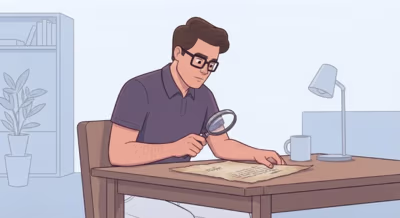
Traditional treatment often uses group therapy as its primary structure. A person may spend an hour or more in a group with a counselor, discussing addiction education, stages of change, Maslow’s hierarchy of needs, emotions, and life circumstances.
For someone who has never spoken openly about emotions, this can be a valuable starting point. But group therapy is not the same as individualized treatment. Much of the time, there is limited one-on-one counseling. Group check-ins can become what I think of as a kind of emotional “core dump”—a broad, unfocused release of thoughts rather than a carefully guided process of understanding.
The neurochemistry education was also often simplified. Addiction was reduced to dopamine, and perhaps serotonin. But the brain involves far more than dopamine. Motivation, reward, pain, fear, stress, memory, impulse control, and emotional regulation depend on interconnected systems involving GABA, glutamate, endorphins, norepinephrine, serotonin, dopamine, endocannabinoids, hormones, and brain circuits.
I was also interested in the formation of emotional webs, belief systems, and habitual pathways. Concepts such as myelination and the strengthening of repeated neural pathways were not subjects I commonly encountered in rehab. Yet these ideas helped me understand why repeated behaviors can become automatic and why changing them requires more than simply knowing what would be better.
My research eventually led me to The Orange Papers, a deeply critical examination of Alcoholics Anonymous and the twelve-step model. It was my first exposure to a sustained, well-researched rebuttal of an approach I had been told was the only true path to recovery.
From there, I discovered alternatives such as SMART Recovery and began reading the work of people such as Stanton Peele. I explored secular recovery, self-management, cognitive behavioral approaches, rational-emotive methods, mindfulness, meditation, and the broader idea that recovery can involve many pathways.
For the first time, I began to see recovery as something that could involve self-efficacy rather than helplessness.
What Addiction Did to My Family
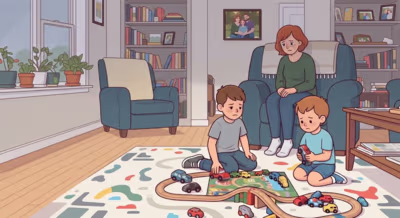
While I was repeating the cycle of rehab, sobriety, relapse, and rehab, addiction was wearing down Michele’s patience and trust.
Maintaining an active addiction requires secrecy. It requires lying, explaining missing time, finding money, hiding evidence, and creating stories that might preserve the appearance of control. As my addiction progressed, I did things I am not proud of. I stole money from my children’s wallets and from my stepson. If Michele had a prescription for pain medication, I spent time searching for where she might have hidden it.
These are not things I can excuse.
Addiction can help explain why a person lies, steals, and conceals what they are doing. The brain begins to treat the substance as an urgent survival need. Craving and fear of withdrawal can overwhelm judgment, long-term thinking, and normal priorities. Shame then reinforces concealment because the person knows, somewhere inside, that what they are doing is wrong.
But explanation is not the same as absolution.
My addiction did not mean I stopped loving my family. It did mean that my behavior harmed them. I was responsible for that harm, even while I was struggling with a condition that impaired my ability to make healthy decisions. That distinction became important to me: addiction can reduce control without eliminating responsibility.
Michele did not deserve the lies, fear, uncertainty, and repeated disappointment I brought into our marriage. My children did not deserve to have money taken from them. I can understand the mechanisms of addiction and still acknowledge that my actions were selfish, frightening, and destructive.
Trying to Use the Tools I Already Knew
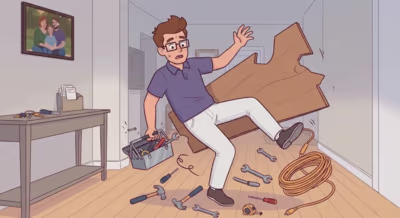
A reasonable question is: If I already understood hypnosis, mindfulness, and emotions, why did I not simply apply those tools to my recovery?
The answer is that knowing how to help other people does not make a person immune to their own struggles. A dentist may be the best dentist in the world, but that dentist still cannot properly drill their own teeth.
Hypnosis can be a powerful state of focused attention, but deep emotional work requires structure and perspective. When someone attempts complex self-hypnosis while dealing with early recovery, post-acute withdrawal, anxiety, depression, relationship conflict, and the pressure of rebuilding life, the mind can wander easily.
There is also a dual-role problem. In a guided session, the practitioner holds the structure, tracks the context, notices when the person is drifting, and helps connect emotional material. During self-hypnosis, I would have to be both the person doing the work and the person guiding it.
That is difficult even under normal circumstances. During early recovery, it can be nearly impossible. Post-acute withdrawal can bring brain fog, poor concentration, memory problems, sleep disruption, and emotional instability. Deep belief work requires mental energy that may not be available.
There is another complication: the subconscious mind often protects a person from painful material. If the substance has been used to bury difficult emotions, attempting to uncover those emotions alone may cause the mind to resist. The person may become sleepy, lose focus, forget the original goal, or simply leave the hypnotic state.
Self-hypnosis can be useful for relaxation, confidence, sleep, and positive suggestions. But deep emotional healing generally benefits from a skilled, trusted guide and a stable environment. Hypnosis may be part of recovery, but it cannot replace medical care, withdrawal management, accountability, or the practical changes required to live safely.
Medication-Assisted Treatment
As my experience continued, I learned more about medication-assisted treatment, now commonly called medications for addiction treatment or medications for opioid use disorder.
Naltrexone is an opioid antagonist. It binds to opioid receptors without producing the typical opioid high and can block other opioids from activating those receptors. The extended-release injectable form is commonly known as Vivitrol. I tried Vivitrol several times, but I returned to use not long after stopping.
Buprenorphine, found in medications such as Suboxone, is a partial opioid agonist. It activates opioid receptors but produces a more limited effect than full opioid agonists. Methadone is a full opioid agonist used in carefully regulated treatment. Both can reduce withdrawal, cravings, and the dangerous cycle of seeking and using short-acting opioids.
I also learned about other medications sometimes used in addiction treatment. Disulfiram, sometimes known by the brand name Antabuse, interferes with alcohol metabolism and can produce an unpleasant reaction if alcohol is consumed. Its usefulness can be limited by the need for consistent adherence and by the fact that psychological dependence may be stronger than the deterrent.
Gabapentin is sometimes prescribed off-label for anxiety, sleep problems, or other symptoms associated with addiction, although it requires careful medical judgment and is not appropriate for everyone.
Medication is not a substitute for personal change, but neither is personal effort a substitute for appropriate medication. For some people, medication is the foundation that makes recovery possible. For others, a different combination of support is needed.
The Overdose That Changed My Direction

In August 2019, before a business trip, I stopped in Camden to buy heroin and crack before heading to the airport. On the way, I overdosed. Police found me slumped over the steering wheel in a town near Philadelphia International Airport.
After that incident, I became deeply dejected and exhausted by addiction. I was tired of the secrecy, the danger, the repeated promises, and the cycle that seemed to consume every part of my life. I fell into a depression and wandered around the Philadelphia and South Jersey areas.
Michele and I separated, and I eventually moved back in with my father in Baltimore.
In January 2020, just before COVID-19 changed the world, I entered Maryville Rehabilitation Center in Williamstown, New Jersey. Afterward, I moved into a sober living house. The house manager’s idea of sober living became difficult for me, and I eventually left.
I rented a room from someone in Mickleton, New Jersey, but that situation also became emotionally unstable. I left again and began moving from inexpensive hotel to inexpensive hotel.
I was lost, depressed, and convinced I was not worthy of anyone or anything.
During that period, I cut off nearly everyone: my father, my siblings, Michele, and the rest of my family. Sometimes I did not have a phone, and when I did, I would not answer calls. Michele and my children did not know where I was.
I spent long stretches alone in cheap hotels, getting high by myself.
I have no excuse for how I treated my family during that time. I understand now how frightening and irresponsible it was. I regret the pain and uncertainty I caused. I can only say that I hope no one reading this ever finds themselves in a similar place.
Homeless in Camden
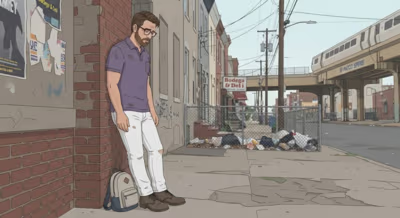
Eventually, I became homeless in Camden, New Jersey. I had to set aside whatever pride I had left and move into Joseph’s House, a shelter in Camden.
That experience showed me the extent of suffering addiction can create. I met people from many social and economic backgrounds. Some had once held jobs, owned homes, raised families, or built careers. Others had spent most of their lives in instability. In the shelter, the distance between those categories disappeared.
I came to think of that period as a trial in the desert—a time when I was stripped of many things I had used to define myself and forced to determine what remained.
Life in the shelter required structure. In 2023, residents had to leave around noon and could not return until eight in the evening. We had to figure out how to spend the day.
I could have spent that time running the streets, hustling, manipulating people, or looking for drugs. Instead, I began rebuilding my life at the library.
Rebuilding at the Library
In 2022, I turned the library into my office.
Using my technology background, I learned how to work within the limitations of public computers. I created local development environments and wrote a PowerShell environment-bootstrapping script called TxFx. It allowed me to quickly set up the tools I needed for software development on computers that were not designed for that purpose.
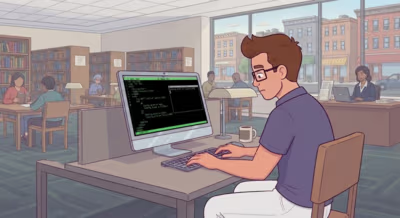
I used cloud storage, GitHub, scripting, and my systems-engineering experience to create a working environment. I installed local copies of software such as Python, Paint.NET, Git, and PuTTY where possible and built around the restrictions of the machines.
That process led to the development of this website.
The site was a ground-up redesign of the Baltimore Hypnosis Center website I had created in 2005. It uses static HTML, CSS, and JavaScript. I did not handwrite every page. Instead, I developed my own static-site generator, Cinnamon, so that I could separate content from layout and reuse common components.
Cinnamon began as a simple script called
page_gen.py
. As it grew, I recognized repeated patterns and began abstracting them into reusable components. I defined menus and other structures in YAML and used the generator to produce the pages.
I built the first version of the site before ChatGPT and the current generation of AI tools were available. I used my own knowledge, Google, and Stack Overflow. I now use AI to assist with editing, proofreading, and boilerplate code, but I do not see it as a replacement for having ideas, understanding the underlying logic, or directing the work.
The limitations of homelessness forced me to become resourceful. The library was not merely somewhere to pass the day. It became the place where I began building a way forward.
Learning to Create Again
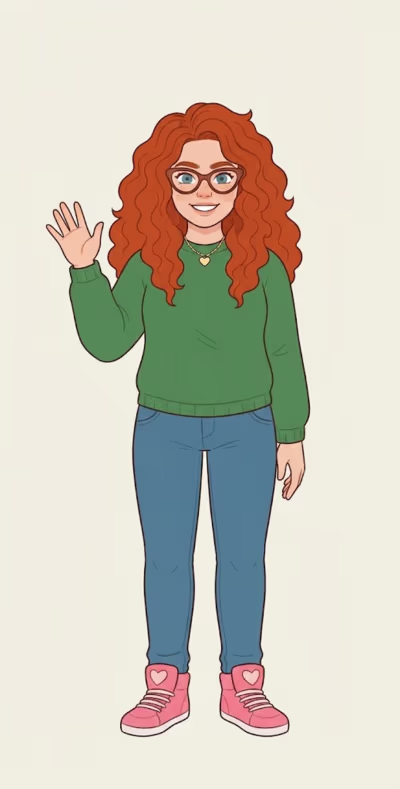
While developing the website, I also began learning to use drawing software such as Paint.NET. I had never considered myself artistic. Even drawing a stick figure felt like an accomplishment.
I wanted images to accompany the content on my site, so I started by modifying existing clip art. Over time, I began creating my own simple illustrations. That eventually developed into the two-dimensional clip-art style and characters such as Cathy Green.
The work was modest, but it mattered. I was taking pieces of myself that had not disappeared—technology, hypnosis, handwriting analysis, astrology, public speaking, and curiosity—and using them to construct something new.
I had no outside savior coming to rescue me. I had to build my own way out with the skills I already possessed and the knowledge I continued to acquire.
The Intolerable Trials
Near the end of my time in Camden, I went through what I called the “Intolerable Trials.” For roughly a year, I encountered a long series of people who tried to exploit me, use my kindness, take advantage of me, or manipulate my circumstances.
Homelessness and addiction can strip away a person’s sense of dignity and boundaries. In some environments, deeply destructive behavior becomes ordinary. People may appear to be friends while their conversations are filled with contempt, exaggeration, lies, and manipulation. They criticize others for behaviors they are also practicing.
I was repeatedly told that I was naïve or stupid because I refused to adopt the same greed and cruelty. Some people tried to use my kindness against me. In one case, someone kicked in the door of the place where I was staying and tried to kill me.
I could not control the behavior of those people. I could control whether I allowed their view of the world to become mine.
I refused to let my circumstances turn my heart bitter and cold. I refused to let other people’s cruelty rob me of my sense of wonder. I had already overcome painful shyness earlier in life. Now I had to use that same determination to survive addiction, homelessness, and the people who tried to take advantage of both.
Eventually, I realized that I could turn those experiences into strength.
What I Had to Let Go of
For a long time, I thought recovery meant holding on. I held on to my marriage, my family, my career, and the hope that the next treatment episode would finally end the cycle of recovery, return to use, and rehab. I kept trying to preserve what I had, even as active addiction continued damaging the marriage and the relationship I was trying so hard to save.
Building a relationship with someone who is repeatedly slipping in and out of active addiction is difficult. Michele was not simply dealing with one isolated crisis. She was living through a continuing pattern of promises, treatment, sobriety, disappointment, and renewed fear. I was so focused on preserving my family that I did not fully understand how much the relationship itself was suffering.
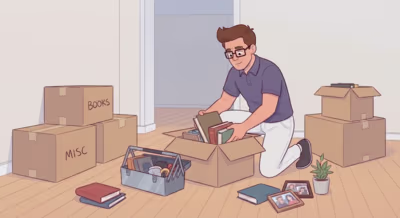
Eventually, I was released from that overall situation, and I had very little left. Divorce had taken away the life I had known. I lost contact not only with Michele and my children, but with much of my birth family as well. People told me that I had lost everything. Materially, that was true, and I do not want to minimize the emotional devastation of divorce, separation, homelessness, and isolation.
But one of the great questions found in spirituality and psychology is this: if everything a person believes defines them is stripped away, what remains?
I did not experience that as a thought experiment. I experienced it in real life.
What I discovered was that much of what I thought defined me had never really been mine. It came from living up to expectations, pleasing other people, pursuing career success, collecting possessions, seeking status, and worrying about what others thought of me. Once those things were gone, they began to lose their power.
In one sense, I had lost everything. In another, I had shed things that were no longer serving me.
I began to let go of defining myself through career success, material possessions, social status, public opinion, and other people’s expectations. I also let go of an identity built around constantly following the news, politics, and sports. There was a time when I could tell you exactly what was happening in the world or give you detailed information about the NFL or NASCAR. Now I barely watch an entire football game, and I am no longer consumed or divided by politics and news.
This was not about becoming indifferent to the world. It was about becoming less controlled by it. Letting go created the space for me to discover who I was beneath the roles I had been trying to perform.
Discovering and Rediscovering Myself
Along with discovering who I was came the process of rediscovering myself.
What emerged was someone who could use the technology experience I had gained over the years to rebuild a life under extremely limited circumstances. I had no money and no personal computer, but I still found ways to use public computers, cloud storage, GitHub, scripting, and my systems-engineering background to develop a website and create a path forward.
I also rediscovered my roots in hypnosis. During my marriage, I had worked in technology because it offered stable income. Raising a family left little time to dedicate to building a hypnosis practice. In early recovery, however, I was able to return to knowledge that had been buried beneath the demands of work, marriage, addiction, and family life.
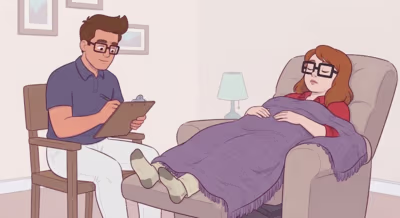
As I moved beyond the worst of the early-recovery deficits, I became better able to apply those techniques and ideas to myself. For the first time, I was alone with my own thoughts outside the context of who I had tried to be in my family and work life. I could examine my belief systems, perceptions, and emotions through sustained inner focus.
I began working with the connections between emotional experiences—what I think of as affective bridging between webs of emotion. One feeling led to another, one belief connected to an older perception, and patterns that had seemed unrelated began to make sense.
It was applying that knowledge to myself, more than anything I had learned in rehab, that finally helped free me from the urges and cravings of addiction and allowed me to heal emotionally. I was finally able to work without the same expectations, pressures, and burdens that had made it so difficult to see myself clearly.
Eventually, I began practicing hypnosis with other people on the streets of Camden. I even practiced with other consenting adults while I was in rehab, sometimes to the frustration of the facility. The staff did not understand what I was doing and wanted to stop two consenting adults from using an approach that they believed was providing genuine relief.
For me, this became a crucial part of recovery: letting go of the identity I had been trying to protect, discovering who I was when everything I thought defined me was gone, and then rediscovering what I knew and loved. Finally, I was able to apply that knowledge to myself.
What Recovery Means to Me Now
I am still rebuilding. Getting out of Camden did not instantly restore everything I had lost. I am still working to establish an office, grow a business, and create a stable future.
For now, I am building through this website, online groups, video content, and public work. I use my experience with hypnosis, mindfulness, handwriting analysis, astrology, addiction, neurochemistry, and emotional change to help people understand themselves and make meaningful changes.
I offer short stress and relaxation resets, anger-release and control techniques, handwriting insights, astrology readings, and education about behavior and recovery. These activities help me build awareness, connect with people, and generate the resources needed to continue moving forward.
My recovery did not come from one program, one meeting, or one dramatic moment. It came through repeated failure, painful consequences, research, humility, survival, and the gradual discovery that I could still create a life after destroying much of the one I had.
I do not believe that everyone needs the same recovery path. Twelve-step programs help many people, but they were not the complete answer for me. I needed self-efficacy, education, emotional understanding, practical tools, and the freedom to explore multiple approaches.
I also needed to stop confusing shame with accountability. I must acknowledge what I did. I must accept that my choices hurt people. I must repair what I can. But I do not have to spend the rest of my life believing that I am nothing more than the worst things I did while addicted.
The deepest lesson I learned is that recovery is not simply the absence of a substance. It is the rebuilding of judgment, trust, identity, emotional regulation, relationships, purpose, and hope.
I am still in that process.
But I am no longer waiting for someone else to save me. I am using what I know, learning what I do not know, and building my way forward one piece at a time.
If you are interested in working with me on addiction, unwanted habits, overwhelming emotions, hypnosis, mindfulness, personal transformation, handwriting analysis, or astrology—or if you would like to book me for an event or invite me to speak to your organization—please Contact me

Discussion