
Hypnosis

Experience, Training & Approach
As the former owner and primary hypnotist at Baltimore Hypnosis Center, I bring years of experience working with hypnosis, mindfulness, visualization, and other approaches to personal transformation. Now based right here in the South Jersey and Philadelphia area, I work with clients throughout Camden County, Gloucester County, Burlington County, and Atlantic County. I became a Board Certified Hypnotist through the National Guild of Hypnotists (NGH) in 2007 and have continued to build on that foundation through experience, study, and exploration of different approaches to behavior and change.
My training includes the structured 5-PATH approach to hypnosis, which provides a systematic framework for conducting a hypnotic session and working with the patterns that may be involved in a person's particular concern. I also draw from mindfulness, visualization, NLP, Cognitive Behavioral Therapy (CBT), Dialectical Behavior Therapy (DBT), and other behavioral and contemplative approaches.
These approaches give me a broader toolkit rather than a single formula that has to work for everyone. Whether someone in our local community is working on a habit, stress, confidence, behavior change, personal development, or another challenge, the approach can be adapted to the individual and the goal.
My work with hypnosis has included concerns such as weight management, smoking cessation, stress, fears, habits, and other areas where changing established patterns may be useful. I also have a particular interest in the relationship between hypnosis, mindfulness, behavior, and addiction and recovery.
Hypnosis isn't a replacement for appropriate medical or mental health care, nor is it a magic solution to every problem. I see it as one practical tool that can be incorporated into a larger approach to understanding ourselves and creating meaningful change.
If you'd like to learn more about my professional experience, training, and work at Baltimore Hypnosis Center, you can read my Hypnosis Professional Experience page.
Hypnosis: Not as Mysterious as It Seems
The word "hypnosis" can make the subject sound far more mysterious than it really is.
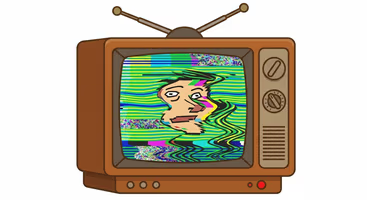
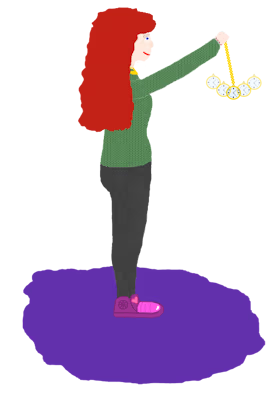
Movies and television often portray hypnosis as something mysterious: a hypnotist waves a pocket watch, says a few carefully chosen words, and somehow takes control of another person's mind.
That's a great premise for a movie. It isn't a very good description of hypnosis.
Much like computers, medicine, psychology, and many other subjects, hypnosis has been represented in popular culture in ways that don't necessarily correspond to how it works in real life.
My view of hypnosis is considerably less mysterious. I see hypnosis as a useful term for a collection of ordinary human processes, including focused attention, absorption, imagination, expectation, suggestion, emotion, perception, and the way we respond to information and context, that can be deliberately harnessed for personal change.
These processes aren't unique to hypnosis. We experience them throughout everyday life. What makes hypnotic work interesting is that we can deliberately structure and direct these natural capacities toward a particular purpose.
Hypnosis Is Something You Experience, Not Something Done to You
A hypnotist doesn't magically create hypnosis inside another person's mind.
I think of the hypnotist more as a guide or coach. The practitioner provides structure, language, suggestions, imagery, and direction that can help a person deliberately focus their attention and become more deeply absorbed in an experience.
The person experiencing hypnosis remains an active participant. Their expectations, interpretation of the experience, willingness to participate, attention, imagination, and response to suggestion all matter.
This is one reason the relationship between the hypnotist and client is important. A hypnotist can have tremendous technical skill, but if a client doesn't trust the practitioner, doesn't understand the process, or believes that hypnosis cannot work for them, simply performing a technically perfect induction isn't likely to accomplish very much.
Hypnosis isn't a magic trick that works independently of the person experiencing it. It is an interaction between the practitioner, the participant, the context, and a collection of psychological processes that are already part of being human.
Focused Attention and Selective Thinking
One of the central ideas in my approach is that hypnosis involves more than simply "going into a trance." It involves changes in how attention is directed and how information is processed and interpreted.
When attention becomes highly focused, some information becomes more prominent while other information fades into the background. Our thinking can also become more selective. We may temporarily give greater attention and significance to certain ideas, sensations, memories, images, or possibilities while paying less attention to others.
This happens all the time without anyone calling it hypnosis.
You can become completely absorbed in a movie and temporarily stop analyzing whether every scene could really happen. You can become so involved in a book that you lose track of time. You can become absorbed in a difficult programming problem, a piece of music, a video game, or an idea that fascinates you.
Hypnotic techniques provide ways of deliberately working with this same flexibility of attention and experience.
Hypnosis Doesn't Require Relaxation
Hypnosis is often associated with relaxation, and relaxation can certainly be useful. A comfortable and relaxed person may find it easier to reduce distractions, focus attention, and become absorbed in an experience.
But relaxation isn't the definition of hypnosis.
Attention can become highly focused under many different emotional conditions. Curiosity, excitement, anticipation, fascination, love, fear, anger, frustration, and other emotional states can all dramatically affect attention and perception.
In fact, if someone is already highly emotional about something, their attention may already be intensely focused on it. Rather than having to create focused attention from scratch, a practitioner may be able to work with the attention and emotional activation that are already present.
The useful question isn't necessarily "How relaxed is this person?" but rather "How is this person's attention operating right now, and how can that attention be used constructively?"
Hypnosis Happens in Everyday Life
You don't need a hypnotist to experience the kinds of focused attention and absorption associated with hypnosis.
Have you ever become so absorbed in a movie that you temporarily forgot about everything happening around you? Have you ever lost track of time while reading, listening to music, working on a project, playing a game, or becoming deeply involved in a conversation?
These experiences demonstrate how flexible human attention can be. Our awareness can become intensely focused on one thing while other information fades into the background.
Another familiar example is what is commonly called highway hypnosis : driving a familiar route while becoming so absorbed in your thoughts that you arrive at your destination with little conscious memory of the individual turns and landmarks along the way.
Daydreaming, intense concentration, creative absorption, and familiar automatic routines can all provide useful examples of how attention and awareness can operate differently from our ordinary conversational state.
What Does a Hypnotist Actually Do?
A hypnotist doesn't perform an incantation that magically creates hypnosis in another person.
I think of the hypnotist more as a guide or coach. The practitioner provides structure, language, suggestions, imagery, and direction that can help a person deliberately focus their attention and become more deeply absorbed in an experience.
The participant isn't simply sitting there waiting for something to happen to them. They are participating in the process.
In that sense, hypnosis is something you experience , not something that a hypnotist simply does to you .
Your Emotions Can Influence You Before You Think
One of the most interesting aspects of human experience is that our responses aren't always preceded by deliberate conscious reasoning.
Someone can say something that immediately makes you angry. Another person's tone of voice can make you feel safe or threatened before you've consciously analyzed what happened. A particular smell can suddenly bring back an old memory. A familiar song can transport you back to another time.
These experiences illustrate how information can influence us through attention, memory, emotion, expectation, and association before we have consciously decided how to respond.
There is an old saying that your spouse may be your best hypnotist. It isn't meant literally to suggest that your spouse possesses special hypnotic powers. It points toward something much more ordinary: people with whom we have strong emotional relationships can have an extraordinary ability to influence our attention, expectations, interpretations, and automatic responses.
Hypnotic work can deliberately explore some of these same relationships between attention, expectation, imagination, emotion, and response.
Dispelling the Myths About Hypnosis
Once hypnosis is separated from its Hollywood portrayal, many of the familiar myths become much easier to understand.
Myth: Hypnosis Is Mind Control
Fictional characters such as Svengali helped establish the idea that a hypnotist can take control of another person's mind.
Hypnosis does not give the hypnotist ownership of another person's thoughts or decisions. The person experiencing hypnosis continues to have their own values, preferences, thoughts, and ability to make choices.
Suggestion can influence attention, imagination, perception, and experience, but influence is not the same thing as control.
Myth: Hypnosis Means Losing Control
Hypnosis isn't about handing your will over to someone else.
You can generally accept, ignore, reinterpret, or reject a suggestion. If you decide you no longer want to participate, you can communicate that decision and end the session.
The hypnotist provides guidance. The participant remains an active part of the process.
Myth: Hypnosis Can Make You Do Anything
Stage hypnosis can make this misconception particularly convincing. Performers can appear to make participants behave in remarkably unusual ways.
But stage hypnosis is also a performance. Participants volunteer, expectations are established, and people who are comfortable participating in an unusual experience are more likely to volunteer and respond enthusiastically.
Hypnosis shouldn't be understood as a mechanism that allows a hypnotist to simply override someone's fundamental values or force them to act against their wishes.
Myth: You Can Get Stuck in Hypnosis
You cannot become permanently trapped in hypnosis.
Hypnosis isn't a mysterious place that someone enters and cannot leave. Attention naturally shifts, and a person can return to ordinary alertness.
Someone who appears reluctant to emerge from a deeply relaxed state may simply be enjoying the experience. A trained practitioner can provide appropriate guidance for bringing the session to a close.
Myth: Hypnosis Gives You Magical Powers
Hypnosis isn't magic and it doesn't give someone supernatural abilities.
What can sometimes appear extraordinary is the degree to which attention, expectation, imagination, suggestion, and context can influence human experience.
These effects don't require a supernatural explanation.
Myth: Analytical People Can't Be Hypnotized
Being logical, analytical, skeptical, or highly intellectual doesn't make someone immune to hypnosis.
Hypnosis doesn't require you to stop thinking. In fact, anyone who has become completely absorbed in reading, programming, solving a difficult problem, making music, creating art, or researching something fascinating already knows something about the power of focused attention.
Different people simply respond to different ways of focusing attention and engaging imagination and expectation.
What Hypnosis Is Really About
Strip away the pocket watches, mysterious music, swinging pendulums, and Hollywood mind control, and something much more interesting remains.
Hypnosis is about the remarkable flexibility of human attention and experience.
We are constantly responding to information, expectations, memories, emotions, environments, and other people. Many of those responses happen automatically before we have consciously decided how to respond.
Hypnotic techniques provide one way of deliberately working with those processes.
The goal isn't to surrender control of your mind.
The goal is to become more aware of how your mind already works and discover where you may have more flexibility and choice than you realized.
Hypnosis and Personal Transformation
Lasting change usually involves more than simply deciding that we want something to be different. We develop habits, emotional associations, expectations, beliefs, and automatic responses over time.
Hypnosis provides one way of deliberately working with some of those processes rather than relying exclusively on conscious effort.
It can be combined with mindfulness, visualization, behavioral techniques, cognitive approaches, and other methods to create a broader framework for understanding and changing patterns.
Hypnosis and Addiction & Recovery
Addiction provides a particularly interesting example of how automatic patterns can develop and become difficult to change.
My approach to addiction and recovery is informed by my experience with SMART Recovery and by an interest in behavioral science, mindfulness, CBT, DBT, and other approaches to understanding behavior and change.
Hypnosis can be considered as one supplemental tool within that larger framework. It isn't a replacement for appropriate medical, psychological, or addiction treatment, but it can provide another way of exploring attention, habits, associations, motivation, and behavioral patterns.
Your Path to Transformation
Hypnosis is only one part of a broader approach to understanding people, behavior, and personal change.
If you’d like to explore how hypnosis can help you examine and transform unwanted or unhelpful behavioral patterns, work through overwhelming or intrusive emotions, overcome fears, phobias, and anxiety, or process the effects of difficult past experiences, Contact me .
Hypnosis can also be used to help you work with urges and cravings associated with overeating, smoking, alcohol, or substance use, and to explore ways hypnosis can support your recovery. If you’re tired of automatically reacting to anger and would like to learn how to pause, release it, and let it go instead—or if you simply want to lose weight, stop smoking, or change an unwanted habit—contact me and let’s explore how hypnosis may be able to help.
If you're interested in hypnosis, I invite you to explore the rest of the site as well. You'll find information about mindfulness, meditation, addiction and recovery, behavior change, emotional regulation, and other approaches to understanding the patterns that shape our lives.
Explore my Hypnosis Resouces
Contact Adam Fistler, BCH - Behaviroal Change Consultant
Examine a Brief Overview Hypnosis
Learn how Hypnosis Works Under the Hood & How it Physically Affects the Brain
Learn more about Hypnosis Services & Common Issues People use Hypnosis to Address
Learn how Others have Benefited from my Hypnosis Experience by Browsing Client Testimonials
Discover how Hypnosis can Help You Release Anger, Impulsivity, and Road Rage.
Discover how Hypnosis aids with Addiction & Recovery
Discover how Hypnosis can Help you Lose Weight, Manage Cravings, and Overcome Emotional Eating.
Explore my Hypnosis Articles
Review all my Hypnosis Articles
Baltimore Hypnosis Center: A Journey of Personal and Professional Transformation
10 Things to Consider When Choosing a Hypnotist
10 Ways Hypnosis Can Help You Lose Weight
Attract Your Ideal Partner by Focusing Your Mind
Unlocking Freedom from Chronic Pain: Harnessing the Power of Hypnosis
The Essence of Change: Empowering Transformation Through Hypnosis
Should You Use Hypnosis to Lose Weight?
Should You Use Hypnosis to Stop Smoking?
Breaking Free: The Nice Guy's Journey to Authenticity
Winning the Battle Within: Overcoming the Urge
Debunking Hypnosis Myths: Unveiling the Truth Behind Common Misconceptions
Unlocking Wellness: The Profound Influence of the Mind-Body Connection in Healing
Exploring the Subconscious Mind: Unveiling the Depths of Your Mental Landscape
Exploring the Benefits of Gratitude Practices
The Surprising Link Between Hypnosis and Stress Reduction: A Comprehensive Guide
Gnsotic Aeon Pairings: The Pleroma as a Psychology of Becoming