
Hypnosis Under the Hood: Hypnosis' Affect on the Brain
Author: Adam Fistler, BCH - Behavorial Change Consultant ( adam@adamfistler.com )
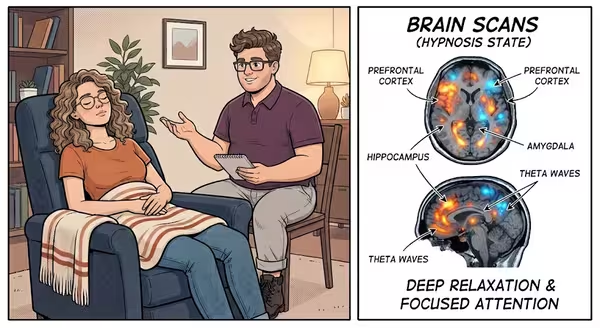
Hypnosis is often portrayed as a mysterious state in which a person surrenders control to someone else. In clinical practice, however, hypnosis is better understood as a form of highly focused attention , increased responsiveness to therapeutic imagery and suggestion, and a temporary shift in how a person interprets internal and external experience.
Research associated with psychiatrist and neuroscientist Standford Psychiatry Professor David Spiegel has helped move hypnosis away from the language of magic and toward a more precise account of attention, self-awareness, executive control, and perception. Hypnosis does not turn off the brain. It changes which brain systems are prioritized, how they communicate, and how experience is interpreted.
That distinction matters. Hypnosis is not sleep, unconsciousness, or mind control. A person generally remains capable of refusing suggestions, maintaining personal values, and ending the experience. Its effectiveness comes not from eliminating agency, but from helping people use attention and imagination in a more deliberate way.
What happens during hypnosis?

A useful working definition is:
Hypnosis is a state of focused attention and absorbed involvement in which suggestions can influence perception, emotion, memory, bodily experience, and behavior.
This definition contains several related processes:
- Focused attention: concentrating on a selected object, image, sensation, or idea.
- Absorption: becoming deeply involved in an experience so that competing information fades into the background.
- Reduced self-monitoring: temporarily loosening habitual evaluation and self-conscious commentary.
- Increased responsiveness to suggestion: allowing a proposed interpretation or action to become experientially meaningful.
- Flexible perception: experiencing imagined events, sensations, or meanings as more immediate and compelling.
These processes occur outside hypnosis as well. People become absorbed while reading, praying, listening to music, driving familiar routes, watching films, or worrying. Hypnosis deliberately organizes this natural capacity.
Focused attention: the doorway into hypnotic experience

Attention is not simply a spotlight that illuminates whatever is in front of us. It is also a filtering system. At any moment, the brain receives more sensory and internal information than conscious awareness can process in detail. Attention determines what receives priority.
During hypnosis, attention may become concentrated on:
- the rhythm of breathing;
- a bodily sensation;
- the therapist’s voice;
- an imagined place;
- a memory or symbolic scene;
- a desired future response;
- a particular emotional meaning.
As attention narrows, irrelevant information becomes less important. This can create the experience of time passing quickly, sounds fading into the background, or the body feeling distant, heavy, light, warm, or unusually relaxed.
Neuroscientifically, this does not require a single “hypnosis center.” It is more accurate to think of hypnosis as a temporary configuration of interacting systems involving attention, executive control, self-related processing, salience detection, imagery, and bodily awareness.
Spiegel’s neuroimaging work has been especially influential because it suggests that hypnotic analgesia and other hypnotic effects are associated with changes in communication among networks involved in:
- executive control;
- salience detection;
- self-awareness;
- sensory and emotional interpretation.
The exact pattern can vary depending on the hypnotic task and the person’s response. Hypnosis is not one uniform brain state.
The “critical factor”: a useful metaphor, not a literal brain switch

Many hypnosis traditions describe a critical factor that evaluates suggestions against existing beliefs. This concept can be useful, but it should not be treated as a discrete anatomical gate that hypnosis simply turns off.
The brain continuously evaluates incoming information. It asks, implicitly:
- Is this plausible?
- Is it relevant?
- Is it safe?
- Does it fit what I already know?
- Should I act on it?
- Does it conflict with my values or goals?
This evaluative process protects us from error and manipulation. It also contributes to habitual thinking. A person who repeatedly thinks, “I cannot cope,” may automatically reject evidence that challenges that conclusion.
Hypnosis can reduce the dominance of habitual evaluation by absorbing attention, increasing experiential involvement, and shifting the person into a mode where an idea is explored rather than immediately argued with. The suggestion is not necessarily accepted blindly. Instead, it may be processed through imagination, emotion, bodily sensation, and expectation before the usual objections fully reassert themselves.
A more scientifically cautious description would be:
Hypnosis can alter the balance between deliberate evaluation, automatic prediction, imagery, and embodied experience.
This is different from “bypassing” critical thought altogether.
Direct Suggestion: How Words Become Experiences

A direct suggestion is a clearly stated proposal about what a person may notice, feel, remember, or do. Examples include:
- “You may notice your breathing becoming easier.”
- “When you encounter that situation, you can pause before reacting.”
- “Your hand may begin to feel comfortably warm.”
- “You can allow confidence to become familiar.”
Suggestions work partly through expectation . Expectations influence perception, attention, motivation, and physiology. If a person expects a treatment to reduce pain, the brain may alter how incoming pain signals are interpreted, even though the original tissue signal has not necessarily disappeared.
Suggestion also recruits imagery. Imagining warmth, heaviness, movement, safety, or distance can activate some of the same sensory and emotional systems involved in actually experiencing those states. The imagined event is not identical to the real event, but it can be sufficiently embodied to influence experience.
At the chemical level, suggestion and expectation may engage systems associated with:
- endogenous opioids;
- dopamine and reward learning;
- noradrenaline and attention;
- serotonin and mood regulation;
- oxytocin and social safety;
- cortisol and stress regulation.
These systems are not switched on by hypnosis in a simple, one-to-one manner. Their activity depends on context, expectation, individual differences, and the specific symptom being addressed.
>The Role of Client Acceptability and Critical Thinking
Hypnosis is not a state of mindlessness or mindless obedience. Clients remain conscious, aware, and actively evaluating throughout the process. A suggestion will be immediately rejected or ignored if it fails to make logical sense, feels counter-productive to their goals, or violates their personal values, morals, or boundaries. Because the conscious mind retains its critical faculty, hypnotists must design suggestions with meticulous care.
Crafting Effective Direct Suggestions
To bypass unnecessary friction and maximize resonance, skilled practitioners follow three foundational rules of phrasing:
- Use Positive Framing: The subconscious mind processes concepts rather than grammatical negatives (much like the classic example of being told "don't think of a pink elephant"). Avoid words like can't, won't, never, not, or try . Instead of "try not to feel anxious," use "allow yourself to feel completely calm and centered."
- Keep It Clear and Specific: Vague directives (such as "just feel better" or "do it") create confusion and are routinely discarded by the mind. Suggestions must offer a concrete, actionable internal experience.
- Measure and Validate: A strong suggestion contains clear internal markers so the client can recognize when the shift is taking place (e.g., "noticing your shoulders dropping an inch lower").
Skilled vs. Amateur Approaches
The hallmark of professional hypnotherapy lies in personalization rather than the repetition of rigid formulas.
| Approach | Amateur / Less Skilled | Skilled Hypnotist |
|---|---|---|
| Source Material | Relies on generic, pre-canned scripts found in textbooks. | Crafts custom suggestions derived from in-depth client interviews and goals. |
| Language | Uses standard clinical phrasing that may alienate the client. | Adopts the client's unique vocabulary, metaphors, and personal idiom for maximum impact. |
| Collaboration | Imposes a top-down structure onto the individual. | Co-creates the therapeutic experience alongside the client. |
What Spiegel’s research contributes

David Spiegel’s work has helped clarify several important points.
First, hypnosis is not equivalent to sleep. Hypnotized people can be alert, responsive, and capable of complex mental activity.
Second, hypnotic responsiveness varies among individuals. Some people become deeply absorbed in imagery and suggestion; others experience hypnosis more modestly. This variation is not necessarily a sign of intelligence, weakness, or gullibility.
Third, hypnotic effects can involve changes in the relationship between brain networks rather than simple increases or decreases in total activity.
In studies of hypnotic pain relief, for example, hypnosis has been associated with altered processing of pain and with changes in the networks that evaluate the significance of bodily signals. The sensation may still be present, but its unpleasantness, threat value, or personal meaning can change.
This distinction is crucial:
Pain is not only a signal. It is also an interpretation.
Hypnosis may influence the interpretation without denying the underlying medical condition. For that reason, hypnosis should complement appropriate medical care rather than replace diagnosis or treatment.
Age Regression: Returning to an Emotional State, Not Recovering a Perfect Recording

“Age regression” can refer to several different experiences. A person may:
- Imagine being younger
- Reconnect with feelings associated with an earlier period
- Experience a childlike perspective or bodily state
- Recall autobiographical material
- Symbolically revisit a formative situation
These experiences should not automatically be interpreted as literal time travel or exact recovery of hidden memories. Popular culture and television often manufacture high drama around regression, depicting it as a terrifying, hazardous, or deeply traumatic ordeal that people should fear. This is largely Hollywood fiction.
In clinical reality, a client undergoing regression acts more like an objective reporter observing a past event than someone perfectly revivifying a trauma. Furthermore, healing does not depend on a massive, painful emotional breakdown or abreaction. True resolution comes from working directly with the perceptions, updated core beliefs, and meaning surrounding the event. If an unexpected emotional spike does occur, a practitioner can immediately implement dissociation techniques to safely remove the client from the immediacy of the experience.
Memory is reconstructive. Each act of remembering involves reactivating stored information and rebuilding an experience in the present. Recall can be influenced by:
- Current beliefs
- Emotional state
- Expectations
- Questions asked by another person
- Later information
- Imagination
- The meaning assigned to the event
This makes hypnotically retrieved memories especially vulnerable to distortion if a practitioner uses leading questions or treats imagery as verified fact.
A responsible approach is to treat regression material as psychologically meaningful but not automatically historically accurate. The relevant question may be:
What emotion, belief, or unmet need is being represented here?
rather than:
Did every detail happen exactly this way?
That distinction protects people from false certainty while still allowing symbolic, emotional, and cognitive work.
Forgiveness: Loosening the Emotional Grip of the Past

Forgiveness is not the same as approving harm, forgetting what happened, abandoning boundaries, or reconciling with an unsafe person. While it may not seem intuitive to address forgiveness during a healing process for behavioral issues like weight loss or smoking cessation, forgiveness is actually a cornerstone of creating lasting change. By overlooking this step, a person fails to address the lingering anger, guilt, or shame that the issue has caused to themselves or others. Without resolving these underlying emotional blockers, a high likelihood remains for the problem to resurface. Lasting transformation requires examining and exhausting all relevant neural pathways, ensuring that residual self-condemnation or resentment does not trigger old coping mechanisms.
In therapeutic terms, forgiveness involves reducing the emotional grip of an injury. That can include loosening:
- Shame
- Self-condemnation
- Chronic anger
- Revenge fantasies
- Repetitive mental replay
- Identification with the role of victim or perpetrator
Hypnosis supports this process by creating a focused context in which a person can revisit an event with greater psychological distance, introduce compassion, and imagine a different response. This allows for both self-forgiveness and the forgiveness of others to happen fluidly, clearing the hidden emotional weight that fuels addictive behaviors or self-sabotage.
Several neurological systems are involved in this shift:
- Prefrontal regulatory systems help reinterpret and reframe emotional material.
- The amygdala and threat circuitry become less reactive when the memory is revisited in safety.
- The hippocampus contributes context, helping distinguish past danger from present circumstances.
- The default mode network participates in updating the self-narrative and autobiographical meaning.
- Social-cognitive networks support perspective-taking and empathy.
Forgiveness therefore changes the relationship to a memory without changing the facts of the event. The goal is not to erase the past, but to prevent the past from continually controlling the present.
Secondary gain: when a symptom is also solving a problem
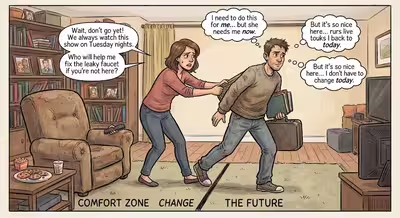
The phrase secondary gain can be misleading if it implies that a person consciously chooses illness or distress. Most people do not deliberately create symptoms for advantage. A better interpretation is that a symptom may serve an understandable protective function.
For example, anxiety may:
- prevent a person from taking a feared risk;
- secure care or connection;
- create permission to rest;
- avoid conflict;
- preserve a familiar identity;
- protect against disappointment;
- maintain loyalty to a family system;
- prevent exposure to judgment.
The symptom may be painful, but it may also be the brain’s best available solution to a perceived problem.
Hypnotic work can explore this function through questions such as:
- “What does this response try to protect you from?”
- “What would become possible if the symptom no longer had to do that job?”
- “What healthier way could meet the same need?”
- “What does this part of you fear would happen if it relaxed?”
This approach resembles “parts work,” motivational interviewing, and predictive models of behavior. The aim is not to fight the symptom as an enemy, but to identify the need it is attempting to address and create a safer alternative.
Why hypnosis can last when conscious effort fails
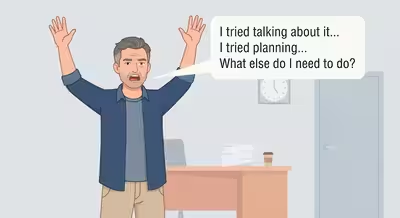
Many people have experienced the frustration of making a sincere conscious decision— I will stop worrying, stop smoking, sleep better, or respond calmly —only to find the old pattern returning.
This does not mean conscious effort is useless. It means habits are supported by more than conscious intention.
A recurring behavior may be maintained by a network involving:
- learned cues;
- emotional associations;
- bodily states;
- reward prediction;
- avoidance;
- identity;
- environmental routines;
- implicit beliefs;
- social reinforcement.
Conscious effort often operates at the level of verbal instruction: Do not do that. But the established pattern may operate more quickly through automatic prediction and action.
Hypnosis can sometimes produce longer-lasting change because it works across several levels at once:
- Attention: It identifies the specific cue or response.
- Expectation: It creates a credible alternative outcome.
- Imagery: It rehearses the new response in an embodied way.
- Emotion: It addresses the fear, shame, or need maintaining the pattern.
- Memory: It may alter the meaning attached to a triggering situation.
- Identity: It makes the desired response feel compatible with the person’s sense of self.
- Repetition: It strengthens the new pathway through practice.
This process is related to memory reconsolidation , a phenomenon in which reactivated memories can become temporarily modifiable before being stored again. However, reconsolidation is not a magic eraser, and evidence for specific therapeutic protocols remains mixed. Lasting change usually requires repetition, real-world practice, environmental support, and—when appropriate—medical or psychological treatment.
Hypnosis may make change feel easier because it reduces the amount of effort required to access a new response. Instead of repeatedly forcing behavior from the outside, the person begins to experience the alternative as more automatic and believable.
Neuroplasticity: from suggestion to new learning
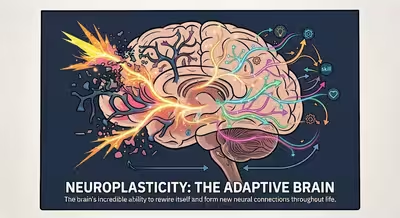
Neuroplasticity means that the nervous system changes in response to experience. Every time a person repeatedly practices attention, relaxation, emotional regulation, or a new behavioral response, the relevant circuits are reinforced.
Over time, the new response may require less conscious effort.
This does not mean hypnosis physically “rewires” the brain after one session in a guaranteed way. It means hypnosis can provide a powerful learning context. The brain changes when new experiences are repeated, emotionally meaningful, and connected to actual behavior.
The most durable results generally occur when hypnotic work is followed by action:
- practicing the new response in daily life;
- approaching rather than avoiding manageable triggers;
- changing environmental cues;
- improving sleep and physical health;
- building supportive relationships;
- addressing trauma or psychiatric symptoms appropriately;
- reviewing setbacks without turning them into failure.
A web rather than a single root cause
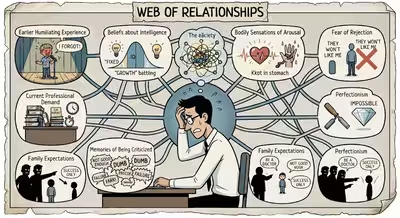
Psychological problems rarely have one isolated cause. They are more like networks of interconnected associations.
A fear of public speaking, for example, may connect to:
- an earlier humiliating experience;
- beliefs about intelligence;
- bodily sensations of arousal;
- fear of rejection;
- perfectionism;
- family expectations;
- memories of being criticized;
- a current professional demand.
Changing one association may influence others, but not always. There may be several maintaining factors that need attention.
Hypnosis can help identify and modify important links in this network through imagery, emotional processing, rehearsal, and reframing. But it should not be described as literally rewriting an entire knowledge base or permanently changing every connected memory. Human memory and learning are more flexible—and more complicated—than that.
A careful model is network updating : when a person encounters a powerful new experience in the presence of an old trigger, some predictions may gradually change.
Neurotransmitters: avoiding the “chemical switch” myth
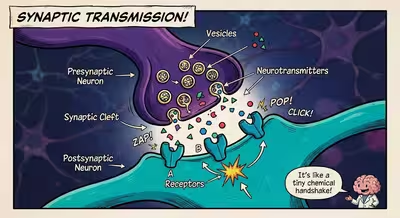
It is tempting to explain hypnosis by saying that it releases a particular neurotransmitter. Current science does not support a simple formula such as “hypnosis equals dopamine” or “trance releases serotonin.”
Brain chemistry operates through interacting systems. Depending on the person and the intervention, relevant processes may include:
- Dopamine: reward prediction, motivation, salience, and learning.
- Noradrenaline: alertness, attention, and memory formation.
- Endogenous opioids: pain modulation and relief.
- GABA: inhibitory regulation and reduced neural excitability.
- Glutamate: learning and plasticity.
- Serotonin: mood, flexibility, and regulation.
- Oxytocin: social trust and perceived safety.
- Cortisol: stress mobilization and recovery.
These systems are shaped by expectation, relationship, context, breathing, emotional arousal, and behavior. The therapeutic relationship itself can influence safety and attention. Hypnosis is therefore best understood as a coordinated psychological and physiological process, not as a single chemical event.
What hypnosis cannot do
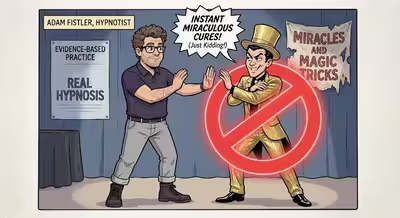
A scientifically responsible account must include limits.
Hypnosis cannot reliably:
- guarantee recovery of accurate hidden memories;
- force someone to violate deeply held values;
- replace emergency medical or psychiatric care;
- cure every physical or psychological condition;
- eliminate the need for behavioral practice;
- prove past-life claims or supernatural explanations;
- make every person equally responsive;
- ensure permanent change after one session.
It can also be misused. Leading questions, claims of certainty, exaggerated promises, and suggestions presented as medical fact can cause harm.
A hypnotist should be well trained to ask give client realstic expectations, as non leading questions, and understand boundries of care.
Conclusion: hypnosis as guided learning

Under the hood, hypnosis is less mysterious than popular culture suggests—but no less interesting.
It brings together:
- focused attention;
- absorption;
- expectation;
- imagery;
- altered self-awareness;
- emotional regulation;
- memory updating;
- bodily perception;
- behavioral rehearsal;
- social safety and therapeutic relationship.
David Spiegel’s research contributes to a picture of hypnosis as a measurable shift in brain function and network communication, not a supernatural state. The person is not removed from the process. The person is participating—often with more concentrated attention and less interference from habitual mental noise.
Hypnosis can sometimes succeed where conscious effort fails because it does not rely only on willpower. It engages the emotional, bodily, imaginative, and predictive systems that help maintain habits in the first place.
The deepest therapeutic question is therefore not:
“How can I force myself to change?”
It may be:
“What does my mind currently predict, protect, and practice—and what new experience would teach it that another way is possible?”
That is where hypnosis becomes most useful: not as a surrender of agency, but as a method for concentrating agency, updating learned predictions, and rehearsing a different future until that future begins to feel familiar.

About The Author
Adam Fistler is a Behavioral Change Consultant, Board Certified Hypnotist, Certified 5-PATH® Hypnotist, and former owner of the Baltimore Hypnosis Center. A member of the International 5-PATH® Hypnosis Association and certified by the National Guild of Hypnotists, Adam has studied hypnosis, behavior change, and the relationship between thoughts, beliefs, emotions, and behavior for more than two decades.
His perspective is shaped by more than professional training. Adam has also lived through addiction and recovery firsthand across South Jersey and the Philadelphia region, including surviving on the streets of Camden. This gives him a deeply personal understanding of the struggle from both sides: as a practitioner who has helped others create change and as someone who has had to confront his own deeply ingrained patterns and beliefs.
During his own recovery, Adam returned to the principles of hypnosis, mindfulness, self-talk, and behavioral change that he had studied throughout his career. He discovered that recovery could be about more than simply managing cravings or avoiding relapse—it could also be an opportunity to understand the beliefs, emotional patterns, and experiences that had shaped his behavior.
Today, Adam combines his professional experience with the lessons of his own journey to serve clients throughout South Jersey, Philadelphia, and beyond, helping others explore the possibility of meaningful, lasting change. His approach is grounded in empathy, curiosity, practical tools, and the belief that people are more than the behaviors they are trying to overcome.
Explore my Hypnosis Resouces
Contact Adam Fistler, BCH - Behaviroal Change Consultant
Examine a Brief Overview Hypnosis
Learn how Hypnosis Works Under the Hood & How it Physically Affects the Brain
Learn more about Hypnosis Services & Common Issues People use Hypnosis to Address
Learn how Others have Benefited from my Hypnosis Experience by Browsing Client Testimonials
Discover how Hypnosis can Help You Release Anger, Impulsivity, and Road Rage.
Discover how Hypnosis aids with Addiction & Recovery
Discover how Hypnosis can Help you Lose Weight, Manage Cravings, and Overcome Emotional Eating.
Explore my Hypnosis Articles
Review all my Hypnosis Articles
Baltimore Hypnosis Center: A Journey of Personal and Professional Transformation
10 Things to Consider When Choosing a Hypnotist
10 Ways Hypnosis Can Help You Lose Weight
Attract Your Ideal Partner by Focusing Your Mind
Unlocking Freedom from Chronic Pain: Harnessing the Power of Hypnosis
The Essence of Change: Empowering Transformation Through Hypnosis
Should You Use Hypnosis to Lose Weight?
Should You Use Hypnosis to Stop Smoking?
Breaking Free: The Nice Guy's Journey to Authenticity
Winning the Battle Within: Overcoming the Urge
Debunking Hypnosis Myths: Unveiling the Truth Behind Common Misconceptions
Unlocking Wellness: The Profound Influence of the Mind-Body Connection in Healing
Exploring the Subconscious Mind: Unveiling the Depths of Your Mental Landscape
Exploring the Benefits of Gratitude Practices
The Surprising Link Between Hypnosis and Stress Reduction: A Comprehensive Guide
Gnsotic Aeon Pairings: The Pleroma as a Psychology of Becoming
Discussion