
Early Childhood: Struggles With Extreme, Painful Shyness and Social Awkwardness
Author: Adam Fistler, BCH — Behavioral Change Consultant

Imagine a child trapped inside himself—desperately longing to connect with other people, yet unable to understand them.
To him, people are an enigma. Body language is a puzzle he cannot piece together. He is unaware of basic social behaviors, such as making eye contact, and does not understand the invisible rules that seem to come naturally to everyone else.
When another child approaches, terror spreads through his body.
The room seems to begin spinning. His chest tightens. He feels suffocated and struggles to breathe. His racing heart feels as though it might pound right out of his chest. His jaw tenses. His fists clench.
He is frozen and trapped in panic.
“Run away.”
“Get out of here.”
These thoughts race through his mind. His body is covered in a cold sweat, but he cannot find anything to say. Betrayed by his own mind and his own body, he runs away.
Slowly, a strong feeling of frustration and self-betrayal washes over him. Wishing he could disappear, his stomach fills with waves of sickening embarrassment. Anger rises from his chest. He balls his fists, screams silently at himself, and asks: “What is wrong with me?”
As he fights back his tears, he has no idea that this struggle will shape much of his childhood.
I Was That Child
I was that child.
I watched life from the outside, trying to find a way in.
“Why do other children play with each other and not me?” Those words echoed through the agonizing cries of my childhood.
It seemed as though other children possessed a special code—a secret club to which I had not been admitted. They seemed to understand something about friendship, connection, conversation, and belonging that I could not figure out.
I felt excluded, but I did not understand why.
I lived in the deep, piercing loneliness of being left on the sidelines—the child no one wanted to play with.
When Other Children Misunderstand
Imagine a child sitting at a table with a large box of crayons and plenty of coloring pages. He is drawing by himself when another child approaches.
The child looks up and says: “Hi.”
But the other child reacts in an unexpected way.

He tenses up. Sweat begins to form. A look of terror flashes across his face. Then, inexplicably, he runs away and moves to another table.
The first child is confused: “What’s wrong? What did I do?” He looks around, trying to understand what just happened. Eventually, he reaches a conclusion: “That kid is weird. Maybe he is stuck-up. Something must be wrong with him.”
He cannot understand that the other child is experiencing overwhelming fear and confusion.
He asks his friends about the situation.
“Oh, that kid? He’s a weirdo. He never talks to anyone,” one child responds.
“Yeah, he just plays by himself. He’s definitely stuck-up or something,” another adds.
At some point, many of the children have tried to approach the other child. The reactions are usually the same: tension, panic, avoidance, and escape.
The child is not trying to be rude. He is not trying to make others feel rejected. He is struggling with something the other children cannot see or understand.
Growing Up Before Autism Was Well Understood
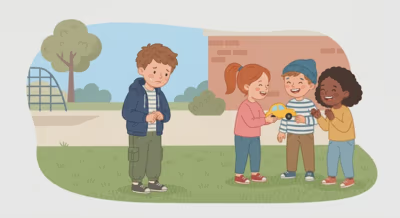
Scenarios like this can be familiar to people on the autism spectrum, especially those who grew up before autism was widely recognized in schools and communities.
When I was in elementary school during the 1980s, teachers and school counselors were not trained to identify children on the autism spectrum in the way many professionals are today.
Back then, I was simply labeled the “odd child.” Some people assumed I was slow, strange, withdrawn, or socially incapable.
Today, I look back and believe it is highly likely that I would have been diagnosed with what was then called Asperger’s syndrome. By the time I sought therapeutic intervention, however, I no longer met the criteria for an autism diagnosis.
That does not mean the challenges were imaginary. It means that development, learning, adaptation, and life experience had changed the way those traits appeared.
People on the autism spectrum may develop at a different pace in certain areas. The process can take longer. Some skills that appear naturally in others may require conscious learning, repetition, and practice.
But taking longer to develop does not mean a person is less intelligent or less capable. In fact, many autistic people grow into exceptionally intelligent, observant, creative, and determined adults.
Delayed Speech and Feeling Trapped Inside
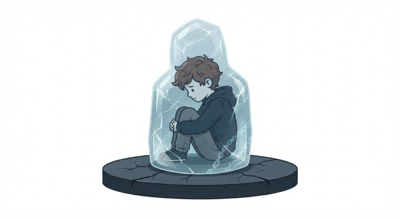
My childhood difficulties were complicated by delayed speech.
I did not begin speaking until I was four years old. Even when I started talking, my speech was difficult to understand. At times, even my parents struggled to comprehend what I was saying.
I spent approximately five years in speech therapy throughout elementary school.
When you cannot communicate clearly, the world can become even more isolating. You may know what you want to say but be unable to express it. You may have thoughts, feelings, questions, and ideas trapped inside you, with no reliable way to communicate them.
Every failed attempt at communication can reinforce the feeling that something is wrong with you. You may begin to expect misunderstanding before you even speak.
“This Is Just the Way You Are”

As I moved into high school, I was told by school counselors and other people:
“This is just the way you are.”
“You are always going to be this way.”
I can still remember the physical impact of hearing those words.
My face began to feel hot and swollen. My nose stung as though I had been slapped. I felt myself falling into the depths of despair.
But then something else rose from deep inside me: defiance, anger, determination.
I rejected those words with everything inside me.
“Bullshit,” I said to myself. “There has to be something out there that can help me. I am going to keep searching until I find it.”
I refused to accept a life defined by painful loneliness. I refused to believe that I would forever feel like a ghost walking among other people—able to see them, but unable to communicate with them.
My heart felt continually shredded, as if a thousand daggers were piercing my soul.
“No more,” I told myself. “I will search everywhere. I will do whatever I can to overcome this.”
Beginning the Search
I spent my first paycheck on therapy. It seemed like a logical place to begin.
And so my journey started.
At the time, I did not understand that the foundation was being laid for something much larger. I did not know that I would eventually transform some of my deepest wounds into sources of strength, knowledge, empathy, and purpose.
I only knew that I could not continue living the way I was living. I was determined not to let a diagnosis, challenge, obstacle, or life circumstance dictate how I would live.
Years of Searching

My early attempts centered around traditional therapeutic methods.
I attended talk therapy and weekly counseling. I tried to examine my emotions, behaviors, and patterns through the lens of the conscious mind.
I gained some useful insights. I learned more about eye contact and began to understand body language somewhat better. I became more aware of social patterns and interpersonal behavior.
But overall, I did not feel that years of therapy had produced the results I wanted. I understood more intellectually, but I did not feel substantially different internally.
I still felt uncomfortable around people. I still felt socially tense. I still carried the painful expectation that I would be rejected, misunderstood, or humiliated.
Eventually, I turned to the internet. I found self-help groups, courses on body language, and material about social anxiety, shyness, communication, emotional patterns, and personal development.
I attended seminars and encountered many different schools of thought about emotions, behavior, personality, and the causes of shyness.
I developed a great deal of intellectual understanding, but understanding alone was not enough. I was building knowledge, but I still had not achieved what I considered satisfying change.
Discovering Hypnosis
At some point, I found hypnosis.
I had encountered the idea earlier in my search, but the images from television and movies influenced how I thought about it. I assumed hypnosis was strange, mysterious, or perhaps even a little frightening.
The problem was that I did not understand what hypnosis really was.
Hypnosis was not a mysterious state that someone else forced me into. It was not mind control. It was not magic. It was not a miracle cure.
Instead, hypnosis was a term used to describe naturally occurring processes—such as focused attention, absorption, imagination, expectation, emotion, and suggestion—that people experience in everyday life.
Hypnosis uses these processes purposefully for personal growth and change.
Hypnosis Happens in Everyday Life

When you become deeply absorbed in a movie, your attention becomes highly focused. You are emotionally engaged in the story rather than actively questioning and scrutinizing every detail.
You may know that the movie is fictional, but your emotional responses can still be real.
A similar process can occur during an argument. Your attention becomes focused on anger, threat, injustice, or the words being exchanged. As the emotional intensity rises, it can become more difficult to think clearly or respond rationally.
Being in love can also involve a highly focused state. The words and actions of the person you love may affect you deeply, while those same words or actions from a stranger might have little impact.
These are ordinary human experiences involving attention, emotion, expectation, and responsiveness.
Hypnosis is not a magical state. It is a structured way of using these natural processes to support inner change and transformation.
Setting the Critical Voice Aside
Hypnosis does not mean surrendering control.
It does not mean someone else takes over your mind. It does not compel you to do something against your values. It does not force you to become a different person.
Hypnosis can help you gently set aside the critical and doubting part of your mind—the part that says:
- “I cannot do that.”
- “That is impossible.”
- “I am not worthy.”
- “I will never get this.”
- “I am always going to be this way.”
- “Nothing will work for me.”
When that automatic resistance becomes quieter, you may be able to examine your thoughts, beliefs, emotions, and patterns from a more objective perspective.
You may become more open to helpful ideas, strategies, imagery, and possibilities that would normally be rejected immediately.
In reality, you move through versions of this process every day. You simply may not think of it as hypnosis.
Hypnosis is a term used to describe deliberately applying these natural human processes toward personal growth, emotional change, and transformation.
Why I Chose the 5-PATH Approach
When I discovered hypnosis, I did not approach it blindly.
I researched different theories, methods, and schools of hypnosis. Eventually, I chose to study the 5-PATH approach because it was one of the structured hypnosis systems I found that approached personal issues systematically.
It offered a thorough process for addressing multiple aspects of a problem rather than relying on a one-size-fits-all suggestion or a single-session promise.
There are many schools and philosophies of hypnosis. Some are thoughtful and effective; others are less comprehensive.
Because of this, the skill, training, judgment, and quality of the hypnotist matter more than choosing a bargain session or searching for a one-session miracle cure.
There is no miracle cure. But there are effective ways to support meaningful and sometimes rapid change.
Hypnosis Was the Turning Point

Hypnosis became a turning point for me.
For the first time, I was able to examine and release some of the old emotions, beliefs, and patterns associated with my painful shyness.
The change was like night and day.
It was not an instant transformation in which I suddenly became a completely different person. The change developed throughout the hypnosis process, and some of the earliest changes were subtle.
I began responding differently to situations without always realizing it at first.
I became more comfortable around people. I felt less tense. I did not experience the same level of fear and panic in social situations.
The difference was not that hypnosis forced me to become sociable. The difference was that I no longer felt trapped by the same emotional reactions.
Hypnosis Restored Choice
I am still relatively quiet and reserved.
Hypnosis did not turn me into a social butterfly. It did not compel me to seek out people constantly or make me enjoy every social situation.
What changed was how I felt around people.
Before hypnosis, I often felt fearful, tense, shy, frozen, or desperate to escape. Afterward, I felt more comfortable and at ease.
I could choose whether I wanted to socialize or spend time alone. I could decide whether to speak or remain quiet without being controlled by overwhelming panic.
That distinction is important. Hypnosis is not about forcing a particular personality or behavior; it is about restoring choice.
The Problem With Overpowering Emotional States
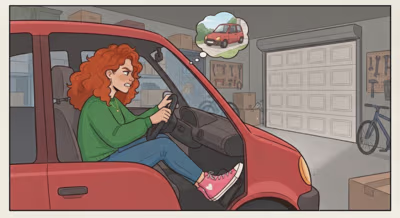
One mistake people often make when trying to solve personal problems is attempting to overpower one emotional state with another.
For example, someone experiencing shyness or social anxiety may try to override fear with confidence.
That can work temporarily, but it requires artificial energy. It requires maintaining the confident state and remaining constantly vigilant. You have to stay on guard.
I know what that feels like because I tried it myself. Eventually, the artificial confidence fades, and the original emotional response returns.
Hypnosis offered a different approach. Rather than forcing confidence over fear, hypnosis helped me release some of the old emotions, beliefs, and patterns that were driving the fear in the first place.
When the original emotional drivers are no longer as powerful, you do not need to maintain an artificial state to overpower them.
From Client to Hypnotist
My experience with hypnosis changed the direction of my life.
After hypnosis helped me overcome a lifelong struggle with painful shyness and extreme loneliness, I became inspired to become a hypnotist myself.
I spent a very cold winter in 2005 at the Banyan Hypnosis Center for Training & Services in Moundsville, Minnesota. There, I learned to become a hypnotist and passed my initial examination to become a National Guild of Hypnotists Certified Hypnotist.
After two years of professional practice, supervision, and peer-to-peer education, I studied for and passed the National Guild of Hypnotists Board Certified Hypnotist examination.
I founded the Baltimore Hypnosis Center in Gambrills, Maryland, where I practiced from 2005 through 2009. Eventually, life circumstances led me to South Jersey.
During my years of practice, I helped clients with concerns including:
- Shyness
- Social anxiety
- Weight loss
- Smoking cessation
- Emotional patterns
- Personal development
- Behavioral change
- Other unique and deeply personal challenges
You can read more about my experience at the Baltimore Hypnosis Center on my Professional Experience page. You can also browse testimonials from that period on my Testimonials page.
Hypnosis Helped With Comfort—But I Still Needed Skills

Hypnosis helped me feel comfortable around people and in social situations. The emotional education I gained through my own experiences also helped me understand and incorporate emotional intelligence into my daily life.
But hypnosis did not automatically teach me every practical communication skill. Feeling comfortable speaking to people and knowing how to structure an effective speech are not the same thing.
While working at Comcast in Center City Philadelphia, I joined my company's chapter of Toastmasters International. Toastmasters is a supportive organization that helps members improve public speaking and leadership skills through structured practice.
At that time, I completed the ten-speech Competent Communicator program and received my Competent Communicator award from Toastmasters International in 2016.
Hypnosis gave me the ability to feel comfortable speaking in front of groups. Toastmasters gave me practical communication skills and helped me learn how to structure and deliver effective speeches. Both were valuable, but they addressed different parts of the problem.
What Hypnosis Can and Cannot Do
Hypnosis helped me become more comfortable, but it did not erase my personality.
I am still somewhat quiet and reserved. I still enjoy time alone. I am not constantly seeking attention or social activity.
What hypnosis changed was the emotional burden attached to social interaction. It helped reduce the fear, tension, and sense of being trapped that had dominated my earlier experiences.
It also gave me room to learn. Once I was no longer overwhelmed by panic, I could focus on developing practical skills—such as communication, public speaking, reading social situations, and emotional intelligence.
This is an important distinction. Hypnosis may help reduce emotional barriers, but it does not eliminate the need to learn, practice, communicate, or make choices.
From Painful Loneliness to Purpose
As a child, I was painfully shy, lonely, and isolated from others. I spent years trying to understand why connection seemed so easy for everyone else and so difficult for me.
Through relentless determination, research, therapy, education, personal development, hypnosis, and practical experience, I became familiar with many different approaches to change and transformation.
The pain did not disappear from my history. Instead, it became part of what helped me understand other people who feel trapped inside themselves.
I know what it is like to desperately want connection but feel unable to reach for it. I know what it is like to feel betrayed by your own mind and body. I know what it is like to believe that you are permanently defective because someone tells you, “This is just the way you are.”
And I know what it is like to discover that change may still be possible.
Your Past Does Not Have to Dictate Your Future
Your diagnosis, childhood, social history, challenges, or past experiences do not have to dictate the rest of your life.
That does not mean change is always easy. It does not mean every difficulty disappears. It does not mean hypnosis is a miracle cure or that one approach works for everyone.
It means that a diagnosis is not the same as a life sentence. A challenge is not the same as an identity. A painful past is not a guarantee of a painful future.
Sometimes change begins with a refusal to accept the idea that you are permanently stuck.
Sometimes it begins with a question: “What else is possible?”
Moving Forward
I would not be the person I am today without the challenges I faced as a child. My deepest wounds eventually became sources of strength, determination, empathy, and professional purpose.
Hypnosis helped me feel comfortable around people. Therapy and personal development helped me understand myself. Toastmasters helped me build practical communication skills. Continued learning helped me combine different approaches into a broader understanding of behavioral and emotional change.
No single method did everything. Each approach contributed something important.
If you struggle with extreme shyness, social anxiety, social awkwardness, painful loneliness, or difficulty connecting with others, you do not have to assume that you will always feel this way.
You may benefit from therapy, social skills training, mindfulness, communication practice, medical support, behavioral approaches, hypnosis, or a combination of different tools.
The most important thing is not finding one perfect system. It is finding an approach that helps you move forward.
If you are facing challenges with shyness, social anxiety, confidence, communication, or emotional patterns, then Contact me to discuss how I may be able to help.

About The Author
Adam Fistler is a Behavioral Change Consultant, Board Certified Hypnotist, Certified 5-PATH® Hypnotist, and former owner of the Baltimore Hypnosis Center. A member of the International 5-PATH® Hypnosis Association and certified by the National Guild of Hypnotists, Adam has studied hypnosis, behavior change, and the relationship between thoughts, beliefs, emotions, and behavior for more than two decades.
His perspective is shaped by more than professional training. Adam has also lived through addiction and recovery firsthand across South Jersey and the Philadelphia region, including surviving on the streets of Camden. This gives him a deeply personal understanding of the struggle from both sides: as a practitioner who has helped others create change and as someone who has had to confront his own deeply ingrained patterns and beliefs.
During his own recovery, Adam returned to the principles of hypnosis, mindfulness, self-talk, and behavioral change that he had studied throughout his career. He discovered that recovery could be about more than simply managing cravings or avoiding relapse—it could also be an opportunity to understand the beliefs, emotional patterns, and experiences that had shaped his behavior.
Today, Adam combines his professional experience with the lessons of his own journey to serve clients throughout South Jersey, Philadelphia, and beyond, helping others explore the possibility of meaningful, lasting change. His approach is grounded in empathy, curiosity, practical tools, and the belief that people are more than the behaviors they are trying to overcome.
Learn my Personal Story
Contact Adam Fistler, BCH - Behavorial Change Consultant
Early Childhood: Struggles With Extreme, Painful Shyness and Social Awkwardness
The Next Challenge: From Family Man to Addiction and Recovery
Recovery Was Not a Straight Line: From Repeated Rehab to Rebuilding My Life
Reclaiming My Identity: Rediscovering Hypnosis in a South Jersey Rehab
Discussion