Your Addiction or Unwanted Behaviors Aren’t Broken Code — They’re Legacy Code
Author: Adam Fistler, BCH - Behavorial Change Consultant ( adam@adamfistler.com )
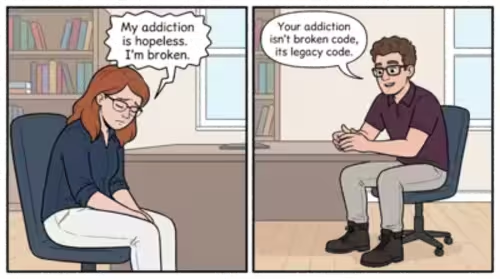
When you inherit an old software system, you often encounter code that makes no obvious sense.
There may be a strange workaround buried deep in the program:
          if condition_x:
               do_weird_thing()
Your first reaction might be:
“Why the hell is this here?”
But an experienced programmer knows not to delete unexplained code immediately. Before changing it, they ask:
“What problem was this originally solving?”
Maybe the system used to crash under a certain condition. Maybe someone added the code during an emergency. Maybe it was written at 2:47 in the morning, when the priority was not elegance but keeping the system running.
The patch worked.
So it stayed.
Over time, other parts of the system began depending on it. The original programmer left. The original problem changed or disappeared. Eventually, nobody remembered exactly why the code existed—but removing it still risked breaking something else.
That is legacy code.
Addiction and other unwanted behaviors can develop in much the same way.
Not because human beings are literally computers, and not because people can be reduced to software. The comparison is useful because it gives us a way to think about how behaviors develop, become reinforced, accumulate dependencies, and eventually become harmful.
It invites a different question.
Instead of asking:
“Why do you keep doing this when you know it is hurting you?”
we might ask:
“What problem was this behavior originally trying to solve?”
The 2:47 a.m. production patch
Many unwanted behaviors do not begin as obvious problems.
They begin as solutions.
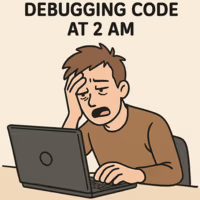
A person encounters something they do not know how to manage. They may feel overwhelmed, anxiou2am Debugging Sessions, lonely, angry, frightened, or emotionally trapped. They may have experienced something painful without having the resources or support to process it.
Then they discover a behavior that changes something.
It may provide relief. It may quiet intrusive thoughts, reduce anxiety, create emotional distance, offer stimulation, produce confidence, or make an unbearable situation temporarily tolerable.
The behavior may not be healthy. It may not be sustainable. It may eventually become destructive.
But at the time, it does something useful.
The brain learns:
This works.
When the behavior is repeated, the association becomes stronger. A particular emotional state, thought, environment, or situation begins to activate the behavior automatically. What started as a conscious workaround gradually becomes part of the system’s normal operation.
Years later, the person may look at the behavior and ask:
“Why do I keep doing this?”
That question resembles the programmer inheriting unexplained legacy code.
The behavior may no longer fit the person’s life. It may now create problems rather than solve them. But it remains available because it was reinforced, practiced, and incorporated into the larger system.
Do not confuse the behavior with its function
One of the easiest mistakes is to judge a behavior only by its current consequences.
A behavior can be harmful and still have served a function.
Understanding that function is not the same as approving of the behavior. It is the difference between excusing a problem and investigating it accurately.
If someone uses a substance to regulate overwhelming emotions, removing the substance does not automatically remove the emotions.
If someone uses a behavior to escape painful thoughts, eliminating the behavior does not necessarily eliminate what they were trying to escape.
If someone repeatedly enters destructive relationships because those relationships provide familiarity, validation, or temporary relief from loneliness, simply telling them to choose better relationships does not explain what the pattern is doing for them.
The behavior may be the visible problem. Its function may be hidden underneath.
So instead of asking only:
“How do we stop this behavior?”
we can also ask:
“What functionality does this behavior provide?”
What feeling does it change? What does it help the person avoid? What does it make possible, at least temporarily? What expectation has been reinforced?
Until those questions are addressed, removing the behavior may leave the underlying need intact.
When the original problem changes

Legacy code often remains long after the conditions that created it have disappeared.
The same can happen with human behavior.
A person may leave a difficult environment, become safer, grow older, develop new resources, or enter a different stage of life. The original problem may no longer exist in the same form.
But the behavior remains.
This can be deeply confusing. Someone may think:
“My life is different now. Why am I still doing this?”
One answer is:
The code is still there.
The nervous system learned a pattern. The pattern became familiar. It may now be activated by reminders, emotional states, or situations that resemble the original circumstances—even when the current situation is objectively different.
The original purpose may be forgotten, but the response remains available.
This is one reason knowledge alone is often insufficient. A person may understand perfectly well that a behavior is harmful and still feel compelled to repeat it.
The problem is not necessarily a lack of information. The behavior may be operating as an old, deeply reinforced process.
Dependencies accumulate
Unwanted behaviors rarely remain isolated.
Like a piece of legacy software, they can develop dependencies throughout the system.
A behavior may become connected to:
- emotional regulation
- daily routines
- beliefs about the self
- expectations about other people
- relationships
- physical environments
- social groups
- sleep and eating patterns
- other behaviors
- memories and learned associations
Eventually, other parts of life may organize themselves around the behavior.
That is why removing it is not always the same as solving the problem.
If a behavior has been regulating emotion, filling time, creating social connection, managing fear, or providing a sense of control, its absence may expose functions that were never replaced.
This is also why a person can stop one behavior and quickly find another taking its place. The system still has a need. It looks for another process capable of meeting it.
The crucial question becomes:
What needs to replace the functionality this behavior was providing?
A replacement does not have to feel identical. It does, however, need to address the underlying requirement well enough for the system to remain stable.
Investigating the system

A useful investigation might ask:
- What problem was this behavior originally solving?
- What does it accomplish now?
- What tends to trigger it?
- What does the person expect it to do?
- What feeling does it change?
- What beliefs support it?
- What routines or relationships depend on it?
- What would happen if it disappeared tomorrow?
- What skills, supports, or environmental changes would need to replace it?
These questions are not intended to turn a person into a mechanical object.
They are intended to replace vague self-condemnation with usable information.
A programmer who discovers a dangerous function does not learn more by shouting at the code. They learn more by examining its inputs, outputs, dependencies, and failure conditions.
The same principle can apply to behavior. Curiosity may reveal information that shame conceals.
The danger of rebuilding everything at once
When people decide to change, they often try to change their entire lives simultaneously.
They stop the unwanted behavior. They change their friends. They repair relationships. They find a new job. They start exercising, meditating, journaling, eating differently, sleeping better, managing their finances, and becoming an entirely new person.
Sometimes a dramatic reset is necessary. But changing everything at once creates a technical problem: it becomes difficult to know which change produced which result.
If the system improves, you may not know why. If it becomes unstable, you may not know what caused the failure.
A wholesale personal refactor can also create unrealistic expectations. When one part of the plan fails, the person may interpret the setback as proof that the entire effort has failed.
A more sustainable approach is often incremental:
- Identify a problem.
- Make one manageable change.
- Observe what happens.
- Learn from the result.
- Adjust the approach.
- Stabilize the improvement.
- Continue from there.
This may feel slower than a complete reinvention. But it allows the person to learn how their own system responds to change.
You do not get a maintenance window for your life
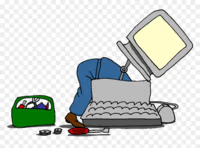
A software system can sometimes be taken offline.
Developers can shut it down, replace components, test a new version, and restart it.
People usually do not get that option.
Change takes place while life continues. There are still responsibilities, relationships, work, financial pressures, physical needs, memories, and emotional reactions.
Recovery is not performed in a perfectly controlled environment. It happens while the system is running.
That means change often has to be iterative:
Identify. Change. Observe. Learn. Adjust. Stabilize. Repeat.
A new behavior may work in one environment but fail in another. A coping strategy may help with anxiety but not loneliness. A plan that seemed realistic may turn out to demand more energy than the person has available.
That is not necessarily evidence of personal failure. It may be information about how the system actually works.
A setback is not the same as losing everything
When software encounters a bug, developers do not automatically discard the entire codebase.
They investigate.
What conditions produced the failure? What assumption was wrong? What dependency was overlooked? What part of the system needs additional support?
Setbacks can be approached similarly.
A setback may reveal:
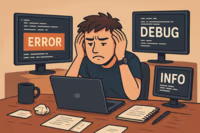
- an unrecognized trigger
- a missing coping mechanism
- an unresolved dependency
- an overly ambitious plan
- an unsafe environment
- a belief that needs reconsideration
- inadequate support
- a replacement behavior that does not perform the required function
This does not mean minimizing consequences. A relapse or harmful action may require repair, accountability, medical attention, or immediate protection from danger.
But a setback does not automatically erase everything learned before it.
The useful question becomes:
“What did this teach me about the system?”
rather than:
“What is wrong with me?”
The interface is not the whole system

The software metaphor has limits.
A person is not a machine waiting to be optimized. Human beings have history, meaning, embodiment, relationships, agency, and dignity.
The metaphor should clarify behavior, not replace the person.
There is also a difference between a person’s conscious explanation and the entire mechanism underlying their behavior.
Someone’s explanation may be accurate, incomplete, or based on what they currently understand. It is information about the system, but it is not necessarily the whole source code.
Automatic associations, emotional learning, bodily states, social conditions, memories, and environmental cues may all contribute.
This is why change sometimes requires more investigation than simply identifying a consciously stated reason.
The visible explanation may be the interface. The deeper pattern may be operating underneath it.
Different problems need different tools
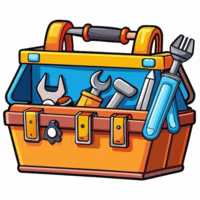
There is no single tool that solves every technical problem.
A screwdriver is not better than a hammer. It is better suited to a different task.
The same is true of recovery and behavior change.
Different approaches may address different layers of the system, including:
- broader therapeutic work
- behavioral techniques
- mindfulness
- medication
- peer support
- recovery programs
- hypnosis
- environmental changes
- medical care
- practical assistance
- community and relationship support
The important question is not:
“Which method is the one true way?”
It is:
“What problem are we actually trying to solve, and what tool fits that problem?”
Some problems require an architectural review: understanding patterns across history, relationships, beliefs, and environment.
Other problems are more like debugging a specific component: identifying a trigger, changing a routine, interrupting an association, or developing a particular skill.
Neither approach is automatically superior.
Sometimes the system needs architectural work. Sometimes it needs targeted debugging. Often, it needs both.
Refactoring instead of rebuilding the person
The goal of change is not necessarily to become a completely different person.
It may be more useful to think of change as refactoring.
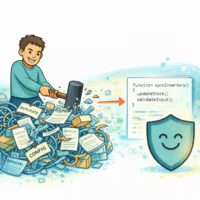
Refactoring means improving the structure and function of an existing system while preserving what works. It can involve:
- keeping useful capabilities
- identifying harmful processes
- replacing ineffective implementations
- building missing functionality
- removing obsolete dependencies
- improving communication between parts of the system
- testing changes gradually
- learning from earlier versions
This approach also makes room for compassion.
Some of the old code may have been written under difficult circumstances. It may have been created by a younger version of the person, one with fewer resources, less information, and fewer choices.
The behavior may have been the best solution available at the time.
That does not mean it must remain the best solution forever.
An adaptation can be understandable and still require change. A behavior can once have been protective and later become destructive. Recognizing its original purpose does not require preserving it indefinitely.
You may not be broken
Some people spend years treating unwanted behaviors as evidence of a fundamental defect.
They conclude that they are weak, damaged, irrational, or incapable of change.
But perhaps another description is more useful.
Perhaps they are running legacy software.

Some of that code is useful. Some is outdated. Some was written under difficult circumstances. Some was never documented. Some has dependencies nobody remembers. Some began as a desperate workaround.
And some may now be causing the very problems it was originally created to solve.
The answer is not necessarily to hate the old code.
It is to understand it.
Ask what it was protecting, regulating, avoiding, or providing. Identify what still depends on it. Build the missing functionality. Replace harmful processes with more effective ones. Make changes carefully enough that the rest of the system can adapt.
The central progression is:
“Why do you keep doing this?”
becomes
“What problem was this solving?”
then
“What dependencies did it create?”
then
“What needs to replace it?”
and finally
“How do we refactor it while life keeps running?”
You may not be broken.
You may be carrying old code that once helped you survive.
Now the work is learning how to update it.
Contact meExplore my Addiction & Recovery Resources
Contact Adam Fistler, BCH - Behavorial Change Consultant
Examine an Overview of Addiction, Substance Abuse & Recovery
The Slow Descent: How Addiction Hijacks the Mind, Body, and Survival System
Learn more about my Addiction, Substance Abuse & Recovery Services
Discover how Hypnosis aids with Addiction & Recovery
Rethinking Recovery: The Science, Stigma, and Advocacy of The Sinclair Method
Addiction Is Not a Moral Failure: Celebrities and Their Struggles with Addiction
Explore my Addiction & Recovery Articles
Review a List of All My Addiction & Recovery Articles
Neurotransmitters and Neurochemistry in Addiction
Endorphins, Pain, Mood, and Addiction: Understanding the Endogenous Opioid System
Your Addiction Isn't Broken Code - It's Legacy Code
Societal Lockout: When Rebuilding a Life Becomes One Roadblock After Another