
The Mechanics of Infidelity: A Neurochemical, Psychological, and Biological Map
Author: Adam Fistler, Behavioral Systems Analyst ( adam@adamfistler.com )
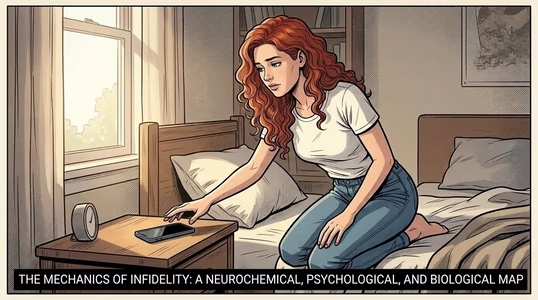
A phone lies face down on the table. The screen lights, goes dark, lights again. Its owner carries it into the bathroom. The password changes. A work meeting appears where there was once an ordinary evening. The other partner notices the altered rhythm before having proof: shortened answers, guarded posture, new distance in the bed.
Then the discovery arrives.
A message thread. A deleted conversation recovered from a backup. A name that appears too often. The facts are incomplete, but the body does not wait for a complete report. The stomach contracts. The heart accelerates. Muscles tighten. Attention narrows around the threat.
The relationship has not merely acquired a secret. Its information system has failed.
What follows is a map of that failure: the psychology, biology, and neurochemistry involved in cheating, concealment, discovery, surveillance, retaliation, trauma bonding, attempted reconciliation, and recovery. The purpose is not to excuse anyone. A mechanism is not a defense. Knowing why a person cheats does not make the cheating less deliberate. Knowing why someone stays does not make them weak.
The body is adapting to incomplete information. Sometimes those adaptations keep a person alive. In a damaged relationship, they can also keep the person trapped.
The Relationship Begins as a Shared Prediction System

A relationship depends on more than affection. It depends on prediction.
Each person makes decisions based on what the other says, what the other does, and whether those two streams generally match. Where are you? Who are you talking to? What do you want? Are we exclusive? Are you still committed?
These are not administrative details. They are the inputs used to construct a shared life.
The brain is a prediction engine. It does not passively record reality. It gathers signals, compares them with stored patterns, and estimates what will happen next. Trust means the brain can make those estimates without spending excessive energy on threat detection.
When a partner is generally consistent, the nervous system lowers its guard. Heart rate, muscle tension, attention, and stress hormones return to ordinary levels. The brain does not need to inspect every delay, facial expression, or change in routine.
This is not blindness. It is energy conservation.
A stable relationship allows the prefrontal cortex—the part of the brain involved in planning, judgment, and impulse control—to operate without constant interference from threat systems. The amygdala still detects danger when necessary, but it is not running the entire process.
Infidelity changes that arrangement.
The First Deception: Why Someone Begins Hiding

The unfaithful partner does not necessarily begin with a grand decision to destroy the relationship. The sequence may start with a message, a flirtation, a private fantasy, or an opportunity that appears harmless.
The internal process often includes several elements:
- desire for novelty,
- need for validation,
- resentment,
- entitlement,
- avoidance of direct conflict,
- poor impulse control,
- fear of aging or rejection,
- inability to tolerate ordinary emotional discomfort,
- or a wish to maintain multiple sources of attention.
Neurochemistry
Novelty and uncertain reward activate the brain’s reward-learning systems. Dopamine is involved less in simple pleasure than in motivation, pursuit, salience, and reward prediction. An uncertain message can be more stimulating than a predictable affectionate one because the brain does not yet know what it will receive.
The person waits for a response. The phone vibrates. Anticipation rises. A flattering message arrives. The reward system marks the interaction as important.
Adrenaline and norepinephrine may increase alertness and energy. Sexual arousal can involve dopamine, norepinephrine, endogenous opioids, and changes in autonomic activation. The exact neurochemical pattern varies by person, but the general system is clear: novelty makes attention narrow around the new source.
Psychology
The person may create a mental separation:
- “It is only texting.”
- “Nothing physical has happened.”
- “I am allowed to have friends.”
- “My relationship is already unhappy.”
- “I can stop whenever I want.”
This is cognitive compartmentalization. The person divides conflicting facts into separate mental rooms so they do not have to experience the full contradiction at once.
They may still see themselves as loyal while behaving disloyally. To preserve that self-image, they redefine the boundary instead of confronting the behavior.
Biology
The body follows the reward signal. Attention becomes biased toward the new person. Time spent thinking about the interaction increases. Ordinary tasks become interruptions. The brain begins assigning importance to cues associated with the affair: a notification sound, a particular time of day, a place where messages are exchanged.
The more often the sequence repeats, the more automatic it becomes:
Cue → anticipation → contact → reward → renewed pursuit
This is not necessarily chemical addiction in the clinical sense. It is a reinforcement loop. Repeated behavior becomes easier to initiate because the brain has learned the path.
Why Some People Need Multiple Sources of Validation
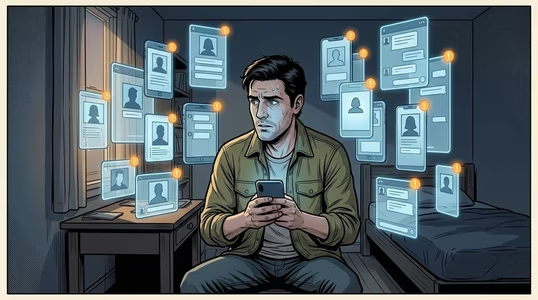
Some people do not pursue one affair. They maintain several hidden conversations, flirtations, profiles, or potential partners.
The structure resembles an attention portfolio. If one person becomes distant, another remains available. The goal is not always to form a new relationship. It may be to prevent the internal sensation of being unwanted.
Neurochemistry
Each new source creates intermittent reward. One person replies quickly. Another disappears and returns later. A third provides sexual attention. Unpredictable rewards are especially effective at maintaining pursuit because the brain keeps checking for the next payoff.
Dopamine is involved in the seeking behavior. The person may feel restless when no messages arrive, then temporarily regulated when attention returns. Over time, external responses become used as rapid corrections for internal discomfort.
Psychology
The underlying belief may be:
If someone wants me, I am real. If nobody wants me, I disappear.
This can produce compulsive self-expansion. The person keeps several mirrors available because one mirror is never enough for long.
They may also fear dependence on one partner. Multiple sources of attention create emotional redundancy. If one relationship fails, the person does not have to experience a complete collapse of self-worth.
Biology
The body learns to associate quiet with threat. Silence becomes a withdrawal-like state—not necessarily from a substance, but from the stimulation and anticipation that have become regulatory.
The person may become more irritable, bored, or empty when attention is unavailable. They then interpret the discomfort as proof that they need another conversation rather than evidence that their reward system has been trained to expect constant external input.
Why Stable Love Can Feel Empty to a Person Trained on Intensity
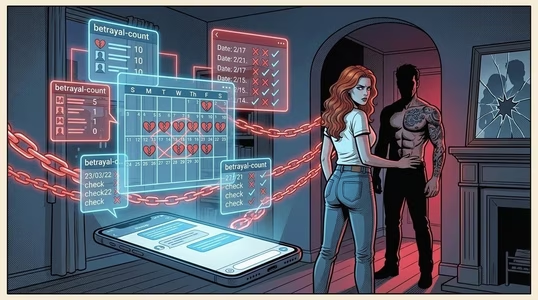
Long-term love usually becomes more predictable. The early uncertainty decreases. The partner’s reactions become familiar. The relationship may become calmer and less theatrical.
For a regulated person, this can feel like safety.
For a person trained to associate arousal with attraction, calm can feel like loss.
Neurochemistry
Early-stage attraction often involves heightened dopamine, norepinephrine, attention, fantasy, and physiological arousal. Novelty and uncertainty amplify these effects.
Over time, the reward response to familiar stimuli generally becomes less intense. This is ordinary adaptation. The brain does not keep responding to every repeated event as if it were new.
That reduction in intensity is not the disappearance of love. It is the nervous system no longer treating the partner as an unknown object.
A person who depends on high stimulation may interpret this ordinary adaptation as evidence that the relationship is dead. They then seek a new person to restart the high-voltage phase.
Psychology
The person may hold a faulty equation:
Intensity = Love
But intensity can also mean uncertainty, fear, competition, novelty, or threat.
A stable relationship asks for sustained behavior after the initial reward falls. That requires frustration tolerance, honesty, and the ability to experience ordinary life without manufacturing a crisis.
Biology
A calm environment reduces stress activation. That is good for the body, but it may feel unfamiliar to a system conditioned by volatility. If the person has spent years using pursuit and sexual novelty to regulate emotion, peace may initially register as numbness.
The problem is not that peace lacks chemistry. The problem is that the person’s attention has been trained to notice spikes rather than baselines.
Why the Cheater Often Wants to Keep the Primary Relationship
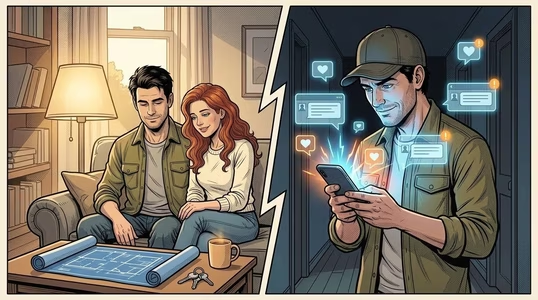
The unfaithful partner may not want to leave. The primary relationship provides structure.
It may include shared housing, money, domestic labor, childcare, emotional familiarity, social legitimacy, healthcare, or a stable identity. The outside relationship provides novelty and affirmation. The two systems serve different functions.
Psychology
This is compartmentalization combined with avoidance.
The person wants the rewards of commitment without accepting the limitations of commitment. They want security and freedom, but define freedom as freedom from accountability rather than freedom through honest agreement.
Leaving would require a direct choice. Direct choices produce consequences. Concealment delays the consequences.
The person may also fear discovering that the outside relationship cannot support a full life. The affair is exciting partly because it is protected from ordinary responsibility. Once it becomes a household, its novelty may decline.
Neurochemistry
The primary relationship may provide bonding, familiarity, comfort, and reduced threat. The outside relationship provides novelty and reward anticipation. The person alternates between systems, receiving different forms of regulation from each.
This creates a divided reinforcement structure:
Primary partner → security and infrastructure
Outside partner → novelty and validation
The person may experience each as necessary while refusing to admit that the arrangement depends on deception.
Biology
Maintaining two realities requires cognitive effort. The person must remember what was said to whom, conceal messages, invent explanations, and control emotional leakage. Chronic concealment can produce stress, but the person may accept that cost because the immediate rewards remain available.
The body does not automatically convert stress into honesty. People can live in contradiction for years if the short-term payoff continues.
Discovery: The Body Enters Threat Mode
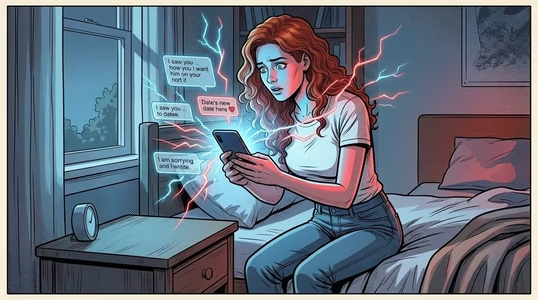
The discovery may happen through a confession, a message, a phone record, a third party, or a pattern that finally becomes undeniable.
The nervous system reacts before the mind has completed its interpretation.
Neurochemistry
The amygdala identifies a major threat. The sympathetic nervous system activates. Adrenaline and norepinephrine increase heart rate, blood flow to large muscles, vigilance, and readiness for action. Cortisol follows through activation of the hypothalamic-pituitary-adrenal axis.
The body may shake, sweat, vomit, freeze, or become numb. Some people experience racing thoughts. Others experience mental blankness.
This is not a moral failure or a lack of love. It is an emergency response to a sudden collapse of expected reality.
Psychology
The mind tries to answer several questions at once:
- What happened?
- How long has it been happening?
- Who knew?
- What else is hidden?
- Was anything real?
- Am I in immediate danger?
- What do I do now?
The brain is attempting to update its model while the stress system is impairing working memory and flexible reasoning. This is why a person may remember certain details vividly and lose access to others.
Biology
High stress can affect sleep, appetite, digestion, pain sensitivity, immune function, and concentration. The body reallocates resources toward immediate threat response. Long-term planning becomes harder because the system is prioritizing survival.
The person may feel compelled to obtain every detail immediately. That urgency is partly biological. The brain is trying to close the uncertainty gap.
The Reality Audit
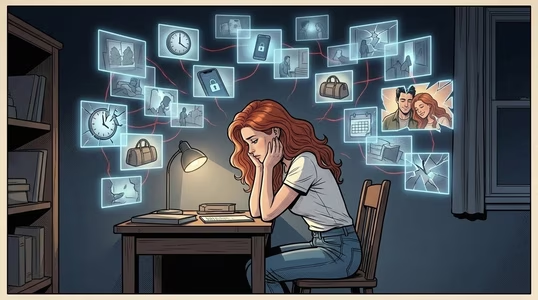
After discovery, the betrayed partner often replays the entire relationship.
The weekend trip. The late arrival. The changed password. The sudden interest in appearance. The night the partner said they were tired.
Every memory is reopened.
Neurochemistry and biology
Stress hormones interfere with normal memory integration. The hippocampus helps organize events in time and context, while the amygdala assigns emotional significance. Under severe stress, the emotional system may dominate the narrative system.
This can leave memories vivid in sensation but disorganized in sequence. A smell, ringtone, location, or phrase may reactivate the bodily response associated with the betrayal.
This does not mean that every traumatic memory is perfectly preserved or that every recollection is automatically accurate. It means that high arousal can alter retrieval, attention, and confidence.
Psychology
The person is trying to restore a coherent story. The question is not only “What did they do?” It is “What world was I living in?”
If the past is reclassified entirely as false, the person loses psychological ground. If every good memory becomes contaminated, grief becomes more difficult because there is no stable version of the relationship to mourn.
The mind may also turn inward:
How did I miss this? What is wrong with my judgment?
That is an attempt to regain control. If the betrayal can be explained as personal incompetence, then perhaps the future can be made safe through better vigilance.
Trickle Truth and Repeated Re-Traumatization
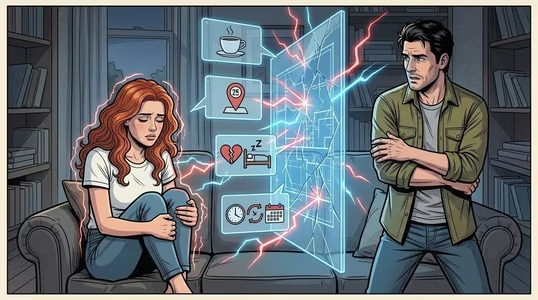
A person who has cheated may disclose the truth in stages.
First: “We only talked.”
Later: “We met once.”
Later: “There was sex.”
Later: “It happened more than once.”
Psychology
Partial disclosure often functions as self-protection. The person wants to reduce immediate consequences, preserve the relationship, or control the other person’s reaction.
But the recipient experiences each disclosure as a new breach. The original event is not processed once. The reality map is repeatedly destroyed.
Neurochemistry
Every new revelation can reactivate the threat system. The amygdala responds to the fresh information as evidence that danger remains present. Cortisol and sympathetic activation rise again.
The person may have briefly begun to regulate after the first disclosure. The second disclosure tells the nervous system that regulation was premature.
Biology
Repeated activation can produce exhaustion. Sleep becomes poor. Appetite changes. Attention narrows. The body remains prepared for another impact.
Trickle truth is therefore not a neutral communication style. It extends the period of uncertainty and prevents the nervous system from establishing a stable baseline.
The Trauma Bond and Intermittent Reinforcement
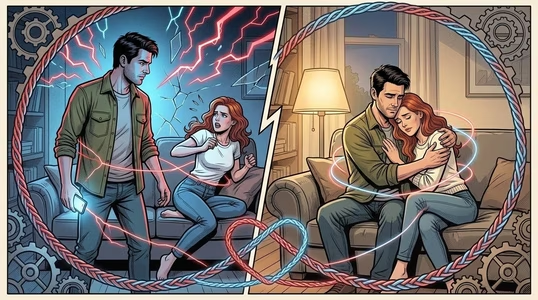
The relationship moves through a repeated sequence:
betrayal → conflict → apology → affection → temporary calm → new betrayal
This pattern can create unusually strong attachment.
Neurochemistry
Dopamine is involved in anticipation and reward prediction. When affection follows deprivation, the relief can be intense. The reward is not only the affection itself. It is the sudden end of uncertainty.
Endogenous opioids may reduce distress. Oxytocin and other bonding-related processes may become associated with reconciliation, touch, sex, and emotional repair. Stress hormones fall as the immediate conflict ends.
The body learns a dangerous association:
same person → pain → same person → relief
The person causing the alarm also becomes the person who appears to turn it off.
Psychology
The betrayed partner may begin waiting for the good version of the other person to return. The relationship becomes organized around potential rather than consistent behavior.
The apology is treated as evidence of the partner’s true nature. The betrayal is treated as an exception. Then the next betrayal requires a new explanation.
Biology
The nervous system can become accustomed to high arousal. Stillness may begin to feel suspicious. Calm may feel like the silence before the next discovery.
This is not proof that the person “likes drama.” It is conditioning. The body has learned that attention is required in order to detect danger.
Hypervigilance
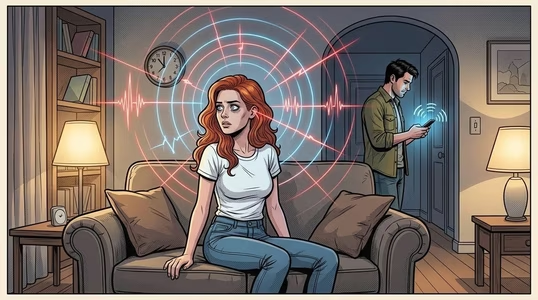
The betrayed partner begins scanning.
A notification sound. A changed tone. A delayed reply. A shower immediately after arriving home. A phone held at a different angle.
Neurochemistry
The threat-detection system remains partially activated. Norepinephrine increases alertness. Cortisol supports prolonged readiness but can become damaging when sustained. Attention is drawn toward ambiguous signals because the cost of missing another betrayal feels high.
The brain begins to favor false positives:
better to mistake safety for danger than danger for safety
That rule may be useful in a dangerous environment. It is exhausting in ordinary life.
Psychology
Hypervigilance creates the illusion that enough observation will produce certainty. The person believes that if they inspect every detail, betrayal can be prevented.
This is a control strategy built on damaged trust. It is not irrational in origin. It is simply unable to solve the problem it is being used against.
A person cannot inspect another adult into becoming honest.
Biology
Sustained arousal can disturb sleep, digestion, concentration, sexual function, and immune regulation. The body pays for continuous monitoring. The person may become irritable, detached, exhausted, or unable to experience pleasure that is unrelated to the relationship.
Their life becomes a background process serving the investigation.
Surveillance and Restriction
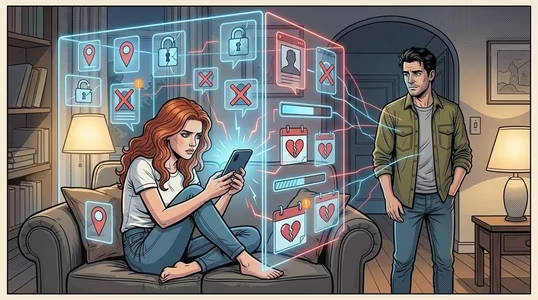
The betrayed partner may demand passwords, track location, block contacts, restrict movement, inspect devices, or forbid friendships.
Psychology
The internal calculation is:
If I control the conditions, I can prevent the outcome.
This creates temporary relief. The person has an action to perform. They are no longer waiting passively.
But the relationship has changed into a prison system. One person monitors; the other performs compliance or searches for a way around the controls.
Neurochemistry
Checking can reduce anxiety briefly. That reduction reinforces the checking behavior. The sequence becomes:
anxiety → check phone → temporary relief
Because the relief is immediate, the brain learns to check again whenever uncertainty rises. This resembles other negative-reinforcement loops: the behavior continues because it removes distress for a short time.
Biology
The checking behavior keeps attention tied to threat cues. Each audit may produce another stress spike, followed by brief relief. The body never learns that it can tolerate uncertainty without inspection.
Fidelity obtained through coercion is not trust. It is monitored behavior.
A relationship may use temporary transparency after betrayal, but the aim must be movement toward voluntary honesty—not permanent captivity.
Retaliatory Cheating
The betrayed partner may decide to cheat in return.
The thought is often: I will not wait helplessly for the next humiliation. I will take control of the damage.
Psychology
Revenge cheating converts passive injury into active injury. The person may feel that participation restores power.
It can also externalize rage. Instead of remaining the person who was betrayed, they become an agent of destruction. For a short period, that may feel preferable.
Neurochemistry
Rage activates sympathetic arousal. Adrenaline, norepinephrine, and dopamine can combine with the anticipation of revenge. The third party becomes a tool for producing an emotional effect in the original partner.
The act may produce temporary excitement or relief. Those effects fade.
Biology
After the arousal falls, the person may experience shame, anxiety, disgust, or emotional collapse. The body now carries two conflicts: the original betrayal and the violation of its own standards.
System effect
The original cheater gains a counter-narrative:
“You did it too.”
The relationship becomes a mutual grievance exchange. Both people now possess evidence they can use to justify continued harm. Retaliation does not restore symmetry. It creates mutual entrapment.
Why the Savior Role Fails
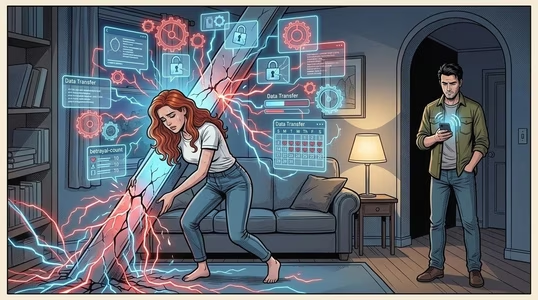
The savior believes that enough care can change the cheater.
They study the partner’s childhood, explain the attachment style, forgive the lies, monitor the triggers, absorb the consequences, and try to become impossible to abandon.
Psychology
The savior role provides a sense of purpose and superiority over the chaos. The person becomes the healer, the exception, the one who understands.
This can function as avoidance. Focusing on the other person’s damage prevents contact with one’s own loneliness, fear, or unmet needs.
The hidden contract is:
I will make myself indispensable, and you will become safe.
But another adult’s history does not create an obligation to change.
Neurochemistry
Rescue can be rewarding. Moments when the partner improves, apologizes, or returns may create strong reinforcement. The savior experiences relief and interprets it as evidence that the intervention is working.
The reward is intermittent because change is inconsistent. That unpredictability can intensify commitment to the rescue project.
Biology
The savior’s body remains in a state of monitoring and response. Stress activation may coexist with bursts of affection and hope. The result is exhaustion disguised as purpose.
The person is not living beside a partner. They are operating an emergency service.
The Cheater’s Experience of the Savior System
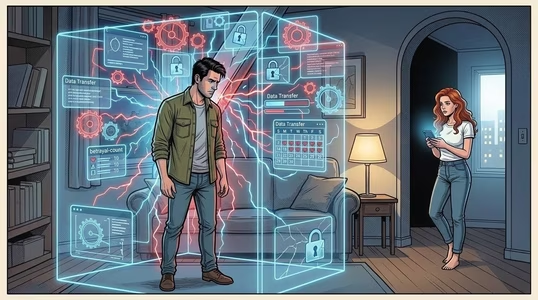
The cheater may initially welcome care, forgiveness, and structure. Later, the arrangement can produce shame or resentment.
One person is cast as the healthy adult. The other is cast as the damaged project.
Psychology
The cheater may feel observed, diagnosed, or morally ranked. Instead of tolerating shame and accepting responsibility, they may seek an outside relationship where they feel unexamined.
Cheating can become a distorted act of autonomy:
You do not own me. I can still operate outside your system.
This is not legitimate freedom. It is secrecy used as a substitute for direct negotiation.
Neurochemistry
If stable attention becomes predictable, it may generate less reward anticipation than uncertain outside attention. The problem is not that the savior is insufficiently loving. The problem is that the cheater has trained their reward system to chase novelty and external confirmation.
No partner can compete indefinitely with an entire novelty machine.
Biology
Repeated pursuit of stimulation can become habitual. The body begins to expect activation, secrecy, and emotional contrast. Ordinary intimacy requires patience and tolerance of lower arousal. If the person refuses that adjustment, they continue searching for spikes.
Why People Stay Trapped
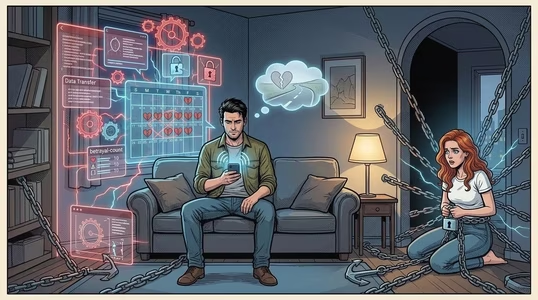
Leaving is a behavioral decision, but behavior is constrained by the body, the mind, and material conditions.
Psychology
The person may be held by:
- fear of being alone,
- sunk costs,
- shame,
- hope,
- social pressure,
- children,
- financial dependence,
- fear of retaliation,
- fear that the betrayal proves personal inadequacy,
- or the belief that one more conversation will finally produce closure.
The person may also be attached to the future they imagined. Leaving requires grieving not only the partner but the expected life.
Neurochemistry
Intermittent reward strengthens persistence. The occasional apology, affectionate night, or period of apparent stability prevents the relationship from becoming psychologically simple.
If the reward were absent, leaving might be easier. The presence of periodic reward keeps the prediction system active.
Biology
Chronic stress can reduce executive capacity. Sleep loss and prolonged arousal make planning, organizing, and decision-making harder. A person may know what they want to do but lack the physiological bandwidth to execute it.
That is why practical support matters. A person cannot solve a material trap with insight alone.
Boundaries, Illusory Boundaries, and Control
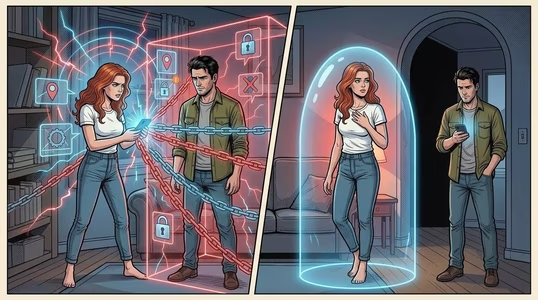
A boundary is a self-directed decision.
It describes what a person will do if a condition occurs.
- “I will not remain in a relationship involving hidden sexual contact.”
- “If you continue communicating with that person secretly, I will separate.”
- “I will not participate in conversations where I am threatened or degraded.”
Control is different:
- “You are forbidden from speaking to anyone attractive.”
- “You must surrender your phone forever.”
- “You are not allowed to leave the house without permission.”
Psychology
Control attempts to eliminate uncertainty by reducing the other person’s options. It may feel safer because it produces visible rules. But it does not create internal commitment.
A boundary accepts a hard fact: the other person is free to choose, and their choice will produce consequences.
Biology
Self-directed boundaries can reduce chronic monitoring because they return decision-making to the person who can actually act. Control keeps the nervous system dependent on the other person’s compliance.
The difference is physiological as well as philosophical:
Control → continuous monitoring
Boundary → clear decision and follow-through
Healing After Betrayal
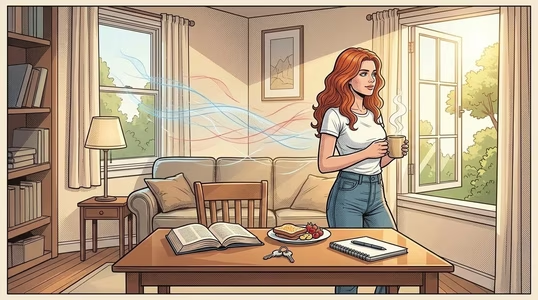
Healing begins when the injured person stops treating the other person’s behavior as the central project.
That may mean leaving, separating, creating physical space, or establishing conditions for continued contact. It may involve restoring sleep, finances, work, friendships, and physical safety.
Neurochemistry
When the person exits repeated conflict and surveillance, sympathetic activation can gradually decrease. This is not immediate. The body may continue to expect danger after the environment changes.
Reward pathways also need time to stop associating the former partner with relief. The absence of contact can feel like withdrawal because the person is losing both the source of pain and the source of intermittent reward.
Psychology
The person must separate memory from instruction.
A memory can say, “This happened.” It does not have to say, “Return to the person who caused it.”
The person may also need to revise beliefs such as:
- I must fix others to be worthy.
- If I leave, I have failed.
- Their behavior determines my value.
- I need total certainty before I can act.
- Love requires endurance without limits.
Biology
Recovery often requires boring physical repetition: sleep, food, movement, daylight, reduced contact with triggers, and predictable routines. The body needs evidence that ordinary life can continue without constant threat.
This is not sentimental healing. It is baseline restoration.
Reconciliation: What the Body and Mind Require
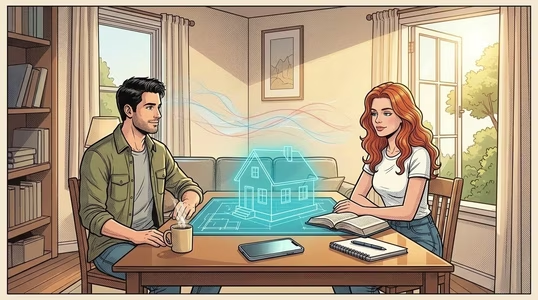
Reconciliation is possible in some cases, but it is not a return to the previous relationship. The previous structure has been destroyed.
A new relationship requires:
- complete termination of the affair;
- honest disclosure;
- responsibility without blame-shifting;
- an end to trickle truth;
- patience with the injured partner’s reactions;
- voluntary transparency;
- consistent behavior over time;
- examination of personal and relational vulnerabilities;
- professional help when necessary;
- freedom for either person to leave.
Neurochemistry and psychology
The betrayed partner’s nervous system needs repeated evidence that the threat has ended. Verbal promises may begin the process, but prediction changes through repeated observation.
Each consistent action updates the brain’s model:
- the person says where they are and is where they said;
- they answer difficult questions without retaliation;
- they disclose problems before being caught;
- they do not use the betrayed partner’s pain as a weapon;
- they accept that trust will be slow.
Trust is not a feeling commanded into existence. It is a prediction built from data.
Biology
Over time, consistent safety can reduce threat activation. The body begins to stop treating every ambiguous signal as an emergency. This requires time because the nervous system updates through repetition, not speeches.
Temporary access to phones or locations may be part of repair if it is voluntary, clearly defined, and not used to create permanent imprisonment. Transparency should decrease as trust becomes reliable—not because accountability disappears, but because the relationship no longer requires a police state.
What a Healthy Relationship Looks Like

A healthy relationship is not one in which nobody experiences insecurity. It is one in which insecurity can be communicated without deception, punishment, or coercion.
Both partners remain separate people. They have their own interests, friendships, work, privacy, and time alone.
Biology
Predictable, respectful interaction allows the nervous system to spend less energy on threat monitoring. The body can return to ordinary regulation. Attention is available for work, play, thought, sex, creativity, and rest.
The relationship does not need constant crisis to prove that it is alive.
Psychology
Healthy partners do not use each other as external batteries for identity. They support each other without demanding total emotional ownership.
They can tolerate silence. They can tolerate disagreement. They can tolerate the fact that the other person has an inner world that is not fully accessible.
Neurochemistry
Stable attachment is not chemically empty. It may involve bonding, reward, pleasure, affection, and sexual arousal, but it is not organized around unpredictable injury and relief.
The nervous system may initially mistake calm for boredom if it has been trained on instability. With time, calm can become recognizable as safety rather than absence.
Behavior
Healthy relationships operate through:
- clear agreements,
- honest disclosure,
- voluntary fidelity,
- mutual respect,
- repair after conflict,
- independent lives,
- enforceable boundaries,
- and the ability to leave without coercion.
The defining feature is not perfection. It is accurate information.
Conclusion: The Body Is Not Proof That the Cage Is Love
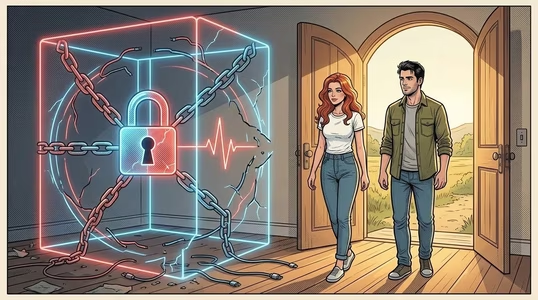
Infidelity turns intimacy into an unstable information environment.
The cheater hides. The betrayed partner investigates. Conflict produces arousal. Apology produces relief. Relief is mistaken for resolution. Surveillance replaces trust. Retaliation creates mutual guilt. The relationship becomes a closed loop.
The chemistry is real. The attachment is real. The pain is real. None of those facts prove that the relationship is healthy or meant to continue.
Intensity is not proof of love. Anxiety is not proof of importance. Jealousy is not proof of commitment. Forgiveness is not proof of repair. A person’s inability to leave immediately is not proof that they want to be harmed.
The useful question is structural:
Does this relationship produce accurate information, voluntary respect, and room for two autonomous people to exist?
If it does not, the solution is not to become a better detective, a more persuasive savior, or a more efficient retaliator.
The solution is to stop feeding the system that converts pain into attachment.
A healthy relationship does not require captivity to maintain connection. It does not need betrayal to create intensity. It does not ask one person to surrender perception, movement, dignity, privacy, or independent life in exchange for temporary peace.
It runs on something less dramatic and more difficult to fake:
consistent behavior when nobody is forcing it.
Moving From Mapping the System to Rewiring It
Understanding the mechanics of betrayal, intermittent reinforcement, and hypervigilance removes the mystery—but insight alone lives in the conscious mind, while relational conditioning lives in the autonomic nervous system and subconscious prediction loops. You cannot think or willpower your way out of a nervous system that has been trained to confuse threat with attachment, or novelty with worth.
My work focuses on the underlying architecture of human behavior—integrating systems analysis, hypnosis, and behavioral conditioning to interrupt these automated feedback loops at the root. Whether you are trying to dismantle the compulsion to chase external validation, break a trauma bond after betrayal, or recalibrate a nervous system stuck in survival mode, the goal is not comforting platitudes. It is restoring accurate perception, emotional regulation, and genuine personal agency.
If you recognize your own operating patterns in this map and are ready to do the structural work to change them, reach out to schedule a consultation.

About The Author
Adam Fistler is a Behavioral Systems Analyst, Board Certified Hypnotist, Certified 5-PATH® Hypnotist, and former owner of the Baltimore Hypnosis Center. A member of the International 5-PATH® Hypnosis Association and certified by the National Guild of Hypnotists, Adam has studied hypnosis, behavior change, and the relationship between thoughts, beliefs, emotions, and behavior for more than two decades.
His perspective is shaped by more than professional training. Adam has also lived through addiction and recovery firsthand across South Jersey and the Philadelphia region, including surviving on the streets of Camden. This gives him a deeply personal understanding of the struggle from both sides: as a practitioner who has helped others create change and as someone who has had to confront his own deeply ingrained patterns and beliefs.
During his own recovery, Adam returned to the principles of hypnosis, mindfulness, self-talk, and behavioral change that he had studied throughout his career. He discovered that recovery could be about more than simply managing cravings or avoiding relapse—it could also be an opportunity to understand the beliefs, emotional patterns, and experiences that had shaped his behavior.
Today, Adam combines his professional experience with the lessons of his own journey to serve clients throughout Greater Baltimore Maryland Region, and beyond, helping others explore the possibility of meaningful, lasting change. His approach is grounded in empathy, curiosity, practical tools, and the belief that people are more than the behaviors they are trying to overcome.
Explore my Addiction & Recovery Resources
Contact Adam Fistler, BCH - Behavioral System Analyst
Examine an Overview of Addiction, Substance Abuse & Recovery
The Slow Descent: How Addiction Hijacks the Mind, Body, and Survival System
Learn more about my Addiction, Substance Abuse & Recovery Services
Discover how Hypnosis aids with Addiction & Recovery
Rethinking Recovery: The Science, Stigma, and Advocacy of The Sinclair Method
Addiction Is Not a Moral Failure: Celebrities and Their Struggles with Addiction
Explore my Addiction & Recovery Articles
Review a List of All My Addiction & Recovery Articles
Neurotransmitters and Neurochemistry in Addiction
Endorphins, Pain, Mood, and Addiction: Understanding the Endogenous Opioid System
Your Addiction Isn't Broken Code - It's Legacy Code
Societal Lockout: When Rebuilding a Life Becomes One Roadblock After Another
The Mechanics of Infidelity: A Neurochemical, Psychological, and Biological Map
Chasing the Spark: Mistaking a Nervous-System Alarm for Attraction