Why the Hell Can’t I Change?
Understanding the Hidden Subconscious Gatekeeper That Keeps You Stuck in Old Habits
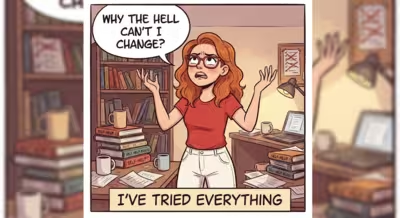
You know what you’re supposed to do. You may understand the consequences. You may have read the books, attended counseling, completed treatment, gone to meetings, written inventories, promised yourself that this time would be different, and tried to rely on willpower.
And yet, when the moment arrives, you find yourself doing the same thing again.
You drink when you promised you wouldn’t. You use drugs even though you know where it leads. You smoke when you’re trying to quit. You overeat when you aren’t physically hungry. You return to the same relationship, reaction, thought pattern, or behavior that you already decided needed to change.
Afterward, you may feel ashamed, frustrated, confused, or hopeless.
You may ask: “Why can’t I change when I know better?”
The answer may not be that you are weak, lazy, defective, or lacking motivation. It may be that conscious knowledge is only one part of how change happens.
Knowing Better Does Not Always Create Different Behavior
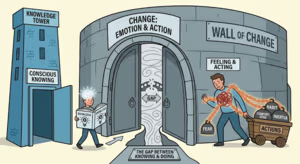
Many people are taught that change is primarily a matter of managing symptoms:
- Manage the cravings.
- Manage the urges.
- Manage your emotions.
- Manage your impulsivity.
- Avoid people, places, and things.
- Distract yourself.
- Replace the behavior.
- Stay busy.
- Attend meetings for the rest of your life.
These tools can be helpful. Education, peer support, counseling, behavioral strategies, and recovery communities all have value. For some people, 12-Step programs are deeply meaningful and provide essential support. For others, they may not be the right fit.
The problem is not that these approaches are always wrong. The problem is that many people are offered the same limited menu of options repeatedly, even when those options have not addressed what is actually driving their behavior. A person may go through rehabilitation, continue into intensive outpatient treatment, and then be directed toward a traditional self-help program. If they relapse, they may be sent back through the same process and given the same advice.
Eventually, they may become discouraged—not because they do not want recovery, but because they expect to be told the same things again. They may think: “What’s the point? I already know what they’re going to tell me.”
This is where it can be useful to consider a different question. Instead of asking only: “How do I manage this urge?” we can also ask: “What is this urge trying to accomplish?”
Behaviors Often Begin as Solutions
Drug use, alcohol use, smoking, overeating, compulsive behaviors, and other patterns often do not begin as conscious attempts to create a problem. They begin as attempts to solve one.

A substance or behavior may temporarily help someone:
- Feel calm
- Escape emotional pain
- Feel confident
- Feel connected
- Shut off overwhelming thoughts
- Reduce anxiety
- Feel safe
- Avoid loneliness
- Experience pleasure
- Numb grief, anger, shame, or fear

For a while, the strategy may appear to work. The problem is that a solution can become harmful when it is repeatedly used long after the original circumstances have changed. What once provided relief can become a compulsion. What once helped someone cope can become a source of serious consequences.
This is sometimes called a maladaptive coping mechanism : a response that may have made sense in the moment but eventually becomes unhelpful, destructive, or dangerous. That does not mean the behavior is harmless. Drug addiction and alcoholism can cause devastating consequences. It means that understanding the behavior’s original purpose may be more useful than treating the person as if they simply chose suffering.
What Are Belief Systems?
A belief system is made up of the often-unwritten rules we carry about:
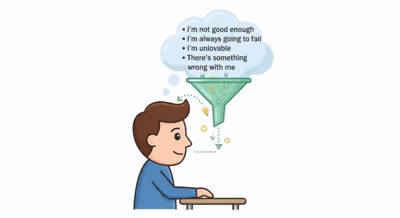
- Who we are
- What other people are like
- Whether we are safe
- Whether we are worthy of love
- What we can expect from relationships
- What we must do to belong
- What it means when something goes wrong
- Whether change is possible
These beliefs become lenses through which we interpret life. Two people can experience the same event and respond completely differently because they assign different meanings to it.
Someone who believes, “People are generally safe and mistakes can be repaired,” may interpret rejection as painful but temporary. Someone who believes, “There is something wrong with me and people always leave,” may interpret the same rejection as proof of a much larger story.
Belief systems are not always consciously stated. A person may never walk around thinking, “I am unworthy of love.” Instead, the belief may appear through automatic reactions:
- Pulling away when someone shows interest
- Assuming compliments are insincere
- Expecting rejection
- Feeling suspicious of kindness
- Sabotaging opportunities
- Using substances whenever closeness or vulnerability becomes uncomfortable
The person may consciously want connection while unconsciously behaving as if connection is dangerous or impossible.
When Conscious Facts Conflict With Internal Experience
When I was in ninth grade, there was a beautiful girl in my class. By almost anyone’s standards, she was one of the most attractive students in the school. Yet she believed she was fat and unattractive. We could tell her she was beautiful. We could reassure her that her weight was within a normal range. We could offer evidence, encouragement, and sincere compliments.
The compliment might make her feel better briefly. But soon she would respond: “You don’t really mean that. You’re just being nice.” The rational evidence could not override what she felt internally.
In high school, I experienced something similar in a different way. I believed I was awkward, unlikeable, and unworthy of attention from someone attractive. There was a girl named Cindy who made her interest in me obvious. She could practically have written a note saying, “I want you to ask me out.”
But I could not perceive what seemed obvious to everyone else. My conscious mind may have noticed some of the signs, but my internal belief system filtered them through the assumption that someone like her could not genuinely be interested in someone like me.
This is one way belief systems operate. They can act like blinders or filters. They influence what we notice, how we interpret it, and how we respond.
The Critical Factor and the Gap Between Knowing and Feeling
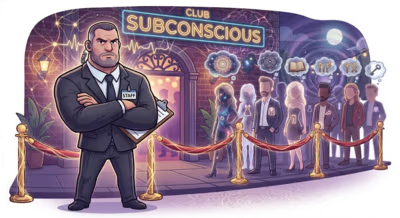
In hypnosis, the term critical factor is often used to describe the evaluating or comparing process that helps determine whether new information fits with what we already believe. You can think of it as a gatekeeper. Information that matches existing expectations may be accepted easily and reinforced. Information that conflicts with deeply held beliefs may be questioned, rejected, or dismissed.
This helps explain why someone can consciously know:
- “I am not unattractive.”
- “People do care about me.”
- “I am capable.”
- “I am safe now.”
- “I do not need to drink.”
- “I want to stop using drugs.”
- “This behavior is hurting me.”
…and still feel, emotionally, as if the opposite is true.
The issue is not necessarily a lack of intelligence or information. The problem may be that the information is not reaching the emotional patterns that are guiding behavior.
How Emotional Patterns Become Connected to Cravings
Imagine a baby becoming tangled in a blanket. The baby cries for help. From the baby’s perspective, a parent is not coming—or is not coming quickly enough. The parent may only be a minute away, on the phone, or unaware of what is happening.
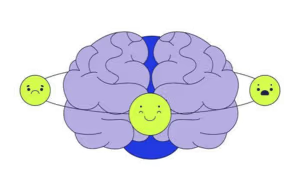
An adult looking back might say: “That was nothing. The parent was coming. The baby was safe.” But a baby does not have the developmental ability to interpret the situation that way. The experience may be accompanied by fear, sadness, loneliness, helplessness, or even a primitive sense of danger.
The baby might form emotional conclusions such as:
- “No one is coming.”
- “I am alone.”
- “I am not important.”
- “There is something wrong with me.”
- “I am not safe.”
- “I may die.”
This example is not meant to suggest that one minor event automatically causes addiction. Human behavior is much more complex than that. The point is that experiences are interpreted according to the information and developmental capacity available at the time.
Later, a child may be teased or excluded by other children. That experience may resonate with earlier feelings of loneliness or helplessness. A parent may cancel a promised trip because of work. The event may reinforce existing beliefs:
- “I am not important.”
- “People leave.”
- “I am not worth showing up for.”
- “There must be something wrong with me.”
Over time, experiences, emotions, interpretations, and responses can become connected in a larger web.
When Relief Becomes Wired to a Behavior
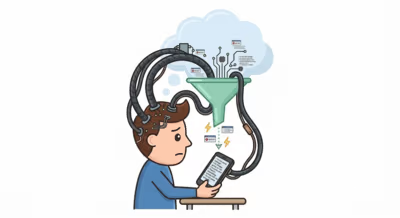
Now imagine that food is associated with love, safety, comfort, or connection. Perhaps family meals were one of the few times everyone felt close. Perhaps a parent expressed affection by baking desserts. Perhaps food was consistently offered as a reward or comfort.
Eventually, the mind may discover: “When I eat this food, I feel better for a while.”
The food may temporarily reduce loneliness, sadness, anxiety, or emotional discomfort. Repeated experiences can strengthen the connection between the uncomfortable feeling and the behavior that brings relief.
Eventually, the person may not experience the original emotion clearly. Instead, it may feel like:
- “I’m hungry.”
- “I need chocolate.”
- “I have a craving.”
- “I need something sweet.”
- “I can’t relax until I eat.”
The emotional discomfort may be experienced as physical hunger. The same general process can occur with cigarettes, alcohol, prescription medication, illicit drugs, gambling, compulsive sex, shopping, rage, avoidance, or other behaviors. The behavior is not necessarily experienced as a problem at first; it is experienced as relief.
The Web Behind Addiction
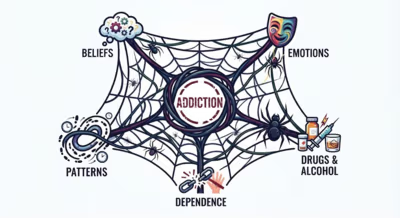
Addiction rarely develops from one simple cause. It may involve an interconnected web of: emotions, beliefs, memories, relationships, expectations, environmental cues, learned associations, reinforcement, trauma, stress, shame, loneliness, impulsivity, coping strategies, and social conditioning.
What begins as one experience may be reinforced by later experiences. Similar emotional states may repeatedly activate the same response. Over time, the behavior can become automatic.
The person may not consciously think: “I am using alcohol to escape shame connected to an old belief about being unworthy.” They may simply feel an urge to drink. They may not consciously think: “I am using cocaine to temporarily overcome loneliness, fear, or insecurity.” They may simply feel that they need it.
The behavior can become so familiar that the underlying emotional process disappears from conscious awareness.
Why Management Alone May Not Be Enough
Traditional recovery tools often focus on managing the behavior: avoiding triggers, distracting yourself, calling someone, attending meetings, using behavioral substitutions, staying busy, practicing restraint, managing emotions, managing cravings, and managing impulsivity.
These tools can be important, especially during acute risk or early recovery. A person may need structure, medical support, supervision, peer connection, and practical strategies to remain safe. But management is not always the same as healing.
If the emotional network underneath the behavior remains unchanged, the person may need to spend enormous energy suppressing, resisting, and monitoring themselves. That can feel like trying to overpower one emotion with another.
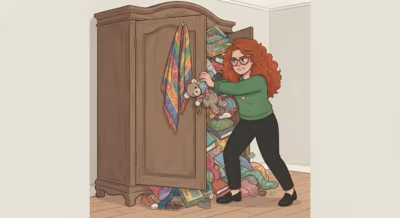
Someone may attempt to defeat fear with determination, shame with punishment, loneliness with constant activity, or cravings with relentless vigilance. This can work temporarily, but it consumes energy. It is like pressing the accelerator and trying to drive through a closed garage door instead of opening the garage door. Overpowering the obstacle requires force. Opening the door changes the situation.
Defining Energy: The Physics of the Unprocessed Mind
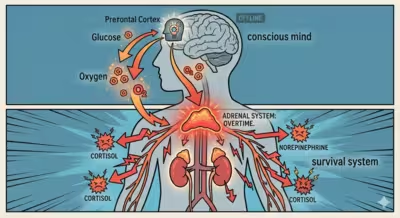
To understand how deep-seated behavioral patterns and stubborn addictions persist, we must first establish a clear, practical definition of energy . To some, energy is viewed as a mystical, unseen force that governs the mind, body, and spirit. Whether or not that is true is ultimately up to the individual to decide. However, when we speak of energy in the context of behavioral change and psychological conditioning, we are not speaking of the esoteric. We are speaking of a concrete, measurable currency: the literal physiological and neurological resources that the human body expends to carry, maintain, and suppress unresolved emotional experiences and rigid belief systems. Every unhelpful belief we hold and every raw, unprocessed emotion we push beneath the surface acts as an active, energy-consuming background process within our nervous system, draining vital biological resources just to keep it contained.
From a neurobiological standpoint, the act of emotional suppression is a high-cost metabolic operation. Research demonstrates that active suppression requires a massive expenditure of glucose and oxygen within the brain, particularly draining the energetic reserves of the prefrontal cortex as it forces a state of constant internal inhibition. While this emotional containment plays out entirely underneath the surface of conscious awareness, the body’s adrenal system begins to work overtime. Because the primitive mind cannot distinguish a past emotional injury from an active external threat, it evaluates all incoming real-world information through the narrow lens of these unresolved patterns. This chronic misevaluation triggers the hypothalamic-pituitary-adrenal (HPA) axis, causing a sustained increase in the release of cortisol and norepinephrine . The mind and body become functionally trapped in an eternal, low-grade fight-or-flight state, burning through physical resources to prepare for a battle that never arrives.
When the nervous system is locked into this survival state, a strict biological triage takes place, deprioritizing long-term maintenance systems in favor of immediate defense. The body systematically down-regulates immune function, disrupts metabolic equilibrium, and fundamentally alters cerebral blood flow, diverting it away from the prefrontal cortex —the region responsible for executive functioning, rational processing, and cognitive flexibility. With blood flow and neural activity restricted in the prefrontal cortex, our capacity to think through a situation logically drops. We are stripped of our ability to deliberately work through a problem and are instead driven entirely by deeply ingrained, primitive reaction loops.
Evolutionarily, this mechanism is a brilliantly designed survival asset. If an individual is faced with an immediate physical threat—whether hunting dangerous game in our ancestral past or surviving the raw exposure of living on the streets in a modern environment—the brain must bypass slow, analytical deliberation to keep them alive. The modern tragedy, however, is that when we carry unhelpful, unprocessed beliefs, our primitive mind treats those internal emotional wounds with the exact same urgency as an active physical predator. The survival network hijacks the steering wheel of behavior, filtering every interaction, word, and environment through a lens of threat. All the while, the conscious, rational mind may be screaming at us to act differently, to choose a healthier path, or to remain calm. Yet that conscious voice almost always loses out to these hardwired survival mechanisms, because the body will always prioritize the biological imperative of immediate self-preservation over the conscious desire for change.
How Hypnosis Can Support Change

Hypnosis is not magic, mind control, or a replacement for medical or mental health treatment. I view hypnosis as a deliberate way of working with naturally occurring human processes such as: focused attention, absorption, imagination, expectation, emotion, perception, memory, suggestion, and response.
You already experience these processes in everyday life. You may become absorbed in a movie and temporarily lose awareness of the room around you. You may drive a familiar route while your attention is occupied by your thoughts. You may become so focused on a book, conversation, project, or problem that other information fades into the background.
Hypnosis uses this flexibility of attention and experience purposefully. My role is not to force you into hypnosis or take control of your mind. My role is to guide you, provide structure, ask questions, use suggestions and imagery, and help you work with your own experience. You remain conscious, aware, and involved.
Working With the Pattern at Its Source
In hypnosis, it may be possible to work with the emotional experiences, perceptions, beliefs, and associations connected to an unwanted behavior. This does not mean assuming that every problem has one hidden root cause. It does not mean treating every image or memory as a historically accurate recording. It does not mean searching for one perfect event that explains everything.
Instead, the work may involve exploring:
- What happens immediately before the urge
- What the urge seems to promise
- What emotion is present
- What the behavior temporarily changes
- What beliefs are activated
- What the person expects will happen
- What earlier experiences may be emotionally connected
- What alternative responses could meet the underlying need
Hypnosis can provide a focused context for examining these relationships and developing more useful ways of responding. The goal is not simply to tell yourself, “I am different now.” The goal is to help create a different emotional relationship with the experiences that once drove the behavior.
Regression, Memory, and Emotional Healing
Some hypnosis approaches use regression to explore earlier experiences connected with current emotions or patterns. I do not treat regression as literal time travel or as a method for retrieving a perfect historical record. Memory is reconstructive. A vivid experience during hypnosis is not automatically proof that every detail occurred exactly as remembered.
The value of regression may be in exploring:
- How an experience was perceived
- What the person believed about themselves
- What emotions became attached to it
- How those emotions influence the present
- What information was missing at the time
- What a healthier understanding might look like now
Sometimes a current emotional experience can act as a bridge to other memories, images, beliefs, or associations. This is sometimes called an affect bridge . The focus is not on proving the past. The focus is on understanding how the person’s present experience is being shaped—and helping reduce the influence of outdated or unhelpful responses.
Healing Is Not the Same as Suppression
One of the most important distinctions in change is the difference between suppressing a response and resolving it.
Suppression says: “This feeling is unacceptable. I must overpower it.”
Healing says: “I can understand this response, update what it means, and allow it to lose its power.”
When an emotional response is genuinely resolved, you may not need constant vigilance to keep it under control. A useful test of emotional healing is whether you can think or talk about a situation without becoming overwhelmed by the same fear, shame, grief, or panic that once controlled you.
That does not mean you forget what happened. It does not mean the event becomes pleasant. It means the event no longer automatically controls your emotional state or behavior.
Hypnosis and Choice
Hypnosis is not about forbidding you from acting. It does not make it impossible for you to intentionally drink, use drugs, smoke, overeat, or engage in another behavior. You always retain choice.
Hypnosis may help reduce the automatic intensity of urges, change the emotional associations connected to a behavior, increase motivation, and make healthier choices feel more available. But you remain responsible for what you choose to do.
The purpose is not to turn you into a puppet. The purpose is to return choice to you. Instead of feeling as though an urge has already made the decision, you may become better able to pause, notice what is happening, and choose your response.
Hypnosis Within a Broader Recovery Plan
Hypnosis should not be used as a substitute for detoxification, medication, medical care, psychiatric treatment, addiction counseling, crisis support, or other appropriate services. Alcohol and certain drugs can produce dangerous withdrawal symptoms. Anyone physically dependent on a substance should seek medical guidance before stopping or changing use.
Hypnosis can be considered as one tool within a broader recovery plan. Depending on the person and the situation, that plan may include: medical or psychiatric care, detoxification support, residential treatment, intensive outpatient treatment, individual counseling, peer support, SMART Recovery, 12-Step recovery, cognitive behavioral therapy, dialectical behavior therapy, mindfulness, motivational interviewing, medication-assisted treatment, family support, lifestyle changes, and relapse-prevention planning.
I draw from hypnosis, mindfulness, CBT, DBT, motivational interviewing, SMART Recovery principles, behavioral strategies, visualization, and my experience with addiction and recovery. I do not believe one recovery philosophy has to explain every person or every problem. Different people need different tools.
Stop Asking Why You Are Broken
You may not be unable to change. You may be trying to change at the wrong level.
You may be using conscious effort to fight patterns that were built through years of emotional learning, reinforcement, association, and repetition. You may be trying to manage a response whose original purpose has never been understood. You may be trying to overpower a feeling that needs to be resolved.
This does not remove responsibility from you. It does not make recovery effortless. It does not guarantee that hypnosis will work for every person or every problem. But it may offer a different way to understand the struggle.
You are not necessarily broken. Your mind may be repeating what it once learned to do in order to protect you, comfort you, help you belong, or help you survive. When that response is no longer useful, the goal is not to attack yourself for having learned it.
The goal is to understand it, update it, and develop the freedom to choose something different.
Stop managing everything forever. Start healing what has been driving the pattern. Reclaim your ability to choose how you live.
A Note About My Approach
I do not promise a miracle cure, instant transformation, or guaranteed freedom from addiction. Hypnosis is not mind control. It does not force you to act against your values, reveal secrets, or accept suggestions you do not want. You remain conscious, aware, and an active participant in the process.
My goal is to help you explore the emotional patterns, beliefs, perceptions, associations, and behaviors connected with the problem—while supporting practical choices and appropriate recovery care.
If you are struggling with drug addiction, alcoholism, drinking, smoking, food cravings, or another compulsive behavior, hypnosis may be worth considering as one part of a broader recovery plan.
The question may no longer be: “Why the hell can’t I change?” It may become: “What has been keeping this pattern in place—and what would it take to finally heal it?”
If you are ready to explore this approach, then Contact me to begin your process today.
Explore my Hypnosis Resouces
Contact Adam Fistler, BCH - Behaviroal Change Consultant
Examine a Brief Overview Hypnosis
Learn how Hypnosis Works Under the Hood & How it Physically Affects the Brain
Learn more about Hypnosis Services & Common Issues People use Hypnosis to Address
Learn how Others have Benefited from my Hypnosis Experience by Browsing Client Testimonials
Discover how Hypnosis can Help You Release Anger, Impulsivity, and Road Rage.
Discover how Hypnosis aids with Addiction & Recovery
Discover how Hypnosis can Help you Lose Weight, Manage Cravings, and Overcome Emotional Eating.
Explore my Hypnosis Articles
Review all my Hypnosis Articles
Baltimore Hypnosis Center: A Journey of Personal and Professional Transformation
10 Things to Consider When Choosing a Hypnotist
10 Ways Hypnosis Can Help You Lose Weight
Attract Your Ideal Partner by Focusing Your Mind
Unlocking Freedom from Chronic Pain: Harnessing the Power of Hypnosis
The Essence of Change: Empowering Transformation Through Hypnosis
Should You Use Hypnosis to Lose Weight?
Should You Use Hypnosis to Stop Smoking?
Breaking Free: The Nice Guy's Journey to Authenticity
Winning the Battle Within: Overcoming the Urge
Debunking Hypnosis Myths: Unveiling the Truth Behind Common Misconceptions
Unlocking Wellness: The Profound Influence of the Mind-Body Connection in Healing
Exploring the Subconscious Mind: Unveiling the Depths of Your Mental Landscape
Exploring the Benefits of Gratitude Practices
The Surprising Link Between Hypnosis and Stress Reduction: A Comprehensive Guide
Gnsotic Aeon Pairings: The Pleroma as a Psychology of Becoming
Discussion