Reclaiming My Identity: Rediscovering Hypnosis in a South Jersey Rehab

My struggle with addiction began in 2012, after I fell from a ladder while cleaning the gutters outside my home. I injured my back, and when I visited the doctor, I was prescribed Percocet for the pain. The prescription was understandable. My doctor was doing what she had been trained to do: help a patient dealing with severe pain. I do not blame her, and I do not believe it is fair to portray physicians as careless “pill pushers.” Doctors are human beings trying to provide the best care they can with the knowledge and tools available to them.
At the time, I had no idea that prescription would mark the beginning of a years-long struggle.
My addiction eventually led me through a revolving door of inpatient rehabs and intensive outpatient programs. The usual structure was familiar: group therapy, education about addiction, emotional discussions, and encouragement to share personal experiences. In theory, treatment programs often spoke about “many pathways to recovery”—the idea that no single method works for everyone.
In practice, however, my experience was much narrower. The dominant expectation was participation in twelve-step recovery.

I understand that twelve-step programs have helped many people. But for me, the repeated insistence that they were the only legitimate path became discouraging. I was told that I needed to attend meetings for life, find a sponsor, and work the steps—or risk relapse. When someone relapsed, the explanation often focused on what that person had supposedly done wrong: perhaps they had been dishonest, failed to complete a step properly, or had somehow “taken their will back.”
There seemed to be little room to consider another possibility: that the model might not be the right fit for everyone.
I remained willing to return to treatment because I had a wife and children I wanted to protect. I had a career I was trying to save. I went back because I valued my family and my future more than I resented the repetition of the process. Still, each treatment experience left me with the same feeling: I was being taught how to manage addiction, but not necessarily how to understand or heal the deeper causes behind it.
The programs focused heavily on managing cravings, managing emotions, preventing relapse, keeping busy, and distracting oneself from painful thoughts and feelings. Those tools can be useful, but I believed they addressed the symptoms more than the underlying wounds.
I began conducting my own research. I studied evidence-based approaches, the neurobiology of addiction, the way neural pathways develop, and how repeated associations can strengthen the connection between emotional pain, substance use, and the desire for relief. I also began thinking more deeply about beliefs—especially the beliefs people carry about themselves—and how those beliefs shape emotions, decisions, and behavior.
My Final Rehab Experience
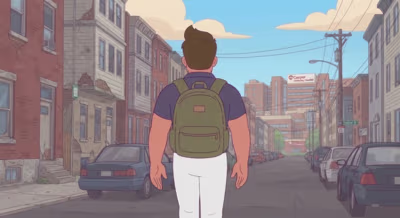
My final rehab experience took place in Hammonton, South Jersey. At the time, I was living at Joseph’s House of Camden, a local shelter. I was trying to rebuild my life, developing a business and working on this website from the library. But the shelter environment was noisy, unstable, and sometimes dangerous. I spent nearly a year surrounded by people who were actively using substances and others who repeatedly tested my character and ability to endure.
Eventually, I reached the point where I needed to get away.
By then, I had already been free from opioid use for approximately two years. I made a decision that may be difficult for some people to understand: I used enough fentanyl to test positive so that I would qualify for inpatient treatment. I was not seeking to return to opioid addiction. I was seeking a safe place where I could step away from the shelter, regroup, and begin rebuilding my life.
That rehab gave me something I desperately needed: quiet, distance, and time to think.
Reclaiming My Recovery
For the first time, I began to dictate the terms of my recovery rather than simply accepting someone else’s assumptions about what recovery was supposed to look like. I participated in groups, but I also openly discussed my own knowledge and questioned approaches that did not make sense to me.
During that period, I reconnected with parts of myself I had set aside. Earlier in my life, I had studied hypnosis and understood how emotions, beliefs, and internal dialogue can influence behavior. I had previously been a Board Certified Hypnotist and had operated a hypnosis center in Baltimore. Now, in a quiet and more stable environment, I was able to apply that knowledge to myself.
Through self-hypnosis—a relaxed state of focused attention—I examined old experiences, emotional patterns, and deeply held beliefs. I learned to view those experiences more objectively and develop more realistic perspectives about them. This process did not erase my past, but it gave me a way to work with it. For the first time in a long time, I felt that I was doing more than managing my pain. I was beginning to heal.
The Power of Language and Suggestion
One experience at the rehab made the limitations of the program especially clear to me. I attended a group about affirmations, but the advice being offered seemed ineffective. Participants were encouraged to use phrases such as “I am not a drug addict,” “Just do it,” or “I’m never going to use again.”
As a hypnotist, I understood the importance of precise language. An affirmation is a form of autosuggestion—a statement repeated with the intention of influencing the subconscious mind. The familiar example is, “Don’t think of a pink elephant.” Before the mind can reject the image, it has to create it. In the same way, an affirmation built around the very idea someone is trying to escape may unintentionally keep that idea active.
Vague statements can also create problems. If someone tells themselves, “Just do it,” the subconscious mind may reasonably ask: Do what? A useful suggestion should be specific, constructive, and connected to a meaningful behavior.
Sharing What I Knew
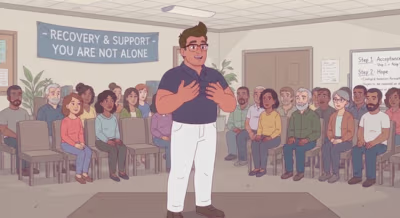
I approached the counselors and proposed leading peer-education groups on mindfulness, meditation, positive self-talk, and effective affirmations. I explained that peer-to-peer education could be an important part of recovery and offered to share what I had learned.
The groups were well received. Participants responded enthusiastically to the material, particularly the discussion of how beliefs and self-talk influence emotions and behavior. Even some of the counselors acknowledged that my explanation of addiction, internal dialogue, and behavior was valuable. One counselor told me that she kept a copy of my handouts for future reference.
Those handouts are still preserved and available here:
Working One-on-One
As people learned about my background in hypnosis, several residents approached me for individual conversations. I began working one-on-one with people who wanted to explore the emotional experiences beneath their substance use.
One man, whose identity I will protect, struggled with abandonment, guilt, and shame. His mother had abandoned him, and he carried the pain of believing that he would never have his parents present at his wedding. He also had experienced the trauma of a cousin dying in his arms from an overdose.
These experiences were not minor details in his story. They were deep emotional wounds. Together, we began exploring how those wounds influenced his beliefs, anxiety, and addiction. Over time, I noticed a significant change. When we first began working together, he was visibly anxious. He fidgeted constantly, moved restlessly, and shook his legs. As the sessions continued, he became calmer and more relaxed.
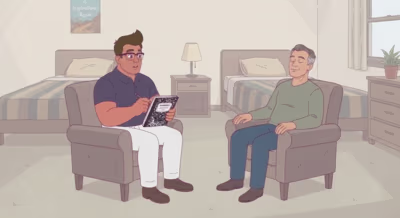
He told me that the work was the most valuable healing experience he had ever received—more meaningful to him than the rehab program itself.
Another man struggled with alcoholism and isolation. He was uncomfortable in social situations and never felt that he belonged. As we explored his history, he connected those feelings to childhood experiences of being ignored and overlooked by his parents and siblings.
“I don’t matter.”
That belief had influenced the way he saw himself, the way he related to other people, and the behaviors he used to cope. It illustrated something I had come to understand through my own recovery: old emotions and beliefs do not simply remain in the past. Unless they are examined, they can continue shaping the present.
Recovery Is More Than Removing the Substance

Recovery is not only about removing a substance. It is also about understanding the emotional patterns, beliefs, and unmet needs that made the substance feel necessary in the first place.
My experience in South Jersey helped me reclaim an important part of my identity. I stopped defining myself solely by my addiction, my relapses, or other people’s expectations of how I was supposed to recover. I rediscovered the knowledge and skills I had developed throughout my life and learned how to use them in service of my own healing.
That experience eventually led me to begin helping others.
I do not claim that hypnosis is a replacement for medical care, addiction treatment, medication, or other professional services. Recovery is personal, and different people need different forms of support. But I do believe that people deserve access to more than one narrow definition of recovery. They deserve the opportunity to understand themselves, examine painful beliefs, and develop healthier ways of responding to life.
Rediscover Your Authentic Self
If I could begin meaningful healing while living inside an inpatient rehab, imagine what may be possible in a safe, individualized setting with focused one-on-one support.
You do not have to remain defined by the parts of yourself that no longer serve you. You can rediscover your authentic self—and begin building a life guided by your own values, choices, and healing.
Contact me to learn more about how hypnosis and focused inner work may support your recovery journey.

About The Author
Adam Fistler is a Behavioral Change Consultant, Board Certified Hypnotist, Certified 5-PATH® Hypnotist, and former owner of the Baltimore Hypnosis Center. A member of the International 5-PATH® Hypnosis Association and certified by the National Guild of Hypnotists, Adam has studied hypnosis, behavior change, and the relationship between thoughts, beliefs, emotions, and behavior for more than two decades.
His perspective is shaped by more than professional training. Adam has also lived through addiction and recovery firsthand across South Jersey and the Philadelphia region, including surviving on the streets of Camden. This gives him a deeply personal understanding of the struggle from both sides: as a practitioner who has helped others create change and as someone who has had to confront his own deeply ingrained patterns and beliefs.
During his own recovery, Adam returned to the principles of hypnosis, mindfulness, self-talk, and behavioral change that he had studied throughout his career. He discovered that recovery could be about more than simply managing cravings or avoiding relapse—it could also be an opportunity to understand the beliefs, emotional patterns, and experiences that had shaped his behavior.
Today, Adam combines his professional experience with the lessons of his own journey to serve clients throughout South Jersey, Philadelphia, and beyond, helping others explore the possibility of meaningful, lasting change. His approach is grounded in empathy, curiosity, practical tools, and the belief that people are more than the behaviors they are trying to overcome.
Learn my Personal Story
Contact Adam Fistler, BCH - Behavorial Change Consultant
Early Childhood: Struggles With Extreme, Painful Shyness and Social Awkwardness
The Next Challenge: From Family Man to Addiction and Recovery
Recovery Was Not a Straight Line: From Repeated Rehab to Rebuilding My Life
Reclaiming My Identity: Rediscovering Hypnosis in a South Jersey Rehab
Discussion