The Slow Descent
How Addiction Hijacks the Mind, Body, and Survival System
The Question Behind the Story

How can someone with a successful career, a family, intelligence, responsibilities, and—on paper—many reasons to be grateful eventually become addicted and live without stable housing in Camden, New Jersey?
It is a question I have had to answer in my own life.
I had been a systems engineer. I had a career, a family, and an identity built around competence, responsibility, and problem-solving. Yet my life eventually moved through addiction, treatment, homelessness, and survival on the streets of Camden.

That transformation can look inexplicable from the outside. It can be tempting to divide people into two categories: responsible people and addicts, moral people and immoral people, people who make good decisions and people who do not.
My experience has taught me that addiction is more complicated than that. It is not a light switch. It is a progression—a gradual interaction between biology, emotion, learning, beliefs, behavior, relationships, and environment. By the time the consequences become obvious, the process may have been developing for a long time.
Understanding that process does not excuse harmful behavior. It helps explain how a person can become capable of actions they once would have considered unthinkable—and why recovery requires more than being told to try harder.
No One Begins by Choosing Addiction
Most people do not begin using drugs or alcohol with the intention of becoming addicted. They begin because the substance appears to solve a problem.
It may seem to provide:
- Relief from anxiety or emotional pain
- Confidence and social ease
- Energy and motivation
- Sleep
- Focus
- Escape from shame, grief, loneliness, or fear
- Temporary freedom from intrusive thoughts
- A sense of belonging
- Relief from physical or psychological discomfort
 <
<
At first, the substance may seem effective. That is part of what makes addiction so powerful. If the experience were immediately destructive, most people would not continue. The early use may feel like a discovery: “This helps me.” “This makes me feel normal.” “This lets me be the person I want to be.”
Over time, the person may begin to associate the substance with the best version of themselves. They may believe that alcohol makes them more relaxed, opioids make them more comfortable, stimulants make them more productive, or another drug makes them more confident, creative, social, or capable.
Eventually, the belief can reverse:
“I am not at my best without it.”
Then it can become:
“I cannot do ordinary things without it.”
Work, sleep, conversation, driving, eating, socializing, handling stress, or simply feeling comfortable in one’s own body may begin to seem impossible without the substance.
These beliefs are not always conscious decisions or deliberate deceptions. They can be learned expectations reinforced by repeated experience. The substance changes how the person feels, and the mind begins to treat that change as evidence about what the substance—and the person—can do.
From Pleasure to Relief
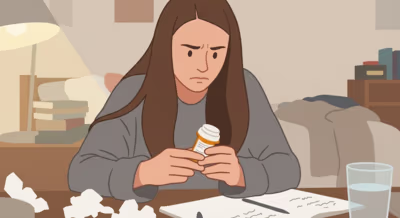
Addiction often develops along two connected tracks: psychological dependence and physical dependence.
Psychological dependence begins when the substance becomes connected to emotional regulation. Particular situations start activating an expectation:
- Stress means I need the substance.
- Loneliness means I need the substance.
- The end of the workday means I need the substance.
- Social discomfort means I need the substance.
- Feeling sad, angry, bored, or ashamed means I need the substance.
The brain learns through repetition. A cue, feeling, place, person, or thought becomes linked with the anticipated relief. The urge can arise before conscious reasoning has fully caught up.
Physical dependence develops as the nervous system adapts to repeated exposure. Early on, a person may use a substance to feel better than their ordinary baseline. Later, they may use it simply to avoid feeling worse.
The goal changes from pursuing pleasure to escaping distress.
That is an important turning point. Someone watching from outside may see continued use and think, “They are choosing the drug over everything else.” The person may experience something closer to, “I need this to get through the next hour.”
Drugs Use the Brain’s Existing Systems
Drugs do not create entirely new brain systems. They interact with systems the body already uses to regulate pain, reward, arousal, fear, learning, sleep, movement, and emotional state.
Different substances have different chemical profiles. They bind to or influence different receptors, transporters, and signaling networks. Opioids interact strongly with opioid receptors and resemble some effects of the body’s natural endorphin system. Alcohol and benzodiazepines affect inhibitory GABA-related signaling and other systems. Stimulants alter dopamine, norepinephrine, and related signaling. Other substances have their own combinations of effects.
The important point is that the brain is not simply receiving a foreign chemical and remaining unchanged. It is continually attempting to maintain balance.
The Body’s Warehouse Manager
 <
<
Imagine a warehouse manager who receives shipments without knowing why they keep arriving. The warehouse keeps receiving far more inventory than it was designed to hold.
At first, the existing shelves overflow. To keep the operation functioning, the manager expands the warehouse, adds storage capacity, changes the workflow, and creates ways to accommodate the increased supply.
The brain responds in a comparable way to repeated exposure, although the biology is more complex than a single warehouse analogy. It can change receptor sensitivity and number, alter signaling pathways, adjust natural chemical production, and modify the communication between brain regions.
These adaptations are attempts at regulation. The body does not know that the chemicals came from a bottle, a prescription, or a street corner. It only registers that the system is repeatedly receiving an unusually strong signal.
The adaptation may reduce the immediate impact of the substance. That can protect against some effects of a particular dose, but it also creates tolerance. The person now needs more of the substance—or more frequent use—to produce the earlier effect or to feel normal.
The adaptation that helped the body manage the surplus becomes part of the trap.
If the outside supply suddenly stops, the warehouse does not instantly return to its original size. The nervous system may still be adjusted for the substance even though the substance is gone. The result can be withdrawal: not simply a desire, but a body and brain struggling to recalibrate.
When the Survival System Is Misled
 <
<
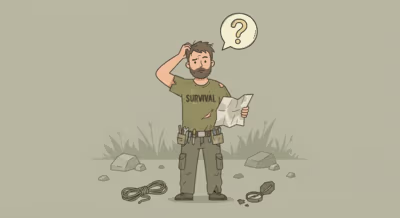
Human beings have powerful systems for responding to deprivation. Hunger is not merely an idea. It is a bodily drive that organizes attention, motivation, memory, and behavior around obtaining food.
Severe addiction can create a comparable survival-like focus. The substance becomes highly salient—meaning the brain gives it extraordinary importance. Thoughts, plans, relationships, money, and time may increasingly organize around obtaining and using it.
This is not a claim that drug withdrawal is literally identical to starvation. The biology differs. The comparison is useful because it helps explain the intensity of the drive.
A person who is truly starving may think about food constantly, take risks to obtain it, become irritable or emotionally blunted, and make decisions that would be unthinkable under ordinary conditions. In severe dependence, withdrawal and craving can produce a similarly narrowed field of attention. The brain begins treating access to the substance as urgently necessary.
The addicted mind may not be asking, “Is this consistent with my values?” It may be asking, “How do I end this distress?”
That is part of what I mean by a survival-system hijack. The substance is no longer experienced only as a source of pleasure. It has become confused with safety, normality, relief, and continued functioning.
Why Endorphin Sensitivity May Have Mattered in My Case
In my own case, I have wondered whether differences in endorphin sensitivity or endorphin-system functioning may have played a role in my vulnerability. The body’s endorphin system influences pain, reward, stress, and well-being. Opioid drugs can strongly affect the same general network.
I cannot claim that endorphin sensitivity was proven to be the cause of my addiction. Addiction is not explained by one molecule, one receptor, or one event. Genetics, stress, emotional learning, trauma, beliefs, opportunity, social environment, mental health, and repeated reinforcement can all contribute.
Still, it is possible that some people experience certain substances as unusually effective or unusually regulating. If a substance produces a powerful sense of relief or normality, the learning signal may be especially strong.
The person may not simply think, “I like this.” Their nervous system may learn, “This is important. Remember how to get it.”
The Broken Thermostat of Withdrawal
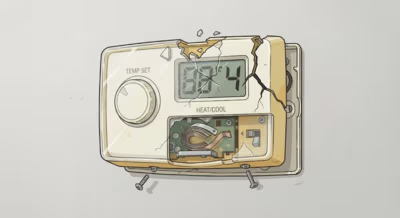
The nervous system constantly tries to maintain equilibrium. When an outside substance repeatedly pushes the system in one direction, the body may develop counter-adjustments.
For example, opioids can suppress pain and arousal signaling. With repeated exposure, the body adapts in ways that increase opposing arousal systems. Noradrenergic activity, including activity associated with the locus coeruleus, is one part of the opioid-withdrawal picture. When the opioid is removed, the drug’s suppressing effect is gone, but the counter-adjustments do not disappear immediately.
The result can include restlessness, anxiety, sweating, rapid heartbeat, agitation, insomnia, and the feeling that the body cannot settle.
Alcohol and benzodiazepines involve another especially important balance. GABA-related signaling acts in part like a brake, while glutamate-related signaling is excitatory. With chronic exposure to substances that enhance inhibitory effects, the brain can adapt by reducing inhibitory responsiveness and increasing excitatory drive. When the substance is abruptly removed, the balance can swing dangerously toward over-excitation.
This is why abrupt withdrawal from heavy alcohol or benzodiazepine use can cause seizures, delirium, and life-threatening complications. Anyone physically dependent on these substances should seek medical guidance rather than attempting to quit suddenly alone.
The body is not simply demanding the drug because a person lacks character. It has adapted to the drug’s presence and is now struggling with the absence of it.
Why Cold Turkey Is So Difficult—and Sometimes Dangerous
A person may sincerely intend to stop. They may promise themselves, their family, or their treatment team that this time will be different. They may mean it completely.
Then withdrawal begins.
The person may experience pain, sweating, nausea, restlessness, insomnia, panic, depression, irritability, emotional flatness, cognitive difficulty, or an overwhelming sense that something is terribly wrong. Even after acute withdrawal improves, post-acute withdrawal symptoms—often called PAWS—may continue in waves. Sleep, mood, motivation, pleasure, stress tolerance, and impulse control may remain unstable while the nervous system rebuilds balance.
At the same time, the substance may still be associated with relief. The brain remembers: “This ends the distress.”
That combination creates a powerful conflict. The conscious mind wants recovery. The body wants immediate relief. Under stress, exhaustion, emotional pain, or withdrawal, the executive functions used for planning and restraint may be less available precisely when they are needed most.
This is one reason intention alone often does not solve addiction.
It is also why severe alcohol or benzodiazepine withdrawal should not be managed through unsupervised cold-turkey cessation. Medical detoxification has an important place in recovery and can help manage serious risks safely.
Normalization: How the Unthinkable Becomes Ordinary

Normalization is the process by which something becomes familiar, expected, and accepted within a person’s everyday environment—even when it once seemed dangerous, unacceptable, or unthinkable.
Normalization does not require someone to make a formal decision that harmful behavior is good. It often happens through repetition and comparison.
The progression may look like this:
- “I only use occasionally.”
- “I use because I am under unusual stress.”
- “Everyone around me does this.”
- “This is how we get through the day.”
- “I need it to work.”
- “I have to do whatever is necessary to obtain it.”
As exposure continues, the person’s reference point changes. Drug use, deception, unsafe environments, and increasingly risky behavior become part of the ordinary landscape.
Being around other users can accelerate the process. A group can provide belonging and practical support, but it can also normalize patterns that would appear alarming from the outside. When everyone is focused on supply, money, withdrawal, and immediate survival, the group’s standards may gradually replace the standards the person once used to evaluate their behavior.
The question shifts from “Would I ever do that?” to “What else can I do?”
The Slow Chipping Away of Morality

People sometimes describe addiction as if a person suddenly loses their moral compass. My experience was more gradual.
The descent usually occurs through small compromises. A person hides use to protect a relationship. Spends money intended for something else. Misses a responsibility. Tells a partial truth. Accepts help under false pretenses. Makes a promise they already suspect they cannot keep.
Each compromise creates discomfort because it conflicts with the person’s self-image. The mind then tries to reduce that discomfort. It explains, minimizes, postpones, or reframes the behavior:
- “This is temporary.”
- “I will fix it tomorrow.”
- “They do not understand what I am going through.”
- “I had no choice.”
- “I am only doing what I need to survive.”
As the behavior repeats, the emotional alarm may become less intense. What once felt like a major violation becomes familiar. The new behavior becomes the starting point for the next decision.
This does not mean the person has no responsibility. It means that responsibility must be understood within the reality of a brain and body increasingly organized around obtaining relief and avoiding withdrawal.
The person may not be internally trying to become immoral. The addiction progressively narrows the field of concern until immediate relief dominates long-term values.
My Descent: From Systems Engineer to Camden

From the outside, a successful professional life can appear to provide protection against addiction. In reality, a career and family can conceal the early stages for a long time.
A person may continue working while using. They may compensate, make excuses, hide deterioration, or rely on intelligence and experience to solve problems that the addiction is creating. Their competence becomes scaffolding that temporarily holds up an increasingly unstable structure.
But scaffolding can collapse piece by piece.
Use takes more time. Money becomes less available. Trust weakens. Responsibilities are missed. Work performance suffers. Relationships become strained. Housing and financial stability deteriorate. The person’s world becomes smaller and more organized around the substance.
In my own life, that progression eventually carried me from being a systems engineer with a career and family to addiction and homelessness in Camden. That was not a single decision. It was the cumulative result of many changes—biological, emotional, behavioral, social, and environmental—that reinforced each other over time.
Understanding the progression does not erase the harm caused to myself or others. It does, however, make the story understandable. A person is not transformed from “good” to “bad” in one moment. They can become increasingly trapped inside a system that keeps rewarding immediate relief while making every other part of life harder to maintain.
When Treatment Environments Teach More Than Recovery
I also believe we need to be honest about the limitations of some treatment environments.
In my first rehabilitation experience, I learned about the availability of drugs on the streets of Camden and how people navigated that environment to obtain substances. I was exposed to scams and other methods that people used to obtain money and drugs.
I am not sharing those details as instructions. I am describing how treatment can sometimes unintentionally expand a person’s knowledge of the very drug culture they are trying to leave.
For some people, rehab can become an avenue for learning new contacts, stories, rationalizations, scams, and acquisition strategies. A person may enter treatment with one set of experiences and leave with a larger knowledge base about how other users survive and obtain substances.
This does not mean rehabilitation is useless. It means treatment environments need to consider group composition, boundaries, information-sharing, supervision, and the possibility that participants may learn from one another in ways that undermine recovery.
In my case, the information I learned in that first rehab experience contributed to my future descent. That is a difficult truth, but honest recovery work requires us to examine what helped and what did not.
Two Kinds of Dependence, One Reinforcing Loop
Physical and psychological dependence continually strengthen each other.
Physical dependence creates withdrawal. Withdrawal creates urgency. Urgency directs attention toward the substance. Using the substance produces relief. Relief reinforces the belief that the substance is necessary. Repeated use deepens physical adaptation.
At the same time, emotional cues continue to activate psychological dependence. Stress, shame, loneliness, anger, fear, boredom, or memories can trigger craving even when the person is not in acute withdrawal.
That is why simply explaining the consequences may not be enough. The person may already know exactly what the substance is costing them. Knowledge does not automatically dissolve the emotional and physiological learning that keeps the cycle active.
Why I Believe Emotional Work Matters Before or Alongside Cessation

A substance often begins as a coping mechanism before it becomes an addiction.
It may help a person calm anxiety, escape shame, numb grief, feel confident, sleep, socialize, work, or stop thinking about something painful. If the substance is removed without addressing the function it served, the person may be left with the original emotional distress plus withdrawal, PAWS, disrupted sleep, emotional flatness, impulsivity, and fear that they cannot function without it.
For that reason, I believe emotional and belief-focused work can sometimes make cessation easier when it is medically appropriate to do so.
This is not an argument against detoxification. Detox can be necessary and lifesaving. It is an argument for recognizing that detox and emotional healing address different parts of the problem.
The traditional sequence may look like this:
Remove or reduce the substance → manage withdrawal → develop coping strategies → address deeper emotional patterns
My preferred sequence, when appropriate, may look like this:
Address emotions and beliefs → develop internal resources → safely remove or reduce the substance → continue recovery support
Both approaches can be valid. Sometimes medical stabilization must come first. Sometimes emotional preparation can begin first. Sometimes both processes occur together.
The most useful question is not, “Which approach is universally correct?” It is:
What does this person need first in order to have a safe and realistic chance of healing?
How I Understand Hypnosis
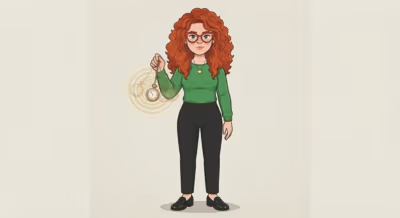
I do not view hypnosis as a mysterious power, mind control, or a loss of consciousness. I see it as a practical way of deliberately working with naturally occurring human processes, including focused attention, absorption, imagination, expectation, suggestion, emotion, perception, and response.
People experience these processes every day. They become absorbed in a movie, a book, music, a conversation, a difficult programming problem, or a familiar drive. Attention can become highly focused while other information fades into the background.
Hypnosis deliberately structures and directs that flexibility toward a chosen purpose.
The hypnotist is a guide, coach, and facilitator. The client remains an active participant—conscious, aware, capable of asking questions, rejecting suggestions, changing their mind, or ending the session. Hypnosis is something a person experiences and participates in, not something simply done to them.
Relaxation can be useful, but it is not the definition of hypnosis. Focused attention can occur during curiosity, excitement, fear, anger, fascination, or emotional engagement. The goal is not merely to make someone relaxed. The goal is to use attention and experience constructively.
Hypnosis and Addiction Recovery
Addiction involves automatic patterns. A person may consciously want one thing while their learned emotional and physiological responses push toward another.
Hypnosis can provide a structured context for exploring:
- What the substance came to represent
- What emotional state it created or removed
- What beliefs became connected to using
- What the person believes they cannot do without it
- Which situations trigger craving
- How bodily sensations influence interpretation and behavior
- What alternatives might become possible
Hypnosis is not a machine for installing arbitrary beliefs. It is not a guaranteed solution, and it is not a substitute for appropriate medical, psychiatric, psychological, or addiction treatment.
Its potential value is that it can help a person work experientially with patterns that may be difficult to change through intellectual understanding alone. A person may know, “This is harming me,” while still feeling, “I need it.” Hypnotic work can help examine that conflict and create new associations, expectations, emotional responses, and choices.
My approach draws from hypnosis and 5-PATH® training, mindfulness, visualization, NLP, CBT, DBT, behavioral approaches, SMART Recovery, and personal experience with addiction and recovery. I do not see these as competing systems where one method must explain everything. I see them as tools that can be adapted to the person, the situation, and the goal.
If Traditional Treatment Has Not Worked
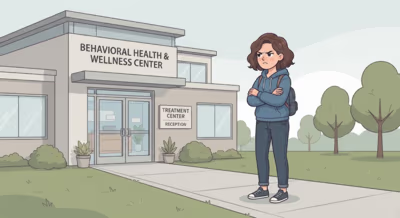
If you have tried traditional approaches and have not succeeded, that does not automatically mean you lacked commitment, honesty, discipline, or willingness to recover. It does not mean you are constitutionally incapable of change.
It may mean that the approach, timing, sequence, treatment setting, or combination of services was not a good fit.
Removing a substance can expose the emotional pain, beliefs, and survival patterns that the substance had been temporarily managing. When those issues remain unaddressed, early recovery can become overwhelming. PAWS, emotional flatness, impulsivity, stress, sleep disruption, and the absence of familiar relief can make returning to use feel like the only available option.
For some people, the next step is not simply trying harder. It may be finding a different entry point—one that addresses the emotional and belief systems first, while still respecting the need for medically safe cessation when necessary.
Detox can help create physical freedom. Emotional healing can help make that freedom livable. Hypnosis may be a powerful tool for beginning that work.
Final Thoughts
Addiction is not formed in a single moment. It develops through repeated interactions among biology, learning, emotional pain, beliefs, environment, relationships, and behavior.
The substance may begin as a solution. It may then become a routine, a requirement, and eventually a survival signal. The body adapts to the outside chemical. The mind adapts to the new normal. The social environment reinforces the pattern. Moral boundaries shift gradually. The person’s world narrows.
That process can happen to people who are intelligent, successful, loving, responsible, and deeply committed to their families. It can happen to people who genuinely intend to stop.
Understanding addiction as a hijacking of reward, emotion, learning, and survival systems does not remove responsibility. It replaces contempt with a more accurate starting point for change.
The person needs safety. The body may need medical support. The mind needs new experiences. The emotions need attention. The beliefs need examination. The coping function needs replacement—not merely removal.
Addiction may begin as a solution, become a requirement, and end as a survival drive. Recovery begins when we address not only what the substance does, but what the person has been trying to survive.
If you would like to explore whether hypnosis and behavior-change work may be appropriate for your situation, Contact me

About The Author
Adam Fistler is a Behavioral Change Consultant, Board Certified Hypnotist, Certified 5-PATH® Hypnotist, and former owner of the Baltimore Hypnosis Center. A member of the International 5-PATH® Hypnosis Association and certified by the National Guild of Hypnotists, Adam has studied hypnosis, behavior change, and the relationship between thoughts, beliefs, emotions, and behavior for more than two decades.
His perspective is shaped by more than professional training. Adam has also lived through addiction and recovery firsthand across South Jersey and the Philadelphia region, including surviving on the streets of Camden. This gives him a deeply personal understanding of the struggle from both sides: as a practitioner who has helped others create change and as someone who has had to confront his own deeply ingrained patterns and beliefs.
During his own recovery, Adam returned to the principles of hypnosis, mindfulness, self-talk, and behavioral change that he had studied throughout his career. He discovered that recovery could be about more than simply managing cravings or avoiding relapse—it could also be an opportunity to understand the beliefs, emotional patterns, and experiences that had shaped his behavior.
Today, Adam combines his professional experience with the lessons of his own journey to serve clients throughout South Jersey, Philadelphia, and beyond, helping others explore the possibility of meaningful, lasting change. His approach is grounded in empathy, curiosity, practical tools, and the belief that people are more than the behaviors they are trying to overcome.
Explore my Addiction & Recovery Resources
Contact Adam Fistler, BCH - Behavorial Change Consultant
Examine an Overview of Addiction, Substance Abuse & Recovery
The Slow Descent: How Addiction Hijacks the Mind, Body, and Survival System
Learn more about my Addiction, Substance Abuse & Recovery Services
Discover how Hypnosis aids with Addiction & Recovery
Rethinking Recovery: The Science, Stigma, and Advocacy of The Sinclair Method
Addiction Is Not a Moral Failure: Celebrities and Their Struggles with Addiction
Explore my Addiction & Recovery Articles
Review a List of All My Addiction & Recovery Articles
Neurotransmitters and Neurochemistry in Addiction
Endorphins, Pain, Mood, and Addiction: Understanding the Endogenous Opioid System
Your Addiction Isn't Broken Code - It's Legacy Code
Societal Lockout: When Rebuilding a Life Becomes One Roadblock After Another
Discussion