The Next Challenge: From Family Man to Addiction and Recovery
After I finally made it through the painful shyness and anxiety that had shaped so much of my early life, I thought the hardest part was behind me. I believed I had solved the problem. I had learned how to function in the world, how to work, how to build relationships, and how to move forward.
I did not yet understand that life sometimes waits until one struggle is quiet before introducing another.
A Temporary Stay in New Jersey
In early 2009, while I was still living in Baltimore, Maryland, I received a call from a former manager I had worked with at Northrop Grumman. He was supporting a Federal Aviation Administration project, and he told me that the contract I had worked on several years earlier had moved to Computer Sciences Corporation in Egg Harbor Township, New Jersey.
The assignment was supposed to be temporary. I would travel to South Jersey for three to six months, rewrite the system-development, automation, and logistics system I had helped create, and then finish the contract by flying out of Baltimore-Washington International Airport. On June 8, 2009, I arrived in Egg Harbor Township expecting to be in New Jersey only briefly.

But life had other plans.
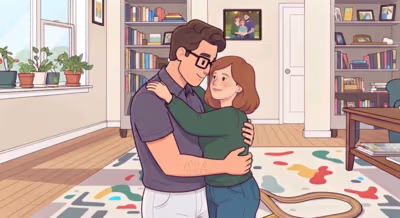
While exploring online dating in the South Jersey area, I met Michele. What began as a temporary work assignment slowly became a new life. On April 10, 2010, Michele and I were married.
For a while, I believed I had finally found the stability I had always wanted: a wife, a home, children, and work I was proud of. I was a family man. I had no idea that my next major struggle would begin with a routine medical prescription.
The Pill That Made Me Feel Normal
About two years into our marriage, I was cleaning the gutters outside our house when the ladder slipped out from underneath me. I injured myself and went to the doctor, who prescribed generic Percocet—oxycodone combined with acetaminophen.
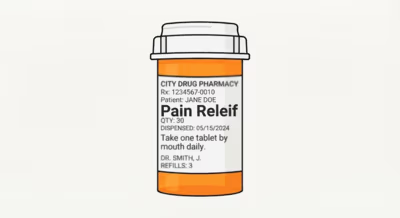
No one sets out to become addicted. Whether a person first encounters a substance through a prescription, experimentation, or recreation, they are not imagining the loss of control that may eventually follow. They are simply trying to manage pain, stress, emotion, or life as they understand it at the time.
When I took the Percocet, I experienced something I later learned was sometimes called a paradoxical drug effect. Instead of feeling sleepy or sedated, I felt energized, euphoric, and alive. Opiates did not slow me down. They seemed to give me energy, confidence, and emotional lift.
For the first time in my life, I felt as if I had discovered something I had been looking for without knowing its name. It was not merely that the pill made me feel good. It made me feel like the version of myself I had always wished I could be.
That first prescription did not instantly turn me into an addict. At first, I used the medication only occasionally. Then I began experimenting with it. Eventually, occasional use became monthly use, monthly use became weekly use, and weekly use became daily use. The progression was gradual—so gradual that I could explain away each step as it happened.
I did not wake up one morning and decide to destroy my life. I drifted into dependence one decision at a time.
Trying to Keep Up With Life
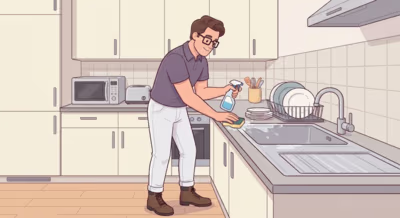
Opiates gave me an energy that felt almost limitless. I could play with my children, clean the kitchen, move on to the bathroom, and keep going without feeling tired. From inside my own mind, I felt normal and in control.
From the outside, however, I looked increasingly intense and erratic. I had more energy than seemed natural. My movements and behavior became unusual. The difference between how I experienced myself and how other people saw me became wider every day.
Eventually, I ran out of the oxycodone I had been prescribed. That was a turning point. I began searching online and found people locally who sold 30-milligram oxycodone pills, often called “the blues.” I had moved from legally obtaining a medication to secretly finding it through people I met on the internet.
Outwardly, I was still a husband, father, and technology professional working in Center City Philadelphia. Privately, I was arranging meetings and trying to maintain a habit I could no longer control.
I repeatedly told myself that I was going to stop. I would buy a final supply and promise myself that this was the end. But the compulsion to use again was stronger than my promises. I was beginning to learn the difference between wanting to stop and being able to stop.
The Person My Family Could Not See
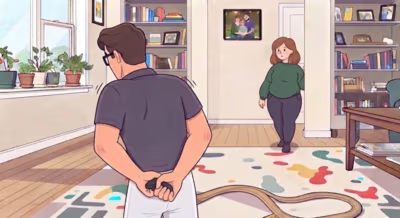
In 2013, I took a job with Micros in Columbia, Maryland. If you have eaten at a restaurant, you may have encountered a Micros terminal without knowing it. During that period, I traveled from our home in South Jersey to Baltimore on Monday mornings, worked there, stayed with my parents, and returned home on Thursday or Friday.
Often, I tried to stop using while I was in Baltimore. I would return home without drugs and begin experiencing withdrawal. Michele saw me come home disengaged, distant, and uninterested. She could not see what was happening inside me. She saw a husband who seemed emotionally absent. I was beginning to experience the physical and psychological consequences of stopping oxycodone.
When opiates are removed after regular use, the person may appear cold or checked out. It can look like they no longer care about their family, interests, or life. But underneath that flat exterior, the nervous system may be in turmoil. Pleasure becomes difficult to feel. Motivation disappears. Anxiety and restlessness rise. The ordinary world feels harsh, exhausting, and strangely empty.
This is one reason addiction is so difficult for families to understand. The person using may appear to be choosing distance, when internally they are trying to survive a storm they do not know how to explain.
Why I Kept It Secret
Someone might reasonably ask, “Why didn’t you just tell your wife?”
The honest answer is that addiction is not governed by logic alone. It is shaped by fear, shame, and isolation.
I was terrified that telling the truth would destroy my marriage, separate me from my children, and expose me as a failure. I believed Michele would reject me if she knew who I had become. I was also ashamed of the lies I had already told. The longer I hid the problem, the more frightening the truth became.
In a distorted way, I also believed I was protecting my family. I thought that if I carried the secret by myself, I could preserve the life they knew. Of course, secrecy did not protect anyone. It only allowed the problem to grow in the dark.
Shame says, “I am bad.” Guilt says, “I did something bad.” For a long time, I confused the two.
I was responsible for my choices and for the damage they caused, but I had also come to believe that I was permanently defective—that I could never make amends or become someone better.
I later learned that addiction is not simply a moral failure, a lack of willpower, or a decision to abandon one’s family. Responsibility still matters, but so do compassion and an honest understanding of what happens to the brain and body. Addiction is more complicated than any single explanation.
When the Pills Ran Out
In January 2014, the people I had been buying oxycodone from became unreachable. I was working in Baltimore and desperately trying to avoid withdrawal when I searched online again. Someone told me, “I don’t have pills, but I have something that won’t make you sick.”
That “something” turned out to be heroin.
I did not seek heroin because I wanted to become a heroin user. I took it because I was desperate not to become sick. That distinction does not erase the consequences, but it explains how quickly desperation can narrow a person’s choices. Heroin was more powerful than the oxycodone, and it affected my behavior dramatically. From the outside, I became increasingly erratic, irrational, and difficult to recognize.
July 4th - The Weekend That Changed Everything
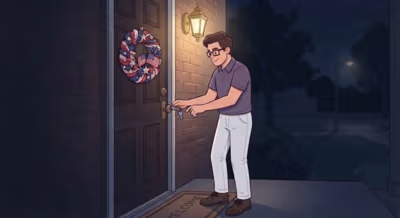
The weekend of July 4, 2014, became one of the great turning points of my life.
Earlier that week, while I was traveling from South Jersey to Baltimore for work, my mother suffered a heart attack. I visited her in the hospital, and by the time I returned home on Thursday, things seemed stable.
Waiting for me was Michele.
Over time, my strange behavior, frequent flat tires, and increasingly late arrivals had become impossible to ignore. Her friend Judy had correctly guessed that I was addicted. Michele had been searching for another explanation—possibly even narcolepsy—because she did not understand that the “nodding” she saw was related to opiate use.
When I came home, Michele was waiting with a drug test. I failed it.
I had spent years imagining that discovery as the moment my life would collapse. I expected anger, rejection, and the end of my family. Instead, Michele responded with compassion. She did not lash out or humiliate me. She told me that we would face it together.
In the moment I expected to find punishment, I found love.
That Sunday, July 7, 2014 Michele and I drove back to Baltimore because my mother was scheduled to have a heart-pump connection removed. My family knew there was a possibility she could die during the procedure, but they had not told me. They were afraid I would not be able to handle it, especially with everything else happening.
At first, the procedure seemed to go well. Michele and I went to find something to eat. When we returned, we learned that my mother had gone into cardiac arrest. The medical team kept her alive long enough for my father to call her sisters in Pennsylvania so they could come and say goodbye.
And then I saw Michele do something I will never forget.
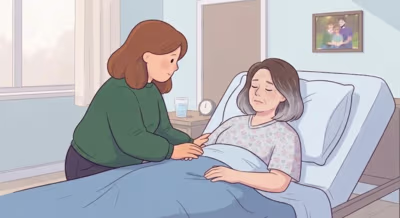
While my mother lay intubated in the hospital bed, Michele sat beside her, held her hand, and talked to her about our sons. She comforted her. She stayed with her. In the middle of a terrifying and heartbreaking moment, she gave my mother tenderness and peace.
If anyone ever asked me to describe who Michele truly is, I would point to that moment. She has frustrated me, as I have surely frustrated her, but I will always love her for sitting beside my mother when our family was falling apart.
That weekend, my wife learned that I was using drugs, and my mother died within days of one another. It was more grief than I knew how to hold.
During the week of the funeral, Michele remained supportive. She was not vindictive or angry. After my mother’s funeral that Friday, she drove me directly from Baltimore to Mirmont Treatment Center in Media, Pennsylvania.
That was my first experience with formal drug and alcohol treatment—and the beginning of a long journey through addiction, recovery, education, and change.
Learning Beyond the First Answer
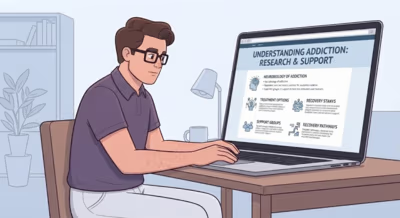
My experience in treatment made me want to understand addiction as deeply as possible. If I was going to live with this condition, I believed I needed to learn everything I could about it.
I learned about the brain, behavior, withdrawal, cravings, and the many systems involved in motivation, stress, pleasure, and emotional regulation. I also learned that treatment is not one-size-fits-all. The approach that helps one person may not help another.
I discovered that twelve-step recovery is meaningful for many people, but it is not the only path. For me, approaches centered on self-efficacy—such as SMART Recovery—offered a language that fit better. I wanted to build skills, examine beliefs, understand triggers, and regain a sense of agency rather than define myself entirely by helplessness.
I also became increasingly aware of the limitations of conventional treatment. People can move from one rehabilitation program to another and hear the same information repackaged without receiving new perspectives or practical choices. When a program does not work for someone, the failure is often placed entirely on the person rather than on the possibility that the approach was not a good fit.
My own breakthroughs came from learning how different brain systems work together. Dopamine is involved in reward, motivation, movement, attention, and learning, but addiction is not simply a story about “too much dopamine.” Serotonin, GABA, glutamate, endorphins, noradrenaline, and the endocannabinoid system also influence mood, stress, arousal, pain, and recovery.
Understanding those systems did not excuse my behavior. It gave me a clearer map of what I was facing.
A Different Kind of Recovery
I eventually began combining what I had learned with my experience in hypnosis, mindfulness, cognitive behavioral therapy, dialectical behavior therapy, and other practical tools. Recovery became more than avoiding a substance. It became the process of learning how my mind and body worked, recognizing the patterns that kept me trapped, and building new ways to respond.
In 2018, I became a certified SMART Recovery facilitator and helped co-run a SMART Recovery group at Recovery at the Crossroads in Blackwood, New Jersey. I began supporting others through peer education and recovery conversations, sharing information I wish I had received much earlier.
I do not believe there is one explanation for addiction or one pathway out of it. I believe people need accurate information, dignity, practical tools, and the freedom to find an approach that genuinely helps them.
I remain responsible for the harm my addiction caused. Recovery does not require pretending otherwise. But responsibility does not have to mean living forever in shame. I can acknowledge the past without believing that I am nothing more than my worst years.
My story did not end when I became addicted. It did not end when my family discovered the truth, when my mother died, or when I entered treatment. Those were painful chapters, but they were not the whole book.
The next part of my life began when I stopped asking only, “How do I avoid using?” and started asking, “How do I understand myself well enough to build a life I no longer need to escape from?”
That question continues to guide me today.
If you are interested in recovery education, hypnosis, mindfulness, or inviting me to speak with your organization or group, please Contact me . I share practical approaches that many people never encounter in traditional treatment.

About The Author
Adam Fistler is a Behavioral Change Consultant, Board Certified Hypnotist, Certified 5-PATH® Hypnotist, and former owner of the Baltimore Hypnosis Center. A member of the International 5-PATH® Hypnosis Association and certified by the National Guild of Hypnotists, Adam has studied hypnosis, behavior change, and the relationship between thoughts, beliefs, emotions, and behavior for more than two decades.
His perspective is shaped by more than professional training. Adam has also lived through addiction and recovery firsthand across South Jersey and the Philadelphia region, including surviving on the streets of Camden. This gives him a deeply personal understanding of the struggle from both sides: as a practitioner who has helped others create change and as someone who has had to confront his own deeply ingrained patterns and beliefs.
During his own recovery, Adam returned to the principles of hypnosis, mindfulness, self-talk, and behavioral change that he had studied throughout his career. He discovered that recovery could be about more than simply managing cravings or avoiding relapse—it could also be an opportunity to understand the beliefs, emotional patterns, and experiences that had shaped his behavior.
Today, Adam combines his professional experience with the lessons of his own journey to serve clients throughout South Jersey, Philadelphia, and beyond, helping others explore the possibility of meaningful, lasting change. His approach is grounded in empathy, curiosity, practical tools, and the belief that people are more than the behaviors they are trying to overcome.
Discussion