
Societal Lockout: When Rebuilding a Life Becomes One Roadblock After Another
Author: Adam Fistler, BCH - Behavorial Change Consultant ( adam@adamfistler.com )
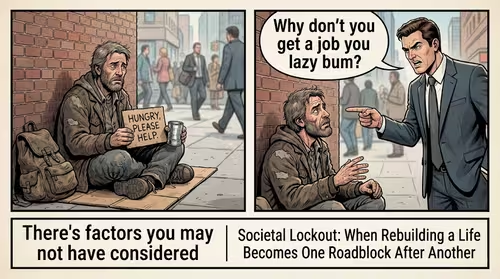
Modern life is built on a quiet assumption: that everyone can remain continuously connected. We are expected to have a working phone, an email address, government identification, reliable transportation, access to money, and the ability to move smoothly between online and in-person systems. Most of the time, these expectations are invisible. They become visible when one of them disappears.
When several disappear at once, the result is more than inconvenience. It can become a lockout from society itself.
I know this because I have lived on both sides of that divide. My name is Adam Fistler, I was once a systems engineer and software developer with a family and what appeared, on paper, to be a stable life. Then a legally prescribed opioid became an addiction. That addiction eventually led to heroin, divorce, homelessness, and life on the streets of Camden, New Jersey.
I am still rebuilding. I also work as a behavioral-change consultant, including with people struggling with addiction. That combination has taught me something that is easy to miss from the outside: recovery is not simply a matter of deciding to change. It is an attempt to reconstruct a life while navigating systems that assume the basic pieces of that life are already in place.
The assumptions beneath ordinary life
Two-factor authentication exists for good reasons. Banks, email providers, government agencies, and social platforms need to protect people from fraud and unauthorized access. Identity verification exists for good reasons too. A state needs to know who is applying for an identification card. An employer needs a way to confirm that an applicant is who they say they are.
The problem is not that any single requirement is unreasonable. The problem is what happens when every system depends on another system, and a person has lost access to all of them at once.
A person leaving homelessness or addiction may need a job immediately to pay for food and housing. A sober-living home may cost roughly $150 to $200 a week—more than $600 and often over $800 a month, depending on the arrangement. That is not a distant financial concern. It is a deadline.
But getting a job commonly requires a phone, email, government identification, transportation, and access to job boards. Accessing email may require two-factor authentication, which requires a phone. Obtaining a phone through the federal Lifeline program generally requires internet access, an email account, or the ability to Contact me . Contacting that organization may require a phone and transportation.
The circle closes before a person has had a chance to begin.
Identification becomes a maze

A state identification card may require several forms of proof: a birth certificate, an old identification card, a Social Security card, a current piece of unopened mail, and another document such as an insurance card or credit card. The exact requirements vary by state, but the underlying problem is consistent: the person who has lost everything is asked to produce evidence of a life they are trying to rebuild.
A birth certificate costs money to obtain. A Social Security card may require identification or an online account. Online identity verification may depend on a credit history or recent activity—something a person living on the street may not have. A current piece of mail must come from an address where the person now lives, but receiving that mail requires an address and a service connected to it.
None of these requirements is absurd in isolation. Together, they form a maze.
And a maze is different from a single obstacle. If one barrier can be overcome by completing another task, but that task requires access to the first barrier, the person is trapped in a circular dependency. They are not refusing to participate. They are unable to reach the starting point.
Help exists, but access to help is also conditional

It is reasonable to point out that organizations, shelters, recovery programs, and support groups exist. They are vital. I have benefited from help, including support from family, and I do not minimize what those resources provide.
But the existence of assistance does not mean assistance is immediately accessible.
Organizations have limited staff, limited budgets, and appointment schedules. In some cases, a person may wait weeks or months for an opening. Appointments are often scheduled by phone. Reaching the organization may require transportation. Transportation costs money, and the person trying to obtain a job without identification, a phone, or email may have no money at all.
There is also a public assumption that someone can simply explain their situation to a bus driver and receive a free ride. Courtesy rides may happen, but they are not a dependable transportation system. Repeatedly asking for free transportation can lead to denial. Meanwhile, a person in sober living cannot always wait for every prerequisite to be completed. Rent is due now. Food is needed now. Recovery itself is happening now.
The same tension appears with public benefits. Programs such as SNAP and general assistance are essential, but applying usually involves visiting social services, completing an application, participating in an interview, waiting for approval, and then waiting for benefits to arrive. The process can take more than a month. The interview may require a phone—or another trip in person, which again requires transportation.
Housing assistance is often misunderstood in the same way. Housing subsidies are not automatic, and Section 8 vouchers are not something a person can simply walk in and receive. Waiting lists can be years long; in some areas, applications are not even being accepted. Even after a voucher is approved, the person still has to find housing that accepts it. Apartment and housing-complex waitlists can add another year or more. From application to move-in, the process may take several years.
That assistance can be necessary and still fail to solve the immediate problem.
The technology barrier after the barrier

I have encountered this most personally through identity-verification systems. A person may finally obtain a low-cost government phone, only to discover that the device cannot reliably handle the verification application. A selfie check may require the user to move their head from side to side while the phone records the process. On a low-end device, the video can become choppy. The camera may not capture a clear image of an identification card. Small movements may fail to register smoothly, making it nearly impossible to center the document or produce an image the system will accept.
If the verification fails, the obvious next step would be to speak with a person or submit a clear scan made with a better camera. Often, that option is not visible or readily available. And contacting platform support may require logging into the very account that has been locked behind the failed verification.
This is how a security feature becomes a wall.
The lockout cycle
The cycle often looks like this:

- A person emerges from homelessness, addiction, a fire, or another crisis without documents or reliable technology.
- They need money immediately for food, transportation, and housing.
- Finding work requires a phone, email, identification, transportation, and access to job boards.
- Email and job-board accounts require two-factor authentication.
- Two-factor authentication requires a phone the person does not have.
- Obtaining a free or low-cost phone requires an application, internet access, an email account, or assistance from an organization.
- Obtaining identification requires documents, fees, transportation, and sometimes proof of address.
- Obtaining those documents may require online accounts, identity verification, current mail, or payment.
- Reaching social services or an assisting organization requires a phone, transportation, or both.
- Opening a bank account requires identification and, increasingly, additional online verification.
- Accessing professional networks and social platforms may require the same identity-verification process that is failing on the available device.
Each individual requirement has a rationale. The combined system, however, can make participation impossible for someone who has lost continuous access to technology, money, transportation, and documents.
The emotional cost is part of the practical cost

The practical barriers are serious, but the emotional consequences matter just as much. Early recovery can include post-acute withdrawal symptoms, exhaustion, anxiety, depression, and difficulty regulating stress. When a person makes an honest effort and encounters setback after setback, the experience can become demoralizing. A task that looks simple to someone else—log into an email account, replace an identification card, schedule an appointment—can consume days or weeks.
That frustration can become a relapse risk.
Without understanding the barriers, observers may reach for labels: lazy, noncompliant, unmotivated, or simply a worthless addict. Those labels confuse an inaccessible system with a lack of effort. They also deepen the stigma surrounding addiction and homelessness.
I was fortunate to have some emotional strength from my earlier work with hypnosis and mindfulness. I was fortunate to receive help from family. Those advantages mattered. Many people leaving addiction and homelessness have neither. They have only their determination, their fragile recovery, and a society organized around resources they do not possess.
Designing for the person who has lost everything
I am not arguing that security requirements should disappear. Two-factor authentication protects accounts. Identity verification serves legitimate purposes. The people who design these systems are not necessarily trying to exclude anyone.
I am arguing that the assumptions underneath these systems need to be acknowledged and tested. What happens when the user has no phone? No identification? No current address? No credit history? No money? No reliable transportation? What happens when the only available device cannot run the verification process? What happens when the help desk is accessible only through the account that has been locked?

There need to be real alternatives: human support that does not require a successful login, in-person pathways with transportation assistance, document-recovery options that do not depend on the missing documents, longer-lived recovery codes, and ways to verify identity through trusted service providers. There should also be a clear, visible path to a human being when the automated process fails—without requiring someone to search through buried documentation, navigate an endless menu, or already possess access to the account they are trying to recover. These alternatives would not eliminate security. They would recognize that security and access are both public concerns.
This matters even more as artificial intelligence becomes part of customer service, government websites, municipal processes, and online assistance. When someone is dealing with an ordinary request, an automated system may be useful. But an account lockout involving missing identification, a lost phone, homelessness, addiction recovery, or an unusual combination of circumstances is not an ordinary request. It is an edge case—and edge cases are where automated systems often become least reliable.
Trying to get help in that situation can lead to confusion, circular answers, and sometimes inaccurate or plainly false information. The system may confidently repeat a step that the person has already explained is impossible. It may send them back to the same page, the same phone number, or the same verification process that caused the problem. Municipalities and other organizations have increasingly introduced AI into their processes, and there have already been well-known instances of automated systems providing incorrect information while the institutions behind them distance themselves from responsibility for the output.
AI can do what it has been trained to do very well. The difficulty begins when it encounters something outside the pattern it recognizes. Instead of acknowledging uncertainty and escalating the matter, it may produce an answer that sounds authoritative but is wrong. For someone with time, money, transportation, and a working phone, that may be an irritating delay. For someone in recovery who is trying to obtain identification, housing, employment, or access to benefits, it can become another serious barrier—and another reason to feel that every door is closing.
There should be a guaranteed escalation path to a trained human being. It should be obvious, accessible, and available before a person reaches a dead end. No one should have to discover a hidden reference buried deep in a website, guess which department might help, or accept that human assistance is unavailable simply because an automated system cannot understand the situation. Organizations should remain accountable for the guidance their systems provide, whether that guidance comes from an employee, a chatbot, or an AI-assisted process.
A person rebuilding a life should not have to prove, all at once, that they already have the life they are trying to rebuild.
I am farther along than I once was, but I still run into these roadblocks. That is what prompted me to write this. I am not claiming that every requirement is unnecessary, or that institutions should ignore fraud and account security. I am asking that we weigh those concerns against the human cost of excluding people who cannot satisfy the assumptions built into the system.
If we want people to recover, work, obtain housing, and participate in society, we have to make those first steps possible. Determination matters. Support matters. But determination cannot substitute for a phone, an identification card, transportation, money, or a way to reach the person who can help.
A system that is secure for the person who has everything may be impenetrable to the person trying to begin again. The difference between those two experiences is not a technical detail. It is the difference between a roadblock and a locked door.

About The Author
Adam Fistler is a Behavioral Change Consultant, Board Certified Hypnotist, Certified 5-PATH® Hypnotist, and former owner of the Baltimore Hypnosis Center. A member of the International 5-PATH® Hypnosis Association and certified by the National Guild of Hypnotists, Adam has studied hypnosis, behavior change, and the relationship between thoughts, beliefs, emotions, and behavior for more than two decades.
His perspective is shaped by more than professional training. Adam has also lived through addiction and recovery firsthand across South Jersey and the Philadelphia region, including surviving on the streets of Camden. This gives him a deeply personal understanding of the struggle from both sides: as a practitioner who has helped others create change and as someone who has had to confront his own deeply ingrained patterns and beliefs.
During his own recovery, Adam returned to the principles of hypnosis, mindfulness, self-talk, and behavioral change that he had studied throughout his career. He discovered that recovery could be about more than simply managing cravings or avoiding relapse—it could also be an opportunity to understand the beliefs, emotional patterns, and experiences that had shaped his behavior.
Today, Adam combines his professional experience with the lessons of his own journey to serve clients throughout South Jersey, Philadelphia, and beyond, helping others explore the possibility of meaningful, lasting change. His approach is grounded in empathy, curiosity, practical tools, and the belief that people are more than the behaviors they are trying to overcome.
Explore my Addiction & Recovery Resources
Contact Adam Fistler, BCH - Behavorial Change Consultant
Examine an Overview of Addiction, Substance Abuse & Recovery
The Slow Descent: How Addiction Hijacks the Mind, Body, and Survival System
Learn more about my Addiction, Substance Abuse & Recovery Services
Discover how Hypnosis aids with Addiction & Recovery
Rethinking Recovery: The Science, Stigma, and Advocacy of The Sinclair Method
Addiction Is Not a Moral Failure: Celebrities and Their Struggles with Addiction
Explore my Addiction & Recovery Articles
Review a List of All My Addiction & Recovery Articles
Neurotransmitters and Neurochemistry in Addiction
Endorphins, Pain, Mood, and Addiction: Understanding the Endogenous Opioid System
Your Addiction Isn't Broken Code - It's Legacy Code
Societal Lockout: When Rebuilding a Life Becomes One Roadblock After Another