Rewired for Compulsion: The Brain and Body Under the Influence of Cocaine
Author: Adam Fistler, BCH - Behavorial Change Consultant ( adam@adamfistler.com )
There is a familiar story about addiction. It says that a person uses cocaine or crack because they make a bad choice. They continue because they lack discipline. They could stop if they truly wanted to.
That story sounds simple because it is simple. It is also deeply misleading.
Addiction can cause enormous harm—to the person using, to families, to communities, and to anyone caught in its consequences. But acknowledging that harm does not require us to pretend that addiction is a moral defect. Cocaine addiction is not simply a failure of character, nor is recovery a matter of deciding, once and for all, to “just stop.” It is the result of a powerful interaction between brain chemistry, learning, stress, trauma, environment, and survival.
To understand why quitting can be so difficult, it helps to imagine what happens inside the person—not as a series of bad decisions, but as a biological system gradually trained to respond to distress in one particular way.
The craving may begin before the person knows what hurts
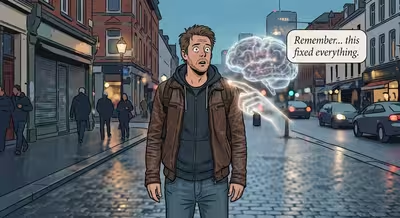
A person may say, “I want to use.” But sometimes the conscious desire for cocaine is not the beginning of the process. It is the final, visible part of something that started earlier.
The real trigger may be an emotional or physical state that the person cannot immediately identify: fear, loneliness, shame, exhaustion, agitation, grief, humiliation, hunger, or the vague sense that something is wrong. It may be a situation that resembles an earlier danger. It may be a belief— I cannot handle this , I am trapped , nothing will change —that has become so familiar it no longer feels like a thought. It feels like reality.
Over time, these experiences can become linked together in the brain. The connections are reinforced through repetition, stress, and relief. The brain begins to associate particular places, people, times of day, body sensations, and emotions with cocaine. Eventually, the person may not consciously experience the original discomfort at all. The network has become so efficient that awareness seems to jump straight to the craving.
What is felt is not always, “I am afraid,” or “I am overwhelmed.”
It is: I need cocaine.
That is one reason addiction can feel mysterious even to the person experiencing it. The conscious mind encounters the urge without seeing the whole chain of events that produced it.
The brain learns what brings relief
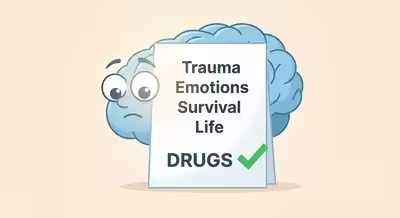
When cocaine is first introduced, it can produce a dramatic change in the body and mind. For a short time, it may relieve emotional pain, physical exhaustion, insecurity, social fear, or a sense of powerlessness. It may create energy where there was fatigue, confidence where there was shame, and intensity where there was numbness.
The brain records that change.
It does not record cocaine merely as a substance. It records the entire sequence:
- the distress that came before;
- the act of obtaining and using the drug;
- the rush;
- the temporary relief;
- the crash;
- and the urge to repeat the cycle.
With repeated use, the connections between discomfort and cocaine become stronger. Neuroscientists sometimes describe repeated learning as the strengthening of neural pathways. “Myelination” is often used in popular explanations of this process, although the biology is more complicated than a single substance simply coating one pathway. The essential point is that repeated patterns become faster, more automatic, and more difficult to interrupt.
A behavior that once required a decision can eventually begin to feel like a reflex.
This is not because the person has stopped having a mind. It is because the brain has learned a response and is deploying it with increasing speed.
Why the brain reaches for the fastest solution
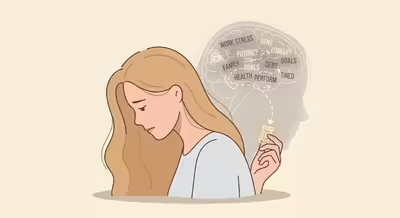
Human beings evolved under conditions in which attention and energy were limited. When an immediate threat appeared, the brain did not always have the luxury of sitting quietly and analyzing the origins of its fear.
It had to act.
The brain’s reflective systems—those involved in self-observation, long-term planning, and considering multiple explanations—consume energy. The default mode network, along with other large-scale brain systems, participates in reflection, autobiographical thought, and internal problem-solving. Those capacities matter, but they are not always prioritized during acute danger, severe stress, hunger, sleep deprivation, or life on the streets.
In a threatening environment, the brain favors speed over completeness.
It asks:
What has worked before?
If cocaine once produced rapid relief, energy, confidence, or alertness, the brain may treat it as an emergency tool. That does not mean the tool is safe or truly effective in the long term. It means the nervous system has classified it as familiar, immediate, and available.
In that sense, drug use can become a survival strategy that has outlived the circumstances that first made it seem useful. The strategy may be destructive, but it is not random. It is the brain trying to solve an unbearable problem with the most efficient method it has learned.
Cocaine’s “rush” is a chemical logjam
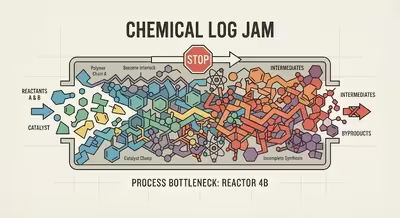
People sometimes imagine that cocaine directly pours an enormous supply of dopamine into the brain. The reality is more precise.
Cocaine primarily blocks the reuptake of dopamine, along with other neurotransmitters such as norepinephrine and serotonin. Normally, after dopamine is released into the space between neurons, transporters help clear it away and return the system toward its baseline state. Cocaine interferes with that clearance.
The result is not simply “more happiness.” It is an abnormal accumulation of signaling.
This can produce intense energy, heightened confidence, increased talkativeness, rapid thought, and a sense of urgency or power. The person may feel unusually capable, brilliant, attractive, productive, or invulnerable. This is the familiar experience of grandiosity: not necessarily a carefully reasoned belief, but a profound bodily conviction that one is unusually powerful and that ordinary limits no longer apply.
Dopamine is involved not only in pleasure but also in motivation, salience, pursuit, and the sense that something matters urgently. Cocaine can make ideas, goals, suspicions, and impulses feel extraordinarily important.
The brain does not calmly evaluate each thought and then decide whether it deserves attention. Under the drug’s effects, thoughts may arrive with the force of commands.
How euphoria turns into paranoia
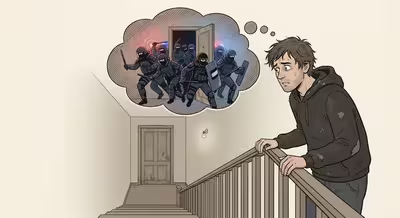
The same system that produces confidence can turn toward fear.
Cocaine stimulates the sympathetic nervous system, increasing heart rate, blood pressure, alertness, and the release of stress hormones. The body enters a state resembling emergency readiness. At the same time, sleep deprivation, dehydration, hunger, and repeated dosing further impair judgment and emotional regulation.
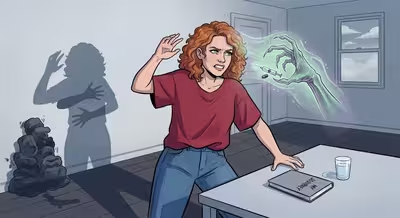
The person becomes hypervigilant. Ordinary sounds acquire significance. A car slowing outside may seem to be surveillance. A shadow may become a person. A neighbor closing a door may be interpreted as a signal. A police siren in the distance may feel like proof that authorities are coming.
Paranoia is not simply a person “making things up” in a casual sense. It is a breakdown in the brain’s ability to distinguish a possibility from a certainty while the threat system is operating at full volume.
The brain is constantly predicting what is happening and comparing those predictions with sensory information. Under cocaine, stress, sleep loss, and high arousal, the balance can shift dramatically toward threat. Ambiguous information is interpreted in the most dangerous way. The brain fills in gaps with a story that matches its alarm.
A sound outside the window is no longer merely a sound. It becomes evidence.
The fear feels real because the bodily state is real: the heart is racing, muscles are tense, attention is narrowed, and the brain is searching for danger. The person is not standing outside the experience, calmly judging it. They are inside it.
This is why reassurance may not work during severe stimulant paranoia. Facts are being processed through a nervous system that has already decided something is wrong.
The distorted sense of time and control

Cocaine can also disrupt a person’s experience of time. Intense stimulation, rapid thought, repeated checking, and compulsive activity can make hours disappear. During a binge, the person may feel as though they have been occupied for only a short while, even as the night passes.
The drug also alters the experience of control. A person may believe they are making a series of deliberate decisions—one more hit, one more search, one more attempt to solve the problem—when the larger pattern has become compulsive.
The mind can construct explanations after the urge has already taken control. It may say:
- “This is the last one.”
- “I need it so I can sleep.”
- “I need to get even.”
- “I can stop after I find the next piece.”
- “I am almost back to normal.”
These thoughts may feel like decisions, but they often function as justifications for a nervous system already organized around repetition.
Chasing a high the brain can no longer produce
The initial rush does not remain stable. The brain is built to protect itself from extremes. When cocaine repeatedly forces dopamine signaling beyond ordinary levels, the brain begins compensating.
Receptors may become less responsive. Natural dopamine release and reward processing can be disrupted. The person may need more of the drug to produce less of the original effect. This is tolerance, though tolerance does not develop in exactly the same way for every effect. A person may become less able to feel euphoria while remaining highly vulnerable to anxiety, paranoia, cardiovascular strain, and impulsive behavior.
That creates the cruel logic of the binge.
The person takes another hit expecting relief or euphoria. Instead, the effect is weaker, shorter, or absent. The nervous system is already overstimulated, but the mind continues to pursue the memory of the first rush.
This is chasing the ghost .
The drug is present, but the original experience is disappearing. The person may keep using not because each hit feels good, but because the body and brain have learned that the next hit might finally restore the feeling that has already been lost.
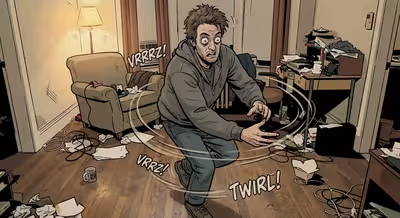
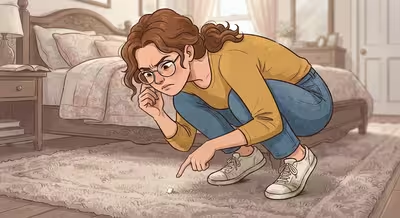
The result can be hours spent searching floors, carpets, clothing, bags, furniture, and empty containers for a fragment that may not exist. This behavior is often mocked as irrational. But from inside the cycle, it can feel urgent and unfinished. The brain’s reward system has attached extraordinary importance to the possibility of finding more. The search itself becomes part of the drug ritual, and each small speck or ambiguous shape can briefly reactivate hope.
Why someone can spend everything without meaning to
Cocaine does not merely create pleasure. It changes what feels important.
During intoxication and craving, immediate acquisition can become more salient than rent, food, relationships, safety, or the future. The brain’s valuation system temporarily assigns disproportionate weight to the drug. Long-term consequences become abstract, distant, or emotionally unreal compared with the immediate demand.
This is why a person may spend money they intended to preserve, sell possessions they expected to keep, or make promises they sincerely meant when they made them. The person may not be calmly choosing destruction over stability. They may be operating within a narrowed field of attention in which obtaining the drug feels like the problem that must be solved first.
That does not erase responsibility for consequences. But responsibility and moral condemnation are not the same thing. Understanding the mechanism makes it possible to respond with treatment, boundaries, and accountability rather than with the assumption that shame will restore control.
The crash: when the body demands relief

Eventually, the supply runs out, the body becomes exhausted, or the person reaches a physical limit. The stimulant effect fades, but the nervous system does not immediately return to normal.
After prolonged stimulation, sleep loss, missed meals, dehydration, and stress-hormone activation, the person may experience profound fatigue, irritability, depression, anxiety, emptiness, and physical discomfort. The body can feel as though it is collapsing.
This is not simply sadness in the ordinary sense. The brain’s reward system may be temporarily blunted. Food, music, conversation, and ordinary pleasures may seem dull or inaccessible. This state is often called anhedonia —a reduced ability to experience pleasure.
The person may not use again because they are seeking euphoria. They may use because they cannot tolerate feeling dead, frightened, restless, or emotionally absent. Another hit promises not happiness, necessarily, but escape from the crash.
That is how the cycle reinforces itself:
- distress creates vulnerability;
- cocaine provides rapid but temporary relief;
- repeated use produces tolerance and dysregulation;
- the crash creates deeper distress;
- the distress becomes a reason to use again.
The drug appears to solve the problem it helped create.
Why quitting is so difficult
Quitting is difficult because a person is not only withdrawing from a chemical. They may also be withdrawing from a learned emotional regulation system.
They are losing:
- a rapid method of changing mood;
- a way to suppress fear or shame;
- a source of energy;
- a ritual connected to particular people and places;
- a perceived solution to unbearable circumstances;
- and, for a time, access to ordinary reward.
Cravings can be triggered by external cues—a neighborhood, a room, a pipe, a pay schedule, a song—or by internal cues such as anger, loneliness, fatigue, sexual arousal, panic, or physical pain. The person may feel the craving before recognizing what emotion activated it.
The prefrontal systems involved in inhibition and long-term planning can also be weakened by intoxication, sleep deprivation, stress, and repeated cycles of use. Meanwhile, the brain’s habit and reward systems become highly responsive to drug-related cues.
In practical terms, the person may have to make a long-term decision while their brain is demanding an immediate one.
That is an uneven contest. Willpower may matter, but willpower is not an unlimited resource. It is affected by sleep, nutrition, stress, trauma, mental illness, safety, housing, pain, and access to support. Asking a person in withdrawal, on the street, or in a state of severe depression to rely on willpower alone is not a treatment plan. It is an abandonment disguised as advice.
Compassion is not the same as excuse
Saying that addiction is not a moral failing does not mean that nothing matters or that consequences should disappear. People can be harmed by addiction, and those harms must be acknowledged. Boundaries may be necessary. Safety may require firm action. Recovery still involves choices, effort, honesty, and responsibility.
But a person cannot be shamed into repairing a nervous system that has been trained around compulsion.
The more useful question is not, “Why do they keep choosing this?” It is:
What pain, conditioning, biology, and environment are making this behavior feel necessary—and what would make another response possible?
Recovery requires more than removing cocaine. It may require sleep, food, medical care, psychiatric support, trauma treatment, stable housing, distance from drug cues, treatment for depression or anxiety, and relationships that do not depend on humiliation. It requires giving the brain time to regain sensitivity to ordinary rewards and helping the person build alternatives to the survival strategy that cocaine once appeared to provide.
The person using cocaine is not a machine without agency. But neither are they an entirely free agent operating outside biology, history, and circumstance. Agency can be damaged without being erased. It can also be rebuilt.
The craving may feel like a command, but it is a learned command. The paranoia may feel like reality, but it is a nervous system in a state of chemical alarm. The compulsive search may feel like necessity, but it is a reward system chasing a memory. The crash may feel permanent, but the brain can recover.
Addiction is not a failure to care about life. Often, it is what happens when a person’s system learns to pursue immediate relief at the expense of a future it can no longer clearly feel.
That is why the answer cannot be moral judgment alone.
The answer has to include truth, safety, treatment, accountability, and compassion—because a hijacked survival system is not healed by calling it wicked.
Overcoming an Addiction
If you would like to regain control over your cocaine or other drug use and the source of your addiction, Contact me to start exploring a path toward lasting change.

About The Author
Adam Fistler is a Behavioral Change Consultant, Board Certified Hypnotist, Certified 5-PATH® Hypnotist, and former owner of the Baltimore Hypnosis Center. A member of the International 5-PATH® Hypnosis Association and certified by the National Guild of Hypnotists, Adam has studied hypnosis, behavior change, and the relationship between thoughts, beliefs, emotions, and behavior for more than two decades.
His perspective is shaped by more than professional training. Adam has also lived through addiction and recovery firsthand across South Jersey and the Philadelphia region, including surviving on the streets of Camden. This gives him a deeply personal understanding of the struggle from both sides: as a practitioner who has helped others create change and as someone who has had to confront his own deeply ingrained patterns and beliefs.
During his own recovery, Adam returned to the principles of hypnosis, mindfulness, self-talk, and behavioral change that he had studied throughout his career. He discovered that recovery could be about more than simply managing cravings or avoiding relapse—it could also be an opportunity to understand the beliefs, emotional patterns, and experiences that had shaped his behavior.
Today, Adam combines his professional experience with the lessons of his own journey to serve clients throughout South Jersey, Philadelphia, and beyond, helping others explore the possibility of meaningful, lasting change. His approach is grounded in empathy, curiosity, practical tools, and the belief that people are more than the behaviors they are trying to overcome.
Explore my Addiction & Recovery Resources
Contact Adam Fistler, BCH - Behavorial Change Consultant
Examine an Overview of Addiction, Substance Abuse & Recovery
The Slow Descent: How Addiction Hijacks the Mind, Body, and Survival System
Learn more about my Addiction, Substance Abuse & Recovery Services
Discover how Hypnosis aids with Addiction & Recovery
Rethinking Recovery: The Science, Stigma, and Advocacy of The Sinclair Method
Addiction Is Not a Moral Failure: Celebrities and Their Struggles with Addiction
Explore my Addiction & Recovery Articles
Review a List of All My Addiction & Recovery Articles
Neurotransmitters and Neurochemistry in Addiction
Endorphins, Pain, Mood, and Addiction: Understanding the Endogenous Opioid System
Your Addiction Isn't Broken Code - It's Legacy Code
Societal Lockout: When Rebuilding a Life Becomes One Roadblock After Another
Discussion