
Gnsotic Aeon Pairings: The Pleroma as a Psychology of Becoming
Author: Adam Fistler, BCH - Behavorial Change Consultant ( adam@adamfistler.com )
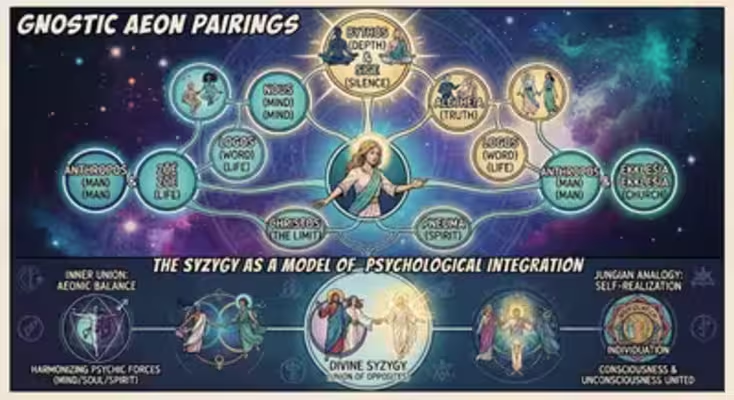
The Valentinian Pleroma can be read not only as a mythological account of divine fullness but also as a symbolic map of human development. Its aeons are not merely supernatural beings arranged in a celestial genealogy. They can be understood as paired psychological functions: ways of perceiving, desiring, remembering, choosing, relating, adapting, suffering, healing, and participating in a world larger than the isolated self. Each syzygy—the union of a masculine and feminine principle—describes a tension that must be held together if the personality is to become integrated. When the pair is divided, one principle tends to dominate while the other is repressed, producing compulsive behavior, rigidity, dependency, self-deception, or spiritual confusion. When the pair is reconciled, the same forces become instruments of behavioral change.
This interpretation does not require treating the aeons as literal psychological parts in a clinical sense. Rather, the aeons function as a symbolic vocabulary for recurring dimensions of human life. They name the inner movements that modern psychology discusses through different terms: cognition, affect regulation, attachment, identity, values, trauma, habit formation, social roles, meaning-making, self-compassion, and systems thinking. The Pleroma therefore becomes a mythic image of psychological fullness. It is not a place one escapes to after abandoning the world. It is the condition in which the many dimensions of the person cease fighting for control and begin participating in a coherent whole.
The Syzygy as a Model of Psychological Integration
The central value of the aeonic pair is that neither pole is sufficient by itself. Wisdom without will remains insight without enactment. Pleasure without essential identity becomes addiction. Truth without compassion becomes cruelty. Foundation without fluidity becomes dogmatism, while fluidity without foundation becomes dissolution. The pair is therefore not a hierarchy in which one side conquers the other. It is a relationship in which each principle corrects the distortion of its counterpart.
This is also how behavioral change actually works. A person rarely changes because of information alone. Understanding a pattern may reveal its origin, but insight does not automatically reorganize the nervous system. Nor does discipline alone reliably transform behavior. Brute force can suppress a response temporarily, yet the unprocessed emotion or unmet need often returns with greater intensity. Durable change requires the integration of perception, emotion, bodily regulation, intention, action, environment, memory, and relationship. The aeonic pairs provide symbolic containers for these interdependent processes.
The Pleroma can consequently be imagined as a psychological ecology. The “fullness” is not an accumulation of abstract qualities but a functional cooperation among them. A human being becomes more whole not by becoming one-dimensional, pure, or invulnerable, but by learning how apparently opposing needs can be coordinated. The need for autonomy must coexist with the need for belonging. The need for stability must coexist with the need for growth. The need for accountability must coexist with the need for forgiveness. The need for personal freedom must coexist with the recognition that every life is embedded in families, institutions, economies, cultures, and communities.
The Primary Ogdoad: The First Eightfold Structure of the Psyche
The primary Ogdoad can be understood as the foundational architecture of inner life. It represents the first four syzygies: the depth and silence from which awareness emerges, the mind’s relation to truth, the grounding of identity, and the capacity to adapt. These are not separate stages that a person completes once and leaves behind. They are continuously operating conditions. Every behavioral pattern is shaped by what remains unconscious, how reality is interpreted, how secure the self feels, and how flexibly the person can respond to changing circumstances.
Bythos and Sige: Depth and Silence
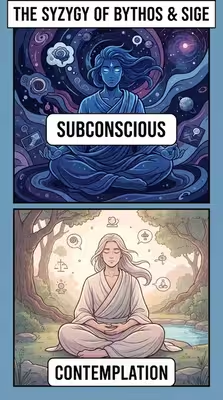
Bythos, the profound depth, symbolizes the unconscious field beneath the surface personality. It includes implicit memory, bodily learning, emotional residues, attachment expectations, survival responses, fantasies, fears, and capacities that have not yet entered conscious awareness. Sige, silence, represents the receptive condition required to encounter that depth. Silence is not merely the absence of sound. Psychologically, it is the interruption of compulsive stimulation long enough for automatic patterns to become perceptible.
The shadow of this pair appears in the modern architecture of distraction. Endless scrolling, compulsive work, substances, entertainment, food, noise, and constant communication can all function as ways of avoiding Bythos. The individual may believe they are simply relaxing or staying productive, yet the behavior may also be preventing contact with grief, shame, loneliness, fear, or an unacknowledged desire for change. The person remains externally occupied so that the internal world never becomes fully audible.
Integrated, Bythos and Sige create the psychological capacity for observation. A person can pause before acting, feel an emotion without immediately discharging it, and notice the difference between an actual present threat and an old survival expectation. This pause is the beginning of behavioral freedom. It does not eliminate impulse; it creates enough space for the impulse to be understood rather than obeyed.
Nous and Aletheia: Mind and Truth
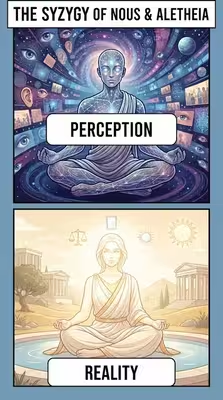
Nous represents the interpretive mind, while Aletheia represents truth—the effort to see what is actually occurring rather than what the ego needs to believe. The mind is not a neutral instrument. It protects continuity, identity, and belonging. It rationalizes behavior that would otherwise produce shame, converts fear into certainty, and creates narratives that preserve a familiar self-image. The conflict between Nous and Aletheia is therefore the cognitive dissonance between reality and the story constructed to avoid reality.
In behavioral change, this pair exposes the difference between explanation and excuse. A person may have understandable reasons for developing an addiction, becoming controlling, withdrawing from intimacy, or remaining in a destructive relationship. Understanding those reasons is essential, but explanation cannot become exemption from responsibility. Truth requires the ability to say, “This pattern began as protection, but it is now causing harm.” It requires acknowledging both the historical intelligence of the behavior and its present cost.
The shadow of Nous appears when intelligence becomes an instrument of evasion. A person may possess extraordinary insight into psychology and still use that insight to avoid feeling, apologizing, changing, or accepting limits. They may classify everyone around them as superior or inferior in order to stabilize their own insecurity. Aletheia corrects this by returning attention to observable consequences. What happened? What did I do? What am I avoiding? What would someone outside my defensive system see?
Acinetos and Syncrasis: Foundation and Fluidity
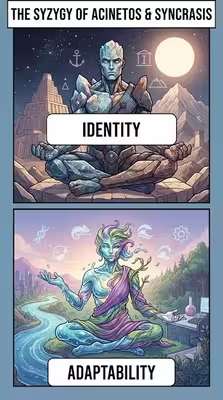
Acinetos is the immovable foundation, the deep sense of worth and continuity that does not depend entirely on approval, status, productivity, or possession. Syncrasis is mixture, flexibility, and the ability to participate in changing conditions without losing one’s shape. Together they describe secure identity.
A person lacking Acinetos may become a social chameleon. They absorb the expectations of partners, workplaces, families, online communities, and cultural trends, mistaking adaptation for belonging. Their personality changes according to the room because there is no sufficiently stable internal reference point from which to choose. The opposite distortion occurs when Acinetos is isolated from Syncrasis. The person becomes rigid, defensive, and doctrinal. Their beliefs must remain fixed because any revision feels like annihilation.
Psychologically mature adaptation is neither stubbornness nor surrender. It is the ability to say, “I can change my mind without losing myself.” A secure person can listen to criticism, enter unfamiliar environments, learn from other cultures, and revise an inherited belief without experiencing every adjustment as betrayal. Foundation allows flexibility to become growth rather than dissolution.
Logos and Zoe: Word and Life
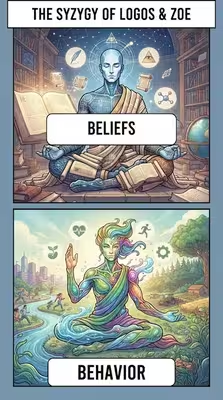
Logos represents language, narrative, internal speech, and the organizing pattern through which experience becomes meaningful. Zoe represents lived vitality: the embodied life produced by that internal organization. The two form a feedback loop. What a person repeatedly says and believes influences what they notice, expect, attempt, and avoid. What they repeatedly experience then reinforces the original narrative.
A hidden Logos such as “I am fundamentally broken,” “people always leave,” or “nothing I do matters” can become a predictive filter. The person interprets ambiguous events as confirmation, withdraws or self-sabotages, and then experiences the resulting isolation as proof of the belief. In this sense, language is not magical control over reality, but it is part of the behavioral machinery through which reality is selected and reproduced.
The integrated form of Logos and Zoe requires an honest, flexible inner language. This does not mean replacing every painful thought with a positive affirmation. It means learning to distinguish fact from prediction, identity from behavior, and present evidence from inherited expectation. “I failed at this task” is different from “I am a failure.” “I feel unsafe” is different from “I am in danger.” More accurate language produces more accurate choices, and more accurate choices gradually produce a different form of life.
The Decad: The Tenfold Field of Desire, Agency, and Relationship
The Decad extends the primary structure into the domains of action, desire, relationship, ancestry, social participation, and hope. If the Ogdoad establishes the inner conditions of consciousness, the Decad describes how that consciousness moves through the world. It includes the tension between self and pleasure, individual and community, depth and mixture, unique identity and happiness, and assistance and trust.
Autophyes and Hedone: Essential Nature and Pleasure
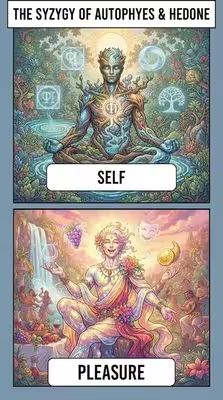
Autophyes represents the self-grown or intrinsic self, while Hedone represents pleasure and delight. Their integration is the difference between pleasure as expression and pleasure as anesthesia. When pleasure arises from contact with one’s values, relationships, creativity, embodiment, and authentic interests, it is restorative. When pleasure is used to compensate for the absence of identity, it becomes compulsive.
The Hedone shadow appears in addiction and material compulsion. The person feels an internal emptiness but interprets it as a demand for an external object, substance, purchase, sexual encounter, achievement, or digital stimulus. The reward is brief because the behavior does not address the underlying absence. The nervous system then seeks repetition, not because the person is weak, but because the reward system has learned that temporary relief is available through a predictable route.
Yet Autophyes can also become distorted when separated from Hedone. The person turns self-examination into punishment and treats ordinary pleasure as a threat to spiritual purity. Rest, food, intimacy, play, and beauty are regarded with suspicion. The result is not freedom but hypervigilance. A healthy identity must have a livable body and a world in which joy is permitted. Pleasure should neither be worshiped nor exiled; it should be brought into relationship with meaning.
Anthropos and Ecclesia: Individual and Community
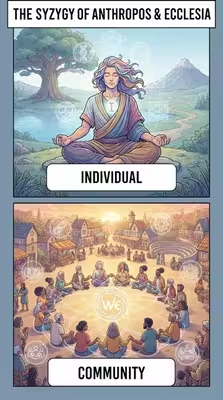
Anthropos represents the human individual, while Ecclesia represents the assembly, community, or collective. This pair asks how an individual can belong without disappearing. It challenges both radical individualism and total conformity.
The individual cannot develop outside relationship. Language, identity, values, and emotional regulation are shaped through families, friendships, institutions, and cultures. At the same time, the collective can become predatory when it demands the sacrifice of conscience, boundaries, health, or truth. People-pleasing is the shadow of Ecclesia: the person suppresses needs and convictions to preserve attachment. Narcissistic control is another shadow: the person treats the collective as an audience whose role is to confirm the individual’s importance.
Integration means reciprocal obligation. The person has responsibilities to family, community, coworkers, and society, but those systems also have responsibilities to the person. Belonging cannot be defined as one-way obedience. A family that demands total submission from a child is not expressing healthy unity; it is confusing authority with ownership. A parent who serves every whim of a child is not practicing unconditional love; they are failing to provide structure. A workplace that expects sacrifice without reciprocity turns loyalty into exploitation. Community becomes psychologically healthy when duties are mutual, roles are explicit, and the dignity of the individual is not treated as disposable.
Bythios and Mixis: Profound Depth and Mixture
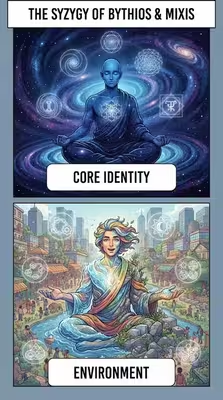
Bythios represents profound depth, while Mixis represents mixture and entanglement with the world. This pair describes the test of whether a person can enter complex environments without losing contact with their deepest values. Life is always a mixture of influences: family expectations, economic pressures, media narratives, institutional incentives, cultural habits, trauma, love, opportunity, and chance.
The shadow of Mixis is dissolution. The person becomes whatever the environment rewards. They adopt the priorities of the employer, the desires of the partner, the outrage of the media cycle, or the status symbols of their social group. When external roles disappear, the person experiences collapse because no inner continuity was developed. Bythios without Mixis produces the opposite problem: a profound inner identity that never risks contact with ordinary life. The person may understand themselves deeply but remain unable to translate that understanding into relationships, work, or service.
Integration requires alchemy rather than avoidance. The world is not merely a contaminant; it is also the place where values are tested and refined. A person discovers what they believe by encountering pressure, disagreement, loss, responsibility, and competing obligations. The goal is not to remain untouched by life but to metabolize experience without allowing every influence to become an unconscious command.
Monogenes and Macaria: Unique Self and Blessedness
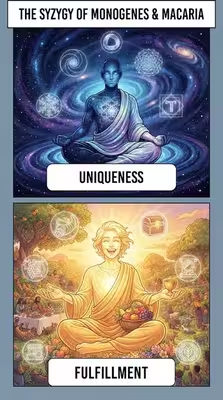
Monogenes symbolizes singularity—the irreducible uniqueness of the individual. Macaria symbolizes blessedness, happiness, or a state of inward fulfillment. Together they describe the psychological basis of non-transactional love.
When a person cannot experience themselves as intrinsically valuable, they use other people as mirrors. Relationships become instruments for proving desirability, importance, innocence, or security. The person may call this love, but the attachment is often to the emotional service provided by the other. When the partner stops regulating the person’s self-esteem, affection can evaporate.
The integrated form of this syzygy allows intimacy without possession. A person can want companionship without making the companion responsible for their entire sense of worth. Solitude becomes less threatening because being alone does not mean being abandoned by the self. This does not eliminate the need for others. It makes mutuality possible, because connection is no longer an emergency extraction of validation.
Paracletus and Pistis: Advocate and Faith
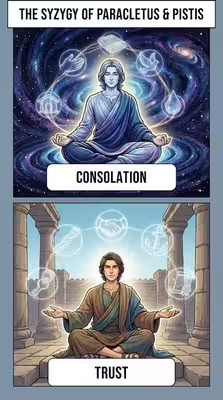
Paracletus represents the comforter, advocate, or helper, while Pistis represents faith and trust. Psychologically, the pair describes the inner capacity to remain oriented toward recovery during difficulty. Healthy hope does not deny evidence. It remembers that the present state is not the only state that has ever existed.
The shadow appears when comfort becomes rationalization. The internal advocate argues for the familiar destructive behavior: one more use, one more excuse, one more postponement, one more return to the person who repeatedly causes harm. Pistis becomes blind faith when it refuses to update itself in response to evidence. Intermittent reinforcement is especially powerful here. Occasional affection or success can keep a person attached to a damaging relationship, workplace, or habit because the mind continues waiting for the next reward.
Integrated trust is neither cynicism nor credulity. It includes trust in one’s capacity to act, trust in carefully evaluated relationships, and willingness to revise conclusions. A therapeutic or spiritual guide can support this process, but the purpose of guidance is to return authority to the individual rather than create dependency. Comfort should strengthen discernment, not replace it.
Patricas and Elpis: Ancestry and Hope
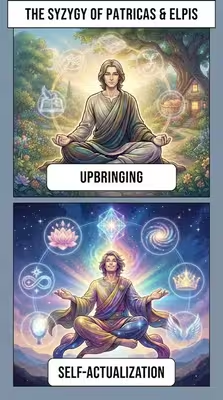
Patricas symbolizes lineage, ancestry, tradition, and inherited structure. Elpis symbolizes hope, expectation, and the future. Together they describe the psychological movement between what has been handed down and what can be consciously created.
Every individual receives more than genes from the past. Families transmit rules about emotion, money, conflict, work, gender, loyalty, religion, success, and failure. Some inherited patterns are valuable. Others are forms of unresolved fear that appear as duty. A person may remain small because unconscious loyalty whispers that surpassing the family would constitute betrayal. They may repeat an addiction, marriage pattern, financial pattern, or emotional silence because deviation feels like exile.
The integrated person neither worships nor reflexively rejects the past. Rebellion can remain a form of obedience if one’s identity is still organized entirely around doing the opposite of what one inherited. Mature individuation is more deliberate. It asks what should be preserved, what should be mourned, what should be repaired, and what must end. Hope becomes self-authored rather than imposed by ancestors, institutions, or social expectations.
Metricos and Agape: Maternal Holding and Unconditional Love
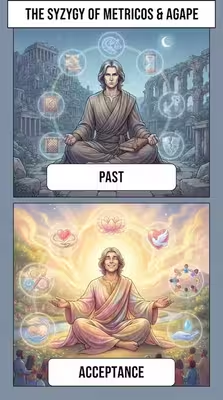
Metricos represents the maternal or nurturing matrix, while Agape represents unconditional love. Their psychological expression is self-compassion joined to accountability. This distinction matters because shame prevents behavioral learning. Guilt can say, “I did something harmful and must repair it.” Shame says, “I am the harm, and therefore repair is impossible.”
The shadow is the eternal debt system. The person believes that because they have failed, harmed someone, relapsed, disappointed their family, or wasted years, they must remain permanently condemned. They turn regret into identity and use self-punishment as evidence of moral seriousness. Yet endless self-hatred does not necessarily produce repair. It can become another form of self-absorption, keeping attention fixed on the ego’s badness rather than on the concrete needs of those affected.
Agape does not mean declaring harmful behavior acceptable. It means creating enough safety to face it accurately. Compassion makes accountability sustainable because the person does not need to flee from the truth in order to preserve a tolerable self-image. The nurturing function says, “You are responsible for what you did, and you are still capable of becoming different.” That is the psychological foundation of recovery.
The Dodecad: The Twelvefold Problem of Social and Spiritual Belonging
The Dodecad can be read as the expansion of inner integration into the full complexity of social, spiritual, historical, and ethical life. It asks not merely whether one knows oneself, but how one inhabits roles. Human beings are never only private selves. They are children, parents, partners, employees, employers, citizens, neighbors, believers, skeptics, caregivers, creators, and people in need. Each role can become a channel of service or a mask adopted for survival.
Ecclesiasticus and Macariotes: Role, Community, and Blessed Participation
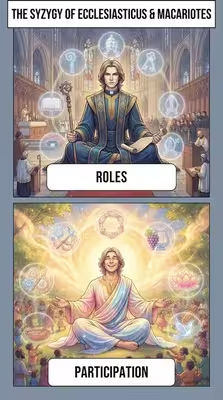
Ecclesiasticus, the churchman or son of the church, represents the person as a participant in an organized spiritual and social whole. Macariotes represents blessedness, grace, and the lived condition of flourishing within that whole. Together they ask the central ethical question: How does one belong without becoming possessed by belonging?
The question is not simply whether one has a duty to the whole or whether one should live entirely for oneself. Both extremes are inadequate. A person who lives only for themselves becomes isolated from the relationships and systems that sustain life. A person who lives entirely for the whole may sacrifice conscience, health, individuality, and truth to maintain an external order. Integration requires a reciprocal model: the individual contributes to the whole, and the whole must protect the conditions under which individuals can remain fully human.
This is especially visible in family roles. A child is not required to be solely obedient in order to belong. Children need guidance and limits, but healthy authority is developmental rather than possessive. Its purpose is to help the child become capable of judgment, responsibility, and eventual independence. Parents are not required to serve every desire of their children. Their responsibility includes care, protection, instruction, boundaries, and the gradual transfer of agency. The family becomes integrated when love is not confused with either domination or indulgence.
The same principle applies to employment. An employee may feel loyalty to a company and may willingly sacrifice time or comfort for a meaningful project, but sacrifice should be evaluated in the context of reciprocity. If the company demands unlimited devotion while offering no security, respect, recognition, or humane conditions, the worker’s sense of obligation may be functioning as internalized exploitation. Conversely, an employee who treats every responsibility as an unacceptable intrusion may be exercising autonomy without accountability. The integrated worker understands that employment is an exchange of labor, skill, time, and compensation—not a demand for total identity surrender.
Entrepreneurship and self-employment reveal another dimension of the pair. The entrepreneur may experience themselves as independent, but independence does not mean freedom from obligation. Customers, collaborators, contractors, families, and communities are part of the enterprise’s moral field. Self-employment can express autonomy and creativity, yet it can also become a way of avoiding structure, feedback, or responsibility. Macariotes is not the fantasy of doing whatever one wants. It is the blessedness that emerges when freedom is joined to meaningful contribution and sustainable limits.
The question becomes even more important when someone is in need. A society that treats need as personal failure abandons the relational nature of human life. No person is entirely self-created; everyone depends on others at different points through childhood, illness, disability, unemployment, grief, or crisis. At the same time, support should not erase agency or create permanent infantilization. The healthy whole offers assistance in ways that restore capacity, dignity, and participation. The individual, when able, has obligations to others not because their worth depends on usefulness but because shared life requires mutual care.
In spiritual life, Ecclesiasticus and Macariotes ask what one believes the divine to be and how belief affects conduct. Spiritual belonging can offer meaning, ritual, moral orientation, and community. It can also become a defensive identity. When a person has not examined other faiths, philosophies, or forms of spirituality, their belief may be less a chosen conviction than an inherited boundary protecting them from uncertainty. Unexamined certainty can produce bigotry, exclusion, judgmentalism, and the belief that outsiders are morally defective simply because they inhabit another symbolic world.
The problem is not commitment itself. A person can hold a serious spiritual conviction while remaining intellectually humble. Examination does not necessarily destroy faith; it can distinguish faith from fear. A mature spiritual life can ask what a tradition teaches, what it produces in practice, which aspects are life-giving, and where it has been used to justify domination. It can learn from other traditions without treating every difference as a threat. When spiritual identity becomes integrated, it enlarges the person’s capacity for compassion and discernment rather than narrowing their circle of concern.
The shadow of Ecclesiasticus is role captivity. One becomes so identified with being the obedient child, perfect parent, loyal employee, self-sacrificing believer, or indispensable helper that the underlying self disappears. The person believes they are serving the whole, but may actually be seeking safety through indispensability. If they stop performing the role, they fear they will no longer deserve love or belonging.
Macariotes corrects this by redefining blessedness. Grace is not the reward for perfect role performance. It is the condition that allows a person to inhabit roles without confusing them with their entire identity. One may be a parent without existing solely for the child. One may be an employee without belonging to the corporation. One may be a spiritual participant without surrendering conscience to an institution. One may care for the community without treating personal needs as morally illegitimate.
Ageratos and Henosis: The Ageless Past and Union
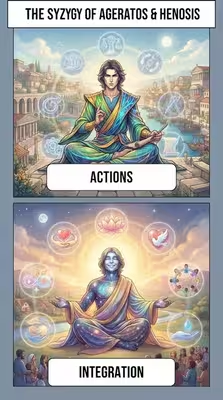
Ageratos represents what cannot be made young again or altered by regret. Henosis represents union, the reintegration of divided experience. Together they describe the psychological work of accepting the past without allowing it to become a sentence.
The past is fixed, but its meaning is not entirely fixed. A person cannot undo childhood, relapse, betrayal, homelessness, abandonment, or a harmful decision. They can, however, change the relationship they have to those events. Rumination often pretends to be problem-solving while repeatedly reopening an unchangeable scene. Henosis interrupts this fragmentation by bringing the event into a larger account of the self: what happened, what it taught, what it damaged, what can still be repaired, and what must be mourned.
Integration does not mean approving of the past or claiming that everything happened for a reason. It means refusing to let an old event remain the only interpreter of the present. The past can become an educator rather than a ruler. A person may carry scars without organizing every new decision around the fear of being wounded in the same way.
Ainos and Synesis: Honor and Systems Intelligence
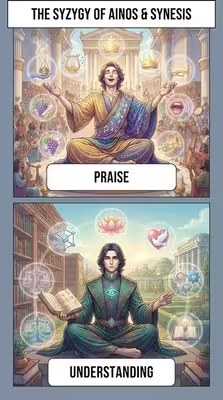
Ainos represents praise, glory, honor, and the direction of reverence. Synesis represents intelligence, synthesis, conscience, and pattern recognition. Together they describe the capacity to see how individual behavior emerges from complex systems.
Synesis prevents the simplistic search for one cause. Addiction may involve trauma, reinforcement, isolation, opportunity, belief, physiology, social context, and meaning. A dysfunctional relationship may involve attachment history, communication patterns, economic dependency, fear, and intermittent reinforcement. A career crisis may involve inherited expectations, identity, exhaustion, and a mismatch between values and institutional demands.
The shadow of Synesis is intellectualization. The person becomes brilliant at describing the system and remains unwilling to feel the grief, fear, or responsibility within it. The shadow of Ainos is external applause. The person seeks recognition for their insight and gradually turns healing into performance. Integrated honor is quieter. It is the experience of living in alignment with one’s conscience even when no audience is present.
Sophia and Theletos: Wisdom and Will
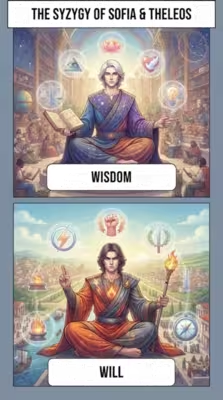
Sophia represents wisdom and the inner map of understanding, while Theletos represents will, resolve, and active execution. Together they bridge the gap between insight and enactment. Understanding a psychological pattern or behavioral trap is necessary, but insight alone does not automatically reorganize nervous system responses or alter habits.
The shadow of this syzygy appears when wisdom is isolated from will, resulting in passive intellectualization. A person may accumulate profound psychological insights, diagnose their own history accurately, and still remain entirely stuck in destructive routines because they never cross the threshold into intentional, decisive action. Conversely, when will is isolated from wisdom, it manifests as brute-force discipline or stubborn self-coercion. Pushing forward without insight suppresses symptoms temporarily while ignoring the underlying drivers of behavior.
Integrated, Sophia and Theletos transform how change happens. Wisdom illuminates the path by revealing what must change and why, while will provides the focused executive force required to navigate it. The internal map and the active step move together, allowing a person to translate awareness into sustainable behavioral evolution rather than endless self-analysis.
The Larger Question: Does the Self Serve the Whole, or the Whole Serve the Self?
The Pleroma does not resolve this question by assigning absolute priority to either side. It dissolves the false opposition. The self is formed through the whole, yet the whole is continually reshaped by the selves within it. A family becomes healthier when one member refuses to continue a generational pattern. A workplace becomes more ethical when an employee names exploitation rather than normalizing it. A religious community becomes more humane when a participant insists that doctrine cannot justify cruelty. A society becomes more resilient when it supports people in crisis without reducing them to their crisis.
Obligation, in this framework, is not blind obedience. It is a relationship between freedom and consequence. Every person has the right to develop an individual life, but individual actions occur within networks of dependence. The question is not whether one has obligations; the question is whether those obligations are conscious, reciprocal, proportionate, and compatible with human dignity.
An obligation becomes pathological when it demands the destruction of the person who fulfills it. A duty becomes meaningful when it expresses chosen values rather than fear of rejection. Service becomes healthy when it is offered freely and bounded by reality. Sacrifice becomes dangerous when it is required to prove worth or preserve an unjust system. Belonging becomes liberating when the person can remain truthful inside it.
Behavioral Change as the Restoration of the Whole
The psychological value of the Pleroma is that it reframes behavioral change as integration rather than conquest. A person does not need to destroy the parts of themselves that developed under pressure. The compulsive part, the avoidant part, the angry part, the people-pleasing part, and the rationalizing part each emerged within a history. They may be outdated, but they are not meaningless. Change begins when their protective intention can be recognized without allowing their method to remain in control.
Bythos and Sige create the pause in which the pattern can be observed. Nous and Aletheia separate explanation from denial. Acinetos and Syncrasis provide stability and flexibility. Logos and Zoe revise the feedback loop between narrative and lived experience. Autophyes and Hedone reconnect pleasure with identity. Anthropos and Ecclesia restore reciprocal belonging. Patricas and Elpis transform inherited programming into conscious hope. Metricos and Agape replace shame with accountable compassion. Ecclesiasticus and Macariotes allow the person to inhabit social and spiritual roles without becoming imprisoned by them. Ageratos and Henosis integrate the past. Ainos and Synesis reveal the system as a whole.
The result is not perfection. It is a greater ability to remain present while contradictory truths coexist. One can love a family and set boundaries. One can serve a community and refuse exploitation. One can honor tradition and reject its harmful elements. One can accept help and retain agency. One can experience pleasure without using it as anesthesia. One can acknowledge guilt without becoming shame. One can belong to a spiritual path without treating every other path as an enemy.
The Pleroma, read psychologically, is therefore not a demand to fit oneself into a preexisting cosmic role. It is an image of a life in which roles are consciously examined and consciously inhabited. The goal is not to become a perfect child, parent, worker, entrepreneur, believer, citizen, or helper. The goal is to become sufficiently integrated that each role expresses the person rather than replacing them.
To live in the fullness of the Pleroma is to understand that the self and the whole are not enemies. The self needs the whole for language, care, culture, challenge, and relationship. The whole needs selves capable of conscience, creativity, dissent, responsibility, and renewal. Psychological maturity begins when one stops asking, “Which side must be sacrificed?” and begins asking, “What form of relationship allows both the individual and the whole to become more alive?”

About The Author
Adam Fistler is a Behavioral Change Consultant, Board Certified Hypnotist, Certified 5-PATH® Hypnotist, and former owner of the Baltimore Hypnosis Center. A member of the International 5-PATH® Hypnosis Association and certified by the National Guild of Hypnotists, Adam has studied hypnosis, behavior change, and the relationship between thoughts, beliefs, emotions, and behavior for more than two decades.
His perspective is shaped by more than professional training. Adam has also lived through addiction and recovery firsthand across South Jersey and the Philadelphia region, including surviving on the streets of Camden. This gives him a deeply personal understanding of the struggle from both sides: as a practitioner who has helped others create change and as someone who has had to confront his own deeply ingrained patterns and beliefs.
During his own recovery, Adam returned to the principles of hypnosis, mindfulness, self-talk, and behavioral change that he had studied throughout his career. He discovered that recovery could be about more than simply managing cravings or avoiding relapse—it could also be an opportunity to understand the beliefs, emotional patterns, and experiences that had shaped his behavior.
Today, Adam combines his professional experience with the lessons of his own journey to serve clients throughout South Jersey, Philadelphia, and beyond, helping others explore the possibility of meaningful, lasting change. His approach is grounded in empathy, curiosity, practical tools, and the belief that people are more than the behaviors they are trying to overcome.
Explore my Hypnosis Resouces
Contact Adam Fistler, BCH - Behaviroal Change Consultant
Examine a Brief Overview Hypnosis
Learn how Hypnosis Works Under the Hood & How it Physically Affects the Brain
Learn more about Hypnosis Services & Common Issues People use Hypnosis to Address
Learn how Others have Benefited from my Hypnosis Experience by Browsing Client Testimonials
Discover how Hypnosis can Help You Release Anger, Impulsivity, and Road Rage.
Discover how Hypnosis aids with Addiction & Recovery
Discover how Hypnosis can Help you Lose Weight, Manage Cravings, and Overcome Emotional Eating.
Explore my Hypnosis Articles
Review all my Hypnosis Articles
Baltimore Hypnosis Center: A Journey of Personal and Professional Transformation
10 Things to Consider When Choosing a Hypnotist
10 Ways Hypnosis Can Help You Lose Weight
Attract Your Ideal Partner by Focusing Your Mind
Unlocking Freedom from Chronic Pain: Harnessing the Power of Hypnosis
The Essence of Change: Empowering Transformation Through Hypnosis
Should You Use Hypnosis to Lose Weight?
Should You Use Hypnosis to Stop Smoking?
Breaking Free: The Nice Guy's Journey to Authenticity
Winning the Battle Within: Overcoming the Urge
Debunking Hypnosis Myths: Unveiling the Truth Behind Common Misconceptions
Unlocking Wellness: The Profound Influence of the Mind-Body Connection in Healing
Exploring the Subconscious Mind: Unveiling the Depths of Your Mental Landscape
Exploring the Benefits of Gratitude Practices
The Surprising Link Between Hypnosis and Stress Reduction: A Comprehensive Guide
Gnsotic Aeon Pairings: The Pleroma as a Psychology of Becoming
Discussion