Everything Is RadioShack Now
How Big Tech Is Like RadioShack Asking for Your Name and Address to Buy Batteries
Author: Adam Fistler, BCH - Behavorial Change Consultant ( adam@adamfistler.com )
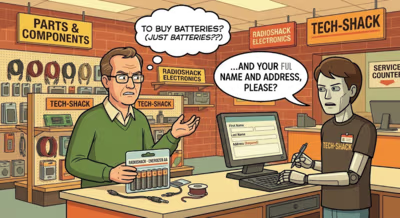
Remember RadioShack?
You could walk into the store for something completely ordinary—usually batteries, a cable, or some other small electronic necessity—and leave feeling as though you had applied for a mortgage.
The joke was that RadioShack wanted your name, address, phone number, and possibly every other detail about your life before allowing you to buy a couple of batteries. It was absurd because the transaction was so simple:
You gave RadioShack money. RadioShack gave you batteries. The interaction should have ended there.
At the time, that kind of data collection seemed excessive enough to be funny.
Now it feels less like a joke and more like a preview.
Welcome to the Modern RadioShack
Today, you may need to identify yourself before doing almost anything.
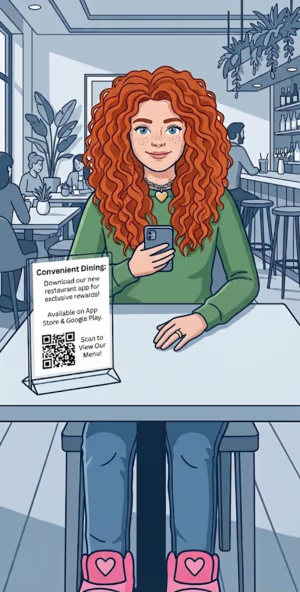
Want to read a restaurant menu?
Scan this QR code.

The menu opens in your browser, perhaps after asking you to accept cookies, enable location access, or visit a website designed primarily to collect information about you. What used to be a laminated piece of paper sitting on the table has become an invitation to enter a company’s digital system.
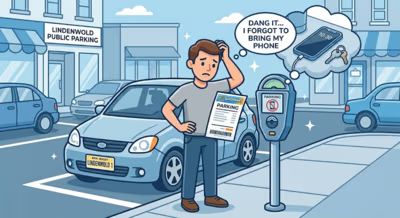
Want to park your car?
Download the app, create an account, enter your license plate, provide your payment information, and allow the service to know where you are parked.
Want the advertised price at a grocery store?
Join the loyalty program.
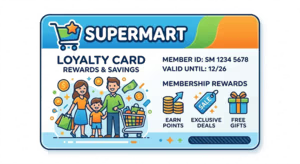
Want a discount at a fast-food restaurant?
Download the app.
Want a digital receipt?
Give the store your email address.
Want to use public Wi-Fi?
Provide your email, phone number, or social-media account.
The transaction itself may take seconds. Establishing your identity takes longer.
The Account for the Twenty-Second Task
The same thing happens online.
Suppose you need to convert a JPEG into an AVIF file. It is a small, uncomplicated task. The sort of thing that used to be handled by a simple utility:
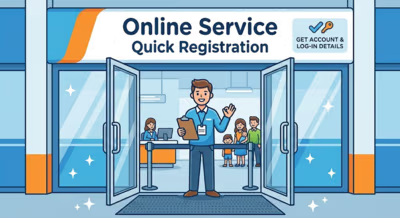
Upload the file. Convert it. Download the result.
Now the process may look more like this:
Create an account.
Verify your email.
Accept the cookie settings.
Provide a phone number.
Upload the file.
Discover that the free version has limitations.
Wait for the conversion.
Download the result.
Receive marketing emails.
The file conversion may take twenty seconds. Joining the service takes five minutes.
The same pattern appears when you want to resize an image, compress a PDF, remove an image background, extract a page from a document, print a file, or use some other small online utility.
The Internet used to be full of tools that let you perform a task and leave. Increasingly, those tools have become services that want you to register before they will help.
You are not merely using the tool anymore.
You are becoming a user.
When the Store Wants More Than the Sale
There is nothing especially strange about a business wanting to sell you something. That is the basic arrangement.
The problem is the growing expectation that every transaction should become the beginning of an ongoing relationship.
The grocery store does not simply want to sell you groceries. It wants your identity connected to your purchases.
The restaurant does not simply want to serve you food. It wants you to order through its app.
The parking company does not simply want to collect payment. It wants your license plate, location, phone number, payment details, and continued participation in its platform.
The website does not simply want to convert your file. It wants an account, an email address, and the opportunity to bring you back.
The result is that ordinary life increasingly involves a series of small negotiations:
Can I do this without registering?
Can I pay without installing an app?
Can I read this without accepting tracking?
Can I receive the ordinary price without joining a loyalty program?
Can I use this tool without giving away my email address?
Can I complete this task without creating another password that will eventually need to be recovered through my phone?
These used to be simple interactions. Now they are often conditional.
The Physical World Is Becoming an App
The most noticeable change is that activities that used to require nothing more than showing up increasingly require a phone.
Parking meters need apps.
Public transportation systems use apps and digital tickets.
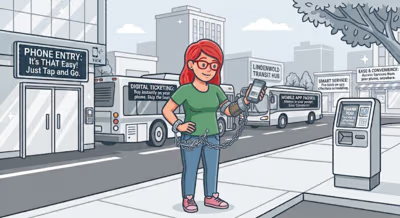
Gyms use apps for entry.
Apartment buildings use apps for access.
Hotels encourage or require mobile check-in.
Events distribute tickets through digital accounts.
Charging stations require registration.
Laundry machines accept payments through apps.
Even some vending machines want a phone between you and the thing you are trying to buy.
The issue is not that apps are always bad. Some are convenient. Some genuinely improve a service.
The issue is what happens when the app stops being an option and becomes the entrance.
The physical world may still be there, but access to it increasingly depends on participation in a digital platform.
You do not simply park. You become a parking-app customer.
You do not simply enter the building. You authenticate through the building’s system.
You do not simply buy the item. You identify yourself to receive permission, access, or the advertised price.
A Tool or a Relationship?
There is an important difference between a tool and a service ecosystem.
A tool helps you perform a task. You use it, accomplish what you came to do, and move on.
A service ecosystem wants an ongoing relationship. It wants an account, a profile, a history, a way to contact you, and a reason for you to return.
This is why such small requirements can feel disproportionate. The service is asking for a relationship when you only wanted to complete a transaction.
You wanted to read a menu.
It wanted your browser activity.
You wanted to park.
It wanted your license plate and account information.
You wanted to convert an image.
It wanted to turn a one-time task into a registered user.
You wanted batteries.
RadioShack wanted your name and address.
The difference is that RadioShack’s demand was once ridiculous enough to become a cultural joke. Today, the same basic demand is often presented as convenience, personalization, security, or modernization.
Sometimes those explanations are legitimate. Sometimes they are not.
But the result is similar: a simple interaction becomes an opportunity to identify, classify, track, and retain the person performing it.
Everything Is RadioShack Now

The old RadioShack joke was funny because it exposed a mismatch.
The store was treating the purchase of batteries as though it were a meaningful personal relationship. The amount of information being requested did not match the importance of the transaction.
That mismatch has become normal.
A menu requires a website.
A parking space requires an account.
A discount requires a profile.
A receipt requires an email address.
A file converter requires registration.
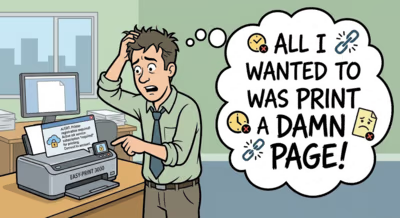
A printer requires an app.
A public service requires a phone.
None of these individual examples is necessarily the end of the world. But taken together, they describe a broader change in the way ordinary tasks are organized.
Simple transactions are increasingly being converted into persistent digital relationships.
You no longer just buy the batteries.
You become a customer profile that happens to receive batteries.
And that raises a larger question: what happens when technology stops being a tool we use and becomes a system we must participate in before we are allowed to do ordinary things?
That is a much bigger subject—one involving privacy, centralization, dependence, and the gradual outsourcing of human agency. It is also the subject of another set of articles.

About The Author
Adam Fistler is a Behavioral Change Consultant, Board Certified Hypnotist, Certified 5-PATH® Hypnotist, and former owner of the Baltimore Hypnosis Center. A member of the International 5-PATH® Hypnosis Association and certified by the National Guild of Hypnotists, Adam has studied hypnosis, behavior change, and the relationship between thoughts, beliefs, emotions, and behavior for more than two decades.
His perspective is shaped by more than professional training. Adam has also lived through addiction and recovery firsthand across South Jersey and the Philadelphia region, including surviving on the streets of Camden. This gives him a deeply personal understanding of the struggle from both sides: as a practitioner who has helped others create change and as someone who has had to confront his own deeply ingrained patterns and beliefs.
During his own recovery, Adam returned to the principles of hypnosis, mindfulness, self-talk, and behavioral change that he had studied throughout his career. He discovered that recovery could be about more than simply managing cravings or avoiding relapse—it could also be an opportunity to understand the beliefs, emotional patterns, and experiences that had shaped his behavior.
Today, Adam combines his professional experience with the lessons of his own journey to serve clients throughout South Jersey, Philadelphia, and beyond, helping others explore the possibility of meaningful, lasting change. His approach is grounded in empathy, curiosity, practical tools, and the belief that people are more than the behaviors they are trying to overcome.
Explore my Technology Resources
Contact Adam Fistler BCH - Behavioral Change Consultant
Examine a Brief Overview of Technology Background
Explore some Select Project's I'm Working On
Explore my Technology Articles
Outsorucing Your Agency: The Platform Wants to Be Your Higher Power
When the Machine Becomes the Scapegoat: Applying the Family Systems Model to Corporate America