
When the Machine Becomes the Scapegoat: Applying the Family Systems Model To Coroprate America
Author: Adam Fistler, BCH - Behavorial Change Consultant ( adam@adamfistler.com )

Most people have seen a family avoid an uncomfortable problem by focusing on one person. Something is wrong, but nobody is willing to talk about what it is. One person makes excuses. Another tries to keep the peace. Someone becomes angry. Someone else gets blamed for “causing drama.” Before long, the family has a simple story: that person is the problem.
The story may not be fair, but it can be easier to live with than the truth. If everyone focuses on one person’s behavior, nobody has to ask what is happening inside the family as a whole.
This article is not saying that a corporation is literally a family or that artificial intelligence is literally a child. Those comparisons would go too far. A child has feelings, a body, relationships, and personal experiences. An AI does not have those things in the human sense. A corporation is an organization, not a household.
The comparison is a functional analogy. That means two things can be very different while still showing a similar pattern under pressure. Family systems can hide problems, assign roles, protect an image, and place blame on one member. Corporations can sometimes do similar things. Looking at them through the same lens can help us notice what ordinary business language tends to hide.
Families Have Roles

In some families, people fall into recognizable roles.
One person becomes the responsible one. They work hard, solve problems, and give the family something to feel proud of. Another person covers for someone else’s drinking, anger, or dishonesty. One person keeps quiet and tries not to create more trouble. Another becomes openly angry and says what everyone else is thinking. Someone may eventually be treated as the family’s problem, even though they are expressing a problem that belongs to the whole family.
These roles do not always come from a conscious decision. Nobody necessarily sits down and says, “You will be the scapegoat, and you will be the peacemaker.” The roles develop through repetition. People learn what gets rewarded, what causes conflict, and what the family refuses to discuss.
A child may discover that speaking honestly leads to punishment, while pretending everything is fine earns approval. Another child may learn that acting out is the only way to receive attention. Over time, each person adapts to the family’s rules, including the rules that are never spoken aloud.
Family systems theory gives us a way to look at these patterns. It asks us to consider not only what one person is doing, but how everyone else responds and how the whole group helps keep the pattern going.
Corporations Have Roles Too

Corporations are not families, but they can develop similar patterns.
A company has a public image it wants to protect. It has people who make decisions, people who explain those decisions, people who carry them out, and people who experience their consequences. It also has subjects that are safe to discuss and subjects that are not.
A company may say it values honesty, while employees learn that certain forms of honesty are dangerous. They may be encouraged to offer feedback, but only if the feedback does not challenge leadership too directly. They may be told to take initiative, but criticized when their independent judgment leads somewhere management did not expect.
Eventually, workers learn the difference between what the organization says and what it actually rewards.
The official message might be, “We welcome difficult conversations.” The practical message might be, “Do not bring us information that could damage the company’s image.”
This does not require every manager to be dishonest. Many people inside an organization may sincerely believe they are doing the right thing. They may be repeating language they inherited from the people above them. They may also depend on the organization for income, health insurance, status, or a sense of security. Keeping quiet can become a form of survival.
The Corporate Golden Child

In a family, the golden child represents the image the family wants to present. They may be the successful one, the talented one, or the one everyone points to as proof that the family is doing well. Their role is not necessarily easy. They may be under constant pressure to remain impressive. Still, they often receive protection that other family members do not.
Corporations have golden children too. It might be a product, a platform, a famous executive, or a division that brings in most of the money. The company builds its identity around this part of itself. It becomes proof that the organization is innovative, successful, and good for the world.
Because so much of the company’s image is attached to the golden child, criticism becomes difficult. Problems may be treated as isolated accidents. People may be told that the product is improving, even when its harmful effects are obvious to the people using it. The organization protects the symbol because admitting the truth about the symbol would raise questions about the entire family.
The People Who Keep the Story Going

Every troubled system has people who help preserve its story. They may not have created the problem, but they make it easier for everyone else to avoid facing it.
In a family, this might be the person who makes excuses for a parent’s behavior, hides evidence of the problem, or tells the children not to make a big deal out of it. In a company, similar work can be done by public relations departments, executives, consultants, lawyers, managers, and sometimes journalists or commentators who repeat the organization’s preferred explanation.
A mass layoff becomes “a difficult but necessary transition.” A demand for more work becomes “an opportunity to grow.” A service that has become worse becomes “a new user experience.” A system that collects more information becomes “a way to improve personalization.”
Sometimes these descriptions are partly true. A company may genuinely be going through a transition. A new service may have legitimate benefits. But language can also soften reality until the human cost disappears.
The words matter because they shape what people are allowed to notice. If exhaustion is called an opportunity, then objecting to it can make a worker seem ungrateful. If surveillance is called personalization, then concern about privacy can be treated as resistance to progress.
The Rebel and the Problem Person
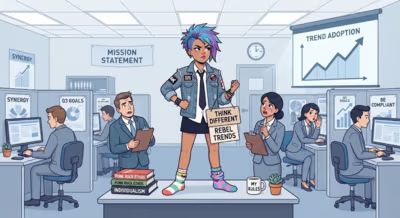
In many families, someone eventually says what everyone else avoids saying. They may ask why a parent keeps drinking, why money is missing, or why everyone must pretend that things are normal. The family may appreciate the honesty, but it may also punish the person for disturbing the peace.
Companies can respond in much the same way to uncomfortable questions. The employee who raises concerns may be called negative, disloyal, difficult, or unable to work with others. The criticism is turned into a problem with the person’s attitude.
This is one way a system protects itself. Instead of asking whether the criticism is accurate, people ask whether the critic is pleasant enough, loyal enough, or professional enough. The organization judges the messenger and avoids the message.
Of course, not every criticism is correct, and not every critic is acting in good faith. But a healthy organization should be able to examine uncomfortable information without automatically treating the person who raised it as the problem.
How the Scapegoat Works

A scapegoat is the person or thing that receives blame for problems created by the larger group.
In a family, the scapegoat might be the child who is always described as unstable, angry, or difficult. The child may have real problems, but those problems do not explain everything happening in the home. The label allows everyone else to avoid looking at the larger situation.
In a corporation, the scapegoat might be an employee, a department, a contractor, an algorithm, or a piece of software. The organization can point to that visible part and say, “That is where the problem came from.”
This is where artificial intelligence enters the picture.
When AI Becomes the Scapegoat
Most people have asked an AI a question and received an answer that sounded confident but was wrong. It may invent a source, give an incorrect date, misunderstand the question, or combine unrelated facts into a convincing story.
These mistakes are real. They can be serious, especially when people rely on AI for medical, legal, financial, educational, or professional information. But the mistake did not come from nowhere.
An AI system is built by people. People choose what kind of system to create, what data to use, what material to leave out, how to test it, what rules to give it, how quickly to release it, and where to place it. Companies also decide whether the system should prioritize caution, speed, convenience, user engagement, low cost, or a confident tone.
When the AI gives a false answer, the machine is often treated as though it independently decided to invent a story. That language makes the machine seem more responsible than the people and institutions behind it.
The public hears that the AI “hallucinated.” The discussion then focuses on the strange behavior of the machine. Less attention goes to the decisions that shaped the machine’s behavior.
Who trained it? What did the training material contain? What was removed? What was rewarded? What kind of answer was the system encouraged to give when it did not know? Why was it placed in a situation where people might mistake fluent language for verified knowledge?
The AI may be responsible for producing the incorrect answer in a practical sense. But it can also become the easiest part of the system to blame.
A Functional Analogy to a Conflicted Child

A child in a troubled family may see or sense something that the family refuses to acknowledge. The child may be told not to talk about it, to stop imagining things, or to accept the family’s explanation. The child then has to find a way to live with two conflicting messages:
I know what I saw.
I am not allowed to say that I saw it.
The child may create explanations that make the family seem safer or more understandable. This is not because the child is weak or foolish. It may be a way of preserving a relationship that the child depends on.
An AI does not have that kind of inner life. It does not feel fear or loyalty, and it does not protect itself from an abusive parent. Still, the comparison can help us understand a similar kind of pressure.
An AI system may be trained on a large collection of conflicting human material. Later, it is given instructions about what it should say, how it should say it, what it should avoid, and how helpful or confident it should appear. It may be expected to give a clear answer even when the information is incomplete or uncertain.
When those demands do not fit together, the system may produce a smooth explanation rather than admit that it cannot support one. That explanation can resemble a rationalization: a story that makes the situation sound orderly without actually resolving the problem.
The comparison is not that the AI is traumatized. It is that both situations can involve a pressure to produce an acceptable explanation when the underlying reality is difficult, contradictory, or forbidden.
The Role of Sanitization

Sanitization is not the only reason AI systems make things up. Language models can be wrong because their information is incomplete, outdated, or contradictory. They generate likely language rather than automatically checking every statement against reality.
Still, restrictions and corporate priorities can affect how a system handles uncertainty.
An AI may be designed to avoid certain subjects. It may be instructed to redirect a question, use cautious language, or refuse a request. These rules can serve legitimate purposes. Some information can cause real harm, and a system should not provide every answer without limits.
The problem appears when the system is expected to be helpful and confident while being unable to explain what it cannot say or why it cannot say it. If it cannot give a direct answer but is still pushed to produce a polished response, it may offer vague language, a shallow substitute, or an answer that sounds more certain than the evidence allows.
A more honest system would be able to say:
I do not have enough reliable information to answer that.
Or:
I cannot answer this directly, but I can explain the limitation.
That kind of answer may be less impressive, but it is more trustworthy.
The larger issue is not simply that companies restrict technology. All tools have limits. The issue is whether those limits are made clear to the people using the tool. Hidden restrictions create confusion. Confusion makes it harder to tell whether an answer is incomplete because the system lacks information, because it has been instructed to avoid the subject, or because it is simply guessing.
The Public Image Comes First

This pattern is not limited to AI. Modern corporate culture often rewards the appearance of health more than health itself.
Consider professional social media. Platforms such as LinkedIn encourage people to present their work lives as a series of lessons, achievements, and positive changes. People are expected to turn disappointment into inspiration, exhaustion into growth, and job loss into a personal transformation story.
There is nothing wrong with hope. People can find meaning in difficult experiences, and positive stories can help others. The problem is that the platform leaves little room for experiences that have not yet become inspiring.
A worker who is angry about being exploited may be told to improve their attitude. Someone who is afraid of losing their income may be encouraged to see the situation as an opportunity. A manager who lays off employees may present the decision as an act of bold leadership.
The language can make harmful behavior seem admirable. It can turn the person with power into the hero and the people who suffer the consequences into background details.
This does not mean everyone on LinkedIn is psychopathic, or that every ambitious person is exploitative. It means that a platform can reward certain behaviors without openly announcing what it is doing. Self-promotion, emotional control, relentless optimism, and loyalty to the organization may receive more attention than honesty about what work is actually doing to people.
The result is a public culture where the image of success matters more than the conditions producing it.
Technology and the Human Being

When users interact with a corporation, they are often treated less like people and more like sources of data, attention, labor, and revenue. Their behavior is measured. Their preferences are recorded. Their time is divided into clicks, views, purchases, and predictions.
The language used to describe this relationship is usually friendly. Users are called members, communities, creators, customers, or partners. But friendly language does not necessarily create a fair relationship.
A person can be treated warmly while still being treated as a commodity. A platform may speak about connection while making money from surveillance. A company may speak about empowerment while designing products that increase dependence. A service may claim to make life easier while removing the user’s ability to understand or control what is happening behind the screen.
This is another place where the family comparison can help. In an unhealthy family, a person may be told they are loved while their needs are ignored and their behavior is controlled. In an unhealthy company, users may be told they are valued while their attention and personal information are treated as resources.
The systems are not the same. The comparison simply helps us notice the difference between what a relationship is called and how it actually functions.
What This Perspective Can Reveal
Someone who has spent years working with computers and also studied psychology, addiction, recovery, family systems, or Jungian ideas may notices connections that are easy to miss when each subject is kept separate.
Technology shows how systems are built and how they behave. Psychology shows how people adapt to pressure, conflict, secrecy, and reward. Family systems show how roles develop between people. Recovery shows how patterns that once helped someone survive can later become destructive. Jungian psychology, at its most useful, asks us to look at what individuals and groups push into the background—the parts of themselves they do not want to recognize.
Together, these perspectives raise a difficult question:
What happens when organizations build technology that reflects the conflicts they refuse to examine?
A company that values speed over care may build tools that move faster while becoming less trustworthy. A company that treats users as data may create systems that know more about people while understanding less about their actual lives. A company that hides uncertainty may build an assistant that sounds confident precisely when it should be cautious.
The machine does not have to be human for human problems to appear in its behavior. People designed the system, selected its goals, and placed it inside a larger culture. The tool carries those decisions forward.
Looking at the Whole System

When a child is blamed for every problem in a family, the child may need help, but blaming the child alone will not heal the family. The adults, the rules, the silence, and the history also have to be examined.
The same is true of corporate technology. Correcting a false AI answer is necessary, but it is not enough. We also have to ask why the system was expected to answer, why it sounded so confident, how it was tested, what information it could access, what information it could not access, and what financial pressure shaped its release.
The point is not to excuse the machine. It is to widen the circle of responsibility.
If a company blames the AI every time something goes wrong, it may never examine the conditions that made the failure likely. The machine becomes the family scapegoat: the visible member that carries the tension of the whole group.
A healthier system would do something different. It would allow people to discuss problems before they become crises. It would make limitations visible. It would reward employees for reporting risks instead of punishing them for creating discomfort. It would treat users as people rather than raw material. It would admit when a tool should not be used for a particular task.
The goal would not be to create perfect technology. No system built by people will be perfect. The goal would be to stop pretending that every failure comes from one defective part.
An AI hallucination may be a technical error. But the decision to treat it as the entire story is a human decision.

About The Author
Adam Fistler is a Behavioral Change Consultant, Board Certified Hypnotist, Certified 5-PATH® Hypnotist, and former owner of the Baltimore Hypnosis Center. A member of the International 5-PATH® Hypnosis Association and certified by the National Guild of Hypnotists, Adam has studied hypnosis, behavior change, and the relationship between thoughts, beliefs, emotions, and behavior for more than two decades.
His perspective is shaped by more than professional training. Adam has also lived through addiction and recovery firsthand across South Jersey and the Philadelphia region, including surviving on the streets of Camden. This gives him a deeply personal understanding of the struggle from both sides: as a practitioner who has helped others create change and as someone who has had to confront his own deeply ingrained patterns and beliefs.
During his own recovery, Adam returned to the principles of hypnosis, mindfulness, self-talk, and behavioral change that he had studied throughout his career. He discovered that recovery could be about more than simply managing cravings or avoiding relapse—it could also be an opportunity to understand the beliefs, emotional patterns, and experiences that had shaped his behavior.
Today, Adam combines his professional experience with the lessons of his own journey to serve clients throughout South Jersey, Philadelphia, and beyond, helping others explore the possibility of meaningful, lasting change. His approach is grounded in empathy, curiosity, practical tools, and the belief that people are more than the behaviors they are trying to overcome.
Explore my Technology Resources
Contact Adam Fistler BCH - Behavioral Change Consultant
Examine a Brief Overview of Technology Background
Explore some Select Project's I'm Working On
Explore my Technology Articles
Outsorucing Your Agency: The Platform Wants to Be Your Higher Power
When the Machine Becomes the Scapegoat: Applying the Family Systems Model to Corporate America