
Outsourcing Your Agency
The Platform Wants to Be Your Higher Power
Author: Adam Fistler, BCH - Behavorial Change Consultant ( adam@adamfistler.com )

I have spent most of my life loving technology because it represented freedom.
A computer was something you could explore. A network was something you could learn. Software was something you could modify. If you were willing to understand how a system worked, you could often make it do things its creators had never intended.
Technology expanded what an individual could do.
When I returned to the technological world after years of addiction, homelessness, and rebuilding my life, I expected technology to have changed. I did not expect it to feel as though it had changed sides.
The technology I encountered was more powerful than the technology I remembered, but it was also more restrictive. It demanded accounts, phones, identity verification, subscriptions, app installations, cloud connections, and permission from systems I could neither inspect nor appeal to.
It did not simply help me do things. Increasingly, it required me to surrender information and judgment before it would let me participate.
Rebuilding Agency
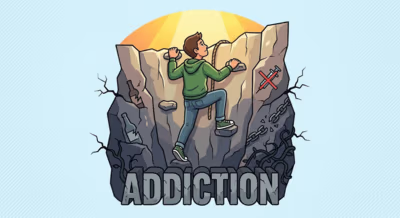
My addiction began with prescription opioids. It eventually led to heroin, divorce, and homelessness. In 2020, I was living on the streets of Camden, New Jersey.
Climbing back from that required more than stopping drug use. I had to rebuild my ability to make decisions, tolerate discomfort, solve problems, and trust my own judgment. I had to reconstruct a life from circumstances that had stripped away much of my independence.
I did not fit comfortably into the traditional recovery model. Because I resisted the Twelve Step approach, I was called noncompliant, resistant, dishonest, or “not ready.” I was told there was one true path to recovery, and that the path required surrendering my will and my life to a higher power and a group.
But I had already lost my agency to addiction. I was not willing to surrender it again as the price of getting it back.
I had to find my own path.
That experience changed the way I think about authority. It made me wary of systems that present obedience as the same thing as healing, safety, or progress. It also gave me a simple question to ask of any institution or technology:
Does this help me exercise my agency, or does it ask me to surrender it?
Returning to Technology
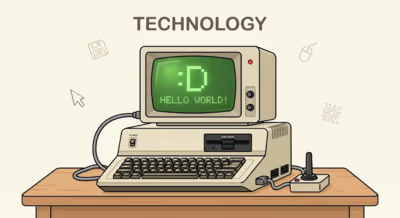
Technology had been one of the things I loved most since childhood.
It represented exploration and self-expression. You could take things apart intellectually, learn how they worked, and build something new. A computer was not merely an appliance. It was a machine you could understand and reshape.
The Internet was a place to explore.
You could find independent websites, technical documentation, unusual communities, personal essays, experimental projects, and perspectives that would never have made it through a traditional publishing system. You could host your own site, run your own services, communicate directly, and participate without first becoming a product in somebody else’s ecosystem.
When I began rebuilding my life and re-entering society, I encountered a different technological world.
I was expected to have continuous access to a phone, email address, government identification, modern hardware, reliable Internet, and working two-factor authentication. Employment systems, financial services, government websites, identity-verification systems, and account-recovery processes all assumed those things were already in place.
When I did not have them, the systems rarely offered a meaningful alternative.
The answer was usually:
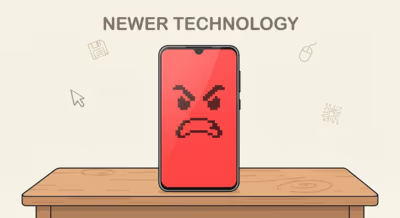
- Get a newer phone.
- Use the app.
- Verify your identity.
- Access the email account.
- Receive the text message.
- Upload the photograph.
- Try again.
If the process failed, the problem was treated as a personal deficiency rather than a design failure. The system did not ask whether its assumptions matched reality. It assumed that anyone who could not satisfy them was an exception to be filtered out.
That was one of the first signs that technology was no longer primarily being designed to expand individual capability.
It was being designed around the needs of the platform.
The Algorithm Decides What Matters

The clearest example is the modern Internet’s treatment of information.
The older Internet was largely about retrieval. You had a question, you entered search terms, and you looked for an answer. You chose what to read, which links to follow, and how deeply to investigate a subject.
The modern Internet increasingly wants to make those choices for you.
YouTube is a good example. It is still possible to find useful, focused material there, but the platform’s incentives have transformed much of its content. Videos that could communicate an idea in a few minutes are stretched into twenty-, thirty-, or forty-five-minute experiences filled with repetition.
The structure is familiar:
- A dramatic opening hook.
- A promise that the important information is coming.
- A repetition of the hook.
- A long introduction.
- A sponsor segment.
- A restatement of the basic premise.
- A few minutes of information.
- Another diversion.
- Another request to subscribe.
- A preview of a later point.
- A conclusion that repeats what was already said.
The information is not necessarily false. It is simply surrounded by padding designed to keep the viewer from leaving.
The goal is no longer just to communicate clearly. The goal is to maximize watch time, engagement, retention, and the probability that the viewer will continue to the next video.
The platform does not merely provide information. It manages attention.
That changes the relationship between the viewer and the content. Instead of deciding what to watch next, the viewer is encouraged to accept the next recommendation. Instead of seeking information, the viewer is placed into a stream that never ends.
The system keeps the next thing ready before the individual has decided whether they want it.
This is a subtle form of agency replacement. No one is forcing you to watch. The platform does not need to force you. It only needs to make choosing unnecessary.
When Search Stops Being Search

Search engines have changed in a similar way.
In theory, search should connect a question with the most relevant information. In practice, the results increasingly seem shaped by advertising budgets, search-engine optimization, institutional authority, commercial relationships, and the ability to produce content in the format platforms prefer.
The question is no longer simply:
What page best answers the terms I entered?
It often becomes:
Which organization has the authority, money, or optimization strategy to appear in front of me?
Independent websites and personal commentary have become harder to find. So have specialist communities, unconventional perspectives, and information that does not fit the language of established institutions.
Search results favor large organizations, commercial sites, established media companies, pages written for ranking systems, and content that has been sanitized into a form acceptable to the platform.
This does not mean every independent source is reliable or every institution is corrupt. It means the user increasingly has less control over the range of perspectives presented for consideration.
The search engine is not merely indexing the web. It is shaping the portion of the web that remains visible.
The terms you enter matter, but so does the infrastructure deciding which results deserve to appear. Relevance is no longer determined only by your question. It is filtered through a system that has its own priorities.
You are still technically searching.
But the platform increasingly decides what counts as findable.
The Company Decides What Is Relevant

This pattern extends beyond search and video.
Platforms increasingly decide:
- Which information is relevant
- Which speech is acceptable
- Which accounts are trustworthy
- Which links are safe
- Which communities are legitimate
- Which businesses can operate
- Which services may remain online
- Which files can be shared
- Which applications can be installed
- Which forms of privacy are suspicious
The language used to justify these decisions is usually reassuring.
It is to reduce spam. It is to protect children. It is to fight misinformation. It is to stop piracy. It is to prevent terrorism. It is to combat money laundering. It is to improve security.
Many of these problems are real. The question is whether every proposed solution deserves unlimited power, and whether the people enforcing the rules can be trusted to define the problem fairly.
A company may say it is removing misinformation, but the company decides what misinformation means.
A platform may say it is protecting users, but the platform decides which users require protection and what that protection looks like.
A hosting provider may say it is preventing abuse, but the provider decides what counts as suspicious infrastructure.
A search engine may say it is improving relevance, but the search engine decides which sources are relevant enough to show you.
The problem is not simply that decisions are being made.
The problem is that decisions affecting public knowledge, communication, and participation are increasingly made by private systems that are difficult to inspect, challenge, or leave.
Independence Is Treated as Suspicious

The older Internet made it possible for individuals and small groups to operate their own infrastructure.
You could run a website. Host a service. Maintain a mail server. Share files. Build a forum. Create an alternative community. Publish information without asking a large platform to distribute it for you.
That independence has become increasingly difficult.
Running your own email server is difficult because large providers treat independent mail systems as suspicious by default. Hosting your own files may resemble piracy to automated systems. Operating a server can trigger abuse classifications. Sharing information outside approved platforms can make you appear untrustworthy.
Privacy itself is often treated as a warning sign.
Encryption is described as something that ordinary people do not need. The implication is familiar:
If you are not doing anything wrong, why do you need privacy?
But privacy is not evidence of wrongdoing. Encryption is not a criminal tool. It is a basic method of establishing boundaries around communication and information.
People lock their doors. They close their curtains. They do not hand their diaries to strangers. Digital communication should not be considered suspicious merely because it has boundaries.
Yet the same arguments used to restrict privacy and independent infrastructure appear again and again:
It is for the children. It is to stop criminals. It is to prevent terrorism. It is to fight abuse. It is to reduce spam. It is to protect the public from misinformation.
Sometimes those concerns are sincere. But those arguments can also become permanent justifications for concentrating power. Once a company or government receives authority to inspect, filter, identify, or restrict everyone, the authority rarely remains limited to the original problem.
The danger is not only what the system is intended to do.
It is what the system can eventually be used to do.
The Customer Becomes Quality Assurance

The outsourcing of agency also appears in software development.
When I was coming up, the basic expectation was that developers would understand the problem, design an architecture, write the code, test it, review it, and send it through quality assurance before deploying it.
Development was iterative. You built something, examined it, learned from it, and refined the design. You discovered that two pieces of code overlapped, that an assumption was wrong, that a configuration belonged outside the program, or that several abstractions could be simplified.
The development process included time for thinking.
Modern development culture increasingly emphasizes speed above all else:
- Move fast and break things.
- Deploy continuously.
- Let production reveal the problems.
- Use monitoring to catch failures.
- Roll back when something goes wrong.
Continuous integration and continuous deployment can be valuable engineering practices. Automation can reduce mistakes and help teams deliver improvements safely.
The problem is the mindset that sometimes accompanies them: the assumption that software can be released before it is genuinely understood because automated systems will detect the consequences.
The customer becomes part of the testing infrastructure.
If the application crashes, an error-monitoring system records it.
If a deployment breaks something, the pipeline rolls it back.
If users lose time, data, money, or trust, the organization describes the system as resilient because it eventually recovered.
But the customer still experienced the failure.
Responsibility has not disappeared. It has been moved away from the people building the system and onto the people using it.
The user is expected to tolerate broken software, confusing interfaces, unexpected changes, performance problems, and temporary outages as the price of innovation.
That is another kind of agency transfer. The company retains control over the system while the customer absorbs the consequences of its decisions.
When AI Becomes the Architect
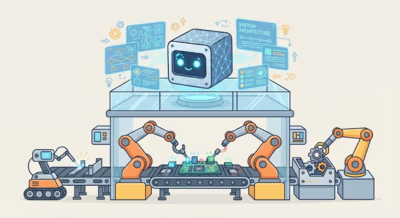
Artificial intelligence introduces another version of the same problem.
AI can be useful. It can generate scaffolding, explain unfamiliar code, automate repetitive tasks, create test cases, and help developers get past tedious work.
There is nothing wrong with using a tool to reduce drudgery.
The danger begins when the tool is treated as an authority rather than an assistant.
Software architecture requires judgment. It involves deciding how a system should be divided, what assumptions are safe, where data belongs, how failures should be handled, which abstractions are useful, and how the system can be changed later.
Those decisions cannot be reduced to producing code that appears to work.
A developer who asks AI to generate boilerplate is still making the important decisions. A developer who asks AI to design the entire system without understanding the results is outsourcing responsibility for the architecture.
The result may compile. It may even pass its initial tests. But the person responsible for maintaining it may not understand why it works, what assumptions it contains, or where it will fail.
The code becomes something that even its owner cannot confidently change.
That is not an expansion of agency. It is a dependency disguised as productivity.
AI should help people understand and create more. It should not become a substitute for understanding.
Convenience Is Not the Same as Freedom

The common defense of all these systems is convenience.
The app is easier. The algorithm saves time. The cloud handles the complexity. The platform protects users. The identity system improves security. The AI writes the code. The automated pipeline catches the errors.
Sometimes these claims are true. Convenience has real value.
But convenience is not the same as freedom. A system can make an individual task easier while making the individual more dependent overall.
A cloud service may make files available everywhere, but it may also make access dependent on an account, a subscription, an Internet connection, and the continued existence of a company.
An app may make parking easier, but it may also turn a public space into a private platform.
An algorithm may help you discover content, but it may also narrow what you encounter and train you to accept whatever it selects.
AI may produce code faster, but it may also weaken the developer’s understanding of the system.
The relevant question is not simply:
Is this convenient?
It is:
What control am I giving up in exchange for that convenience?
The Platform Wants to Be Your Higher Power

This is why the modern technological environment feels so unsettling to me.
The platform wants to become the authority between you and the world.
It decides what information you see, what services you can access, what communication is permitted, which tools are trustworthy, which accounts are legitimate, which content is relevant, and which systems are allowed to exist.
It does not ask you to understand the system.
It asks you to trust it.
Trust the platform. Trust the identity provider. Trust the cloud. Trust the algorithm. Trust the app store. Trust the automated fraud detector. Trust the moderation system. Trust the AI.
And if the system gets it wrong, good luck finding a human.
This resembles the language of surrender that I encountered in recovery. Let go of your judgment. Follow the prescribed path. Accept that the system knows what is best. If it does not work, assume the failure is yours.
But I spent years rebuilding my agency after addiction took it from me. I am not interested in handing it over again—this time to an algorithm, an application, or a corporation that insists it knows what is best for me.
I am not opposed to technology.
I am opposed to surrendering my judgment merely because a platform has made itself difficult to avoid.
Technology should expand the number of things an individual can do. It should help people explore, create, communicate, understand, and act independently.
It should not require individuals to surrender their identity, privacy, attention, and judgment before being allowed to participate.
Technology can be a tool. It can be an instrument of freedom, self-expression, and discovery.
But when the tool begins demanding obedience, it is no longer merely helping us act.
It is asking to become our higher power.

About The Author
Adam Fistler is a Behavioral Change Consultant, Board Certified Hypnotist, Certified 5-PATH® Hypnotist, and former owner of the Baltimore Hypnosis Center. A member of the International 5-PATH® Hypnosis Association and certified by the National Guild of Hypnotists, Adam has studied hypnosis, behavior change, and the relationship between thoughts, beliefs, emotions, and behavior for more than two decades.
His perspective is shaped by more than professional training. Adam has also lived through addiction and recovery firsthand across South Jersey and the Philadelphia region, including surviving on the streets of Camden. This gives him a deeply personal understanding of the struggle from both sides: as a practitioner who has helped others create change and as someone who has had to confront his own deeply ingrained patterns and beliefs.
During his own recovery, Adam returned to the principles of hypnosis, mindfulness, self-talk, and behavioral change that he had studied throughout his career. He discovered that recovery could be about more than simply managing cravings or avoiding relapse—it could also be an opportunity to understand the beliefs, emotional patterns, and experiences that had shaped his behavior.
Today, Adam combines his professional experience with the lessons of his own journey to serve clients throughout South Jersey, Philadelphia, and beyond, helping others explore the possibility of meaningful, lasting change. His approach is grounded in empathy, curiosity, practical tools, and the belief that people are more than the behaviors they are trying to overcome.
Explore my Technology Resources
Contact Adam Fistler BCH - Behavioral Change Consultant
Examine a Brief Overview of Technology Background
Explore some Select Project's I'm Working On
Explore my Technology Articles
Outsorucing Your Agency: The Platform Wants to Be Your Higher Power
When the Machine Becomes the Scapegoat: Applying the Family Systems Model to Corporate America